Argentina offers one of the fastest and most accessible paths to citizenship in the world. Foreigners can apply for naturalization after just two years of continuous legal residency - matched only by Peru and significantly shorter than most countries in Latin America and globally. Combined with a relatively low-cost residency process, dual citizenship recognition, and a passport that provides visa-free access to over 170 countries including the EU Schengen Area, Argentina is an attractive option for those who prioritize long-term mobility over short-term convenience.
Unlike countries with rigid income or investment thresholds, Argentina ties its financial requirements for residency to multiples of the national minimum wage, which means the actual USD value fluctuates with the exchange rate and inflation. This makes Argentina’s residency framework unusually dynamic but also unusually affordable during periods of peso devaluation. Since 2025, significant immigration reforms under Decree 366/2025 have tightened the definition of continuous residency and shifted the citizenship process from the courts to the National Directorate of Migration (DNM), making the system more administrative and digitally driven.
Argentina Residencies Overview
| Residency Path | Exists | Minimum Requirement | Duration | Leads to Permanent Residency | Key Insight |
|---|---|---|---|---|---|
| Rentista | Yes | 5× minimum wage / month (~USD 1,400–2,000) | 1 year (renewable up to 3) | Yes | Passive income only |
| Pensionado | Yes | 5× minimum wage / month (~USD 1,400–2,000) | 1 year (renewable up to 3) | Yes | Same threshold as Rentista |
| Inversionista | Yes | ~ARS 1,500,000 business investment | 1 year (renewable up to 3) | Yes | Requires an active business |
| Work Permit | Yes | Employer-sponsored | 1 year (renewable) | Yes | No profession restrictions |
| Asset-based | No | — | — | — | Not available |
| Digital Nomad | Yes | ~USD 2,500 / month income (estimated) | 180 days (extendable to 360) | No | Transitory status |
| Citizenship by Investment | Approved, not yet operational | ~USD 500,000 (expected) | Direct citizenship | N/A | No residency requirement |
*Indicative thresholds shown as of early 2026. The Rentista and Pensionado income requirements are tied to multiples of Argentina’s minimum wage and fluctuate with exchange rates and inflation adjustments. The income threshold applies to the main applicant only. Spouse and minor children can be included as dependents in the same application without needing to demonstrate separate income.*
Step-by-Step Guide from Resident to Passport
Prepare documents in your home country
The following documents must be obtained in your home country before traveling to Argentina:
- Valid passport (minimum 6 months validity remaining)
- Police clearance certificate from your country of origin and from any country where you have lived for more than one year
- Birth certificate
- Marriage certificate (if applicable)
- Residency-specific proof of eligibility (such as pension confirmation, passive income documentation, or investment project details)
- Health insurance policy valid in Argentina
All foreign documents must be apostilled in the country of origin (for Hague Convention members) or legalized through the Argentine consulate. Documents not in Spanish must be translated by a certified public translator registered in Argentina (traductor público nacional). Apostille and translation must be completed before the documents can be accepted by Argentine immigration.
Enter Argentina and file the application
Residency applications can be filed in Argentina through the DNM (Dirección Nacional de Migraciones). Since 2025, applications are processed through the online RaDEX system. This includes:
- Submitting the full application and supporting documents through the RaDEX online platform
- Paying government filing fees (approximately USD 100 as of 2025)
- Attending an in-person appointment for fingerprinting and biometric registration
- Providing proof of accommodation in Argentina (rental contract or property ownership)
It is also possible to initiate certain categories of residency applications remotely via a power of attorney (poder), with a legal representative in Argentina submitting documents on your behalf. However, biometric registration still requires physical presence at some point in the process.
Application review and waiting period
After submitting the application, the following steps apply during the review period:
- Wait for the application to be reviewed by the DNM
- Provide additional documents or clarifications if requested
- Monitor the status of the application through the RaDEX platform
Processing times vary significantly depending on the visa category and current administrative workload. Typical processing takes between 2 and 6 months, though some applications can take longer if additional documentation is requested or if there are backlogs at the immigration office.
Temporary residency approval
Once approved, temporary residency is granted and formalized locally:
- Obtain a DNI (Documento Nacional de Identidad), which serves as the primary identification document in Argentina
- Register for a CUIL or CUIT (tax identification number) with the tax authority ARCA
- Comply with ongoing residency conditions specific to your visa category
Temporary residency is initially granted for one year and can be renewed annually for up to three years total. The DNI is essential for everyday life in Argentina, including opening bank accounts, signing rental contracts, and accessing services.
Renewals and transition to permanent residency
Temporary residency must be renewed before expiration. Most applicants hold temporary residency for the period required before transitioning to permanent residency or applying directly for citizenship.
- Renew temporary residency before each annual expiration
- Maintain uninterrupted legal residency status
- Apply for permanent residency after 3 years of continuous temporary residency (for non-MERCOSUR nationals) or after 2 years (for MERCOSUR nationals)
Permanent residency grants indefinite legal residence in Argentina and removes the need to periodically re-demonstrate income or investment requirements. However, permanent residents can lose their status after 12 months of continuous absence from Argentina (reduced from 24 months under the 2025 reforms).
Path to citizenship
Argentine citizenship can be obtained through naturalization after a short legal residency period. Since Decree 366/2025 and subsequent reforms, the requirements are as follows:
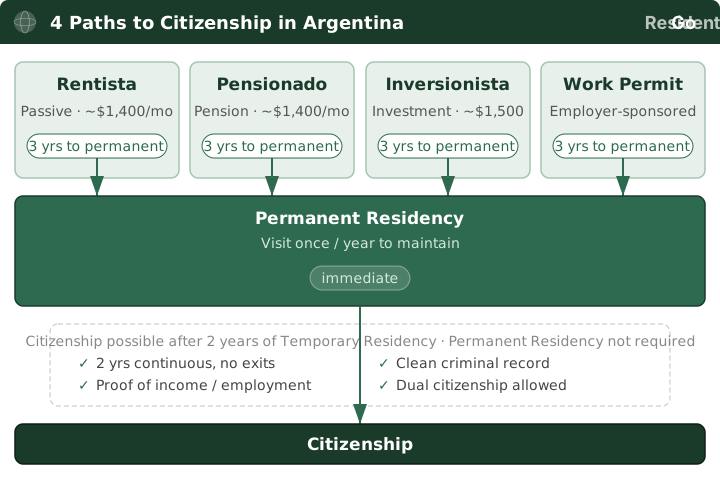
- Hold legal residency (temporary or permanent) in Argentina for at least 2 continuous years
- Remain in Argentina continuously for those 2 years. The text of Decree 366/2025 reads as absolute, permitting no exits. Whether exceptions for brief absences (medical, family, business) can be granted in practice is not yet documented.
- Demonstrate means of subsistence (proof of income or employment in Argentina)
- Have a clean criminal record in Argentina and all prior countries of residence
- Submit the citizenship application through the RaDEX digital platform managed by the DNM
- Be at least 18 years of age
Argentina allows dual citizenship, meaning applicants do not need to renounce their existing nationality. There is no formal Spanish language exam or civics test required for naturalization. Citizenship processing, now handled administratively by the DNM rather than through the courts, typically takes 6 to 12 months from application to approval.
Overview of Argentina Visas
Residencies that are based on Working Permits or Working visas are described in detail here:
→ Working Visas in Argentina
Argentina offers several residency pathways for foreign nationals, primarily based on passive income, retirement pensions, or business investment. All standard options initially grant temporary residency for one year, renewable for up to three years. Argentine citizenship can then be applied for after 2 years of continuous legal residence.
Rentista Visa (Passive Income Residency)
The Rentista visa is designed for financially independent individuals who can demonstrate a stable passive income from sources outside Argentina. Employment income or salary earned within Argentina does not qualify. The income threshold is defined as at least five times Argentina’s current minimum wage (Salario Mínimo Vital y Móvil), which as of mid-2025 corresponds to approximately USD 1,400 to USD 2,000 per month depending on exchange rate fluctuations.
Proof typically requires:
- Bank statements showing consistent passive income (rental income, dividends, investment returns, or similar) over at least the preceding 6 to 12 months
- Documentation confirming that income originates from outside Argentina
- Proof that funds have been or will be transferred to Argentina through authorized banking or financial institutions regulated by the Central Bank of Argentina
- A sworn statement declaring the purpose of entry and residency
- Power of attorney (if the application is filed by a legal representative in Argentina)
Pensionado Visa (Retirement Residency)
The Pensionado visa is intended for retirees who receive a pension or retirement benefit from a foreign source. The financial threshold is the same as the Rentista visa: five times the Argentine minimum wage per month. Unlike some other Latin American countries, Argentina does not distinguish between the Pensionado and Rentista by setting different income requirements — the practical distinction is the source of funds (pension vs. other passive income).
Proof typically requires:
- Official pension statements or letters from the issuing pension authority or private pension provider
- Bank statements showing regular pension deposits consistent with the minimum threshold
- Documentation confirming that the pension is ongoing and not a one-time or fixed-term payout
- If applicable, supporting documents identifying the pension source (public social security system, private plan, or similar institution)
Inversionista Visa (Investment Residency)
The Inversionista visa is available to foreign nationals who establish or invest in an active business in Argentina. Unlike passive investment or golden visa models seen in other countries, Argentina’s investment residency requires a productive business operation — simply purchasing real estate or making a bank deposit does not qualify. The minimum investment threshold is approximately ARS 1,500,000 (roughly USD 1,500–2,000 at recent exchange rates), directed into a locally registered business.
Proof typically requires:
- An approved investment project or business plan submitted to and reviewed by the DNM
- Company registration documents proving the business is legally constituted in Argentina
- Evidence that the investment has been made in the Argentine economy, such as bank transfer records or corporate filings
- Proof of legal origin of invested funds
- Ongoing documentation that the business remains operational during the residency period
Digital Nomad Visa
Argentina introduced a digital nomad visa in 2022 as a transitory residence permit for remote workers employed by or contracting with companies outside Argentina. The visa allows a stay of up to 180 days, extendable once for another 180 days, for a maximum of one year. It does not lead to permanent residency or citizenship.
Proof typically requires:
- A valid passport from a country that does not require a tourist visa to enter Argentina
- A cover letter explaining the applicant’s remote work activity and income source
- Proof of income (bank statements, pay slips, or contracts) — while no official minimum is published, an estimated monthly income of approximately USD 2,500 is commonly expected
- A CV or résumé documenting relevant professional experience
- Health insurance valid in Argentina
Citizenship by Investment (Decree 524/2025 — not yet operational)
In July 2025, Argentina approved a citizenship by investment framework through Decree 524/2025, becoming the first South American country to offer direct citizenship in exchange for investment. The program allows foreign investors to apply for Argentine citizenship without meeting the standard 2-year residency requirement. As of early 2026, the program has been legally established but is not yet accepting applications. Final investment thresholds and qualifying sectors are expected to be formalized during 2026, with an anticipated minimum investment of approximately USD 500,000 directed into government-approved strategic sectors such as agribusiness, technology, renewable energy, or tourism infrastructure.
Key structural features of the program as established by the decree:
- Applications will be managed by a new Agency for Citizenship by Investment Programs under the Ministry of Economy
- No prior residency in Argentina is required
- Security screening involves multiple government agencies including the Financial Intelligence Unit (UIF) and RENAPER
- The National Directorate of Migration must issue a decision within 30 business days after receiving the agency’s recommendation
- Passive real estate purchases are not expected to qualify as an eligible investment
Tax Residency Considerations in Argentina
Argentina is relevant from a tax perspective for individuals who need to understand the implications of extended physical presence in the country. Unlike countries with territorial tax systems (such as Costa Rica or Paraguay), Argentina applies a worldwide income tax system for tax residents. This means that becoming an Argentine tax resident triggers obligations on global income, not just income earned within Argentina.
The following points outline the key tax considerations for foreign residents:
- Argentina taxes residents on worldwide income; non-residents are taxed only on Argentine-source income
- Tax residency is triggered for foreigners who obtain permanent immigration residency or who reside in Argentina continuously for more than 12 months (tax residency begins from the 13th month of presence; temporary absences of up to 90 days within the 12-month period do not interrupt continuity)
- Foreigners on temporary work assignments of up to 5 years are classified as Non-Residents with Permanent Presence (NRPP) and are taxed only on Argentine-source income during that period
- Argentina levies a wealth tax (Impuesto sobre los Bienes Personales) on worldwide assets of tax residents, with progressive rates ranging from 0.5% to 1.25% (rates are being gradually reduced toward a unified 0.25% by 2027)
- There is no federal inheritance or gift tax, though the Province of Buenos Aires levies its own transfer taxes under certain conditions
- Immigration residency and tax residency are distinct concepts — holding a temporary residency visa does not automatically create tax residency, but continuous physical presence for over 12 months does
Income generated within Argentina is subject to progressive personal income tax, with marginal rates ranging from 5% to 35%. These rates apply to all taxable income for residents (worldwide) and to Argentine-source income for non-residents. Tax brackets are adjusted semi-annually (in January and July) based on the Consumer Price Index to account for inflation. The top marginal rate of 35% applies to annual taxable income exceeding approximately ARS 53,000,000 (as of fiscal year 2025). Rental income earned by non-residents from Argentine property is taxed at a flat rate of 21%.
Residency Status Comparison
| Status | Typical Duration | Status Renewal | Identification | Minimum Presence to Maintain Status | Counts Toward Citizenship |
|---|---|---|---|---|---|
| Tourist | 90 days (extendable to 180) | Via re-entering | Passport | None | No |
| Digital Nomad | 180 days (extendable to 360) | One renewal | Passport / TIE permit | None | No |
| Temporary Residency | 1 year (renewable up to 3) | Annual renewal | DNI (temporary) | Continuous presence required for citizenship eligibility | Yes (after 2 years continuous) |
| Permanent Residency | Indefinite | Not needed | DNI (permanent) | Must not be absent for more than 12 consecutive months | Yes |
| Citizenship | Permanent | Not needed | DNI / Argentine Passport | None | — |
2025 Immigration Reforms
If you are applying for citizenship after May 2025, Decree 366/2025 requires 2 years of continuous residency in Argentina. The decree text reads as permitting no exits at all during that period, though whether the DNM or courts will grant exceptions for brief absences is not yet documented. The process also moved from federal courts to the DNM's digital RaDEX platform, and applicants must now prove occupation or means of subsistence.
Permanent residents now lose status after 12 months abroad, down from 24. Temporary residents who entered after May 2025 are no longer eligible for free public healthcare or education and must arrange private coverage.
Currency Competition and Dollar Usage
You can earn, hold, and spend US dollars in Argentina without converting at an unfavorable official rate. Since April 2025, most currency controls (the cepo cambiario) are gone. Residents can open dollar bank accounts, pay via QR in dollars, withdraw dollar cash, and transfer internationally without authorization.
Argentina now functions as a dual-currency economy. Real estate, vehicles, and many services are priced in dollars. Retailers can legally display prices in any currency, and virtual wallets like Mercado Pago hold and transact in dollars. The peso floats within a managed band and remains volatile, but the gap between official and parallel rates has largely closed.
Frequently Asked Questions
✅ Eligibility
What is the most common residency path for expats in Argentina?
The Rentista visa is the most popular option for financially independent expats. It requires proof of passive income equal to at least five times Argentina's minimum wage (roughly USD 1,400–2,000 per month depending on exchange rates) and grants one-year temporary residency, renewable for up to three years.
Can I include my family in an Argentina residency application?
Yes. Spouses, minor children, and financially dependent adult children can be included as dependents on a Rentista or Pensionado application. The main applicant's income threshold covers the entire family group; each member does not need to demonstrate separate income.
What is the minimum income required for Argentina residency?
The Rentista and Pensionado visas both require monthly passive income of at least five times the Argentine minimum wage, which translates to approximately USD 1,400–2,000 per month as of early 2026. This amount fluctuates with exchange rates and inflation adjustments.
What is the minimum investment amount required for Argentina residency?
The Inversionista visa requires a business investment of approximately ARS 1,500,000 (roughly USD 1,500–2,000 at recent exchange rates) into a locally registered, active business. A separate Citizenship by Investment program (Decree 524/2025) is expected to require approximately USD 500,000 once it becomes operational.
📝 Process & Timeline
How much does it cost to apply for Argentina residency?
About $100. Government filing fees are paid through the RaDEX platform. Additional costs for apostilles, certified translations, and legal assistance are separate.
What documents do I need to apply for Argentina residency?
You need a valid passport (minimum 6 months validity), police clearance certificates from your country of origin and any country where you lived more than one year, a birth certificate, proof of income or investment, health insurance valid in Argentina, and proof of accommodation. All foreign documents must be apostilled and translated into Spanish by a certified Argentine public translator.
Can I apply for Argentina residency while visiting as a tourist?
Yes. Residency applications are filed in-country through the DNM's online RaDEX platform. You can enter Argentina as a tourist and submit your application within 90 days of arrival. You will receive a residencia precaria (interim permit) that allows you to stay, work, and re-enter the country while your application is processed.
Do I need to open a bank account in Argentina to apply for residency?
Yes, for Rentista and Pensionado applicants. You must demonstrate that your passive income enters the country through an Argentine bank account on a monthly basis. You can open an immigrant savings account at a public bank like Banco de la Nación using your residencia precaria, even before receiving your DNI.
How long does it take to get temporary residency in Argentina?
Processing times typically range from 2 to 6 months after submitting a complete application through the RaDEX platform. Delays can occur if additional documentation is requested or if there are backlogs at the immigration office.
How long does it take to get Argentina citizenship?
You can apply for citizenship after two continuous years of legal residency in Argentina. Decree 366/2025 reads as requiring no exits during that 2-year period, though whether brief absences can be granted as exceptions is not yet documented. Citizenship processing by the DNM then takes an additional 6 to 12 months, making the total timeline roughly three years from arrival.
🏠 Living in Argentina
Do I need to live in Argentina to maintain residency?
Permanent residents lose their status after 12 consecutive months outside Argentina (reduced from 24 months under 2025 reforms). For citizenship eligibility, the text of Decree 366/2025 reads as requiring 2 years in Argentina without exits. Whether brief absences can be granted as exceptions is not yet established, so plan conservatively.
Can I work in Argentina as a foreign resident?
Yes. Once you receive your residencia precaria (interim permit), you can work legally in Argentina. After approval, you register for a CUIL or CUIT tax identification number. Note that Rentista visa holders cannot work as employees; self-employment and business ownership are permitted.
Does Argentina tax foreign income?
Yes, but only if you become a tax resident. Tax residency is triggered after 12 continuous months of physical presence (starting from the 13th month) or upon obtaining permanent residency. Tax residents pay progressive income tax of 5%–35% on worldwide income and a wealth tax on global assets.
Is health insurance mandatory for residents in Argentina?
Yes. Since May 2025, temporary residents who entered after the reform are no longer eligible for free public healthcare or education and must arrange private health insurance for the duration of their temporary residency. A valid health insurance policy is also a required application document.
Can I have dual citizenship with Argentina?
Yes. Argentina fully recognizes dual citizenship, so you do not need to renounce your existing nationality when naturalizing. There is no formal Spanish language exam or civics test required for the citizenship application.