Few countries in Latin America make it as easy for remote workers as Costa Rica. Foreign income is tax-free, the Digital Nomad Visa costs USD 100 and processes in about 15 days, and you'll find established expat communities across the country. For local employment, the picture is different: work permits are restricted to specialized roles, take 3 to 8 months, and require employer sponsorship with proof that no Costa Rican could fill the position.
Work Options at a Glance
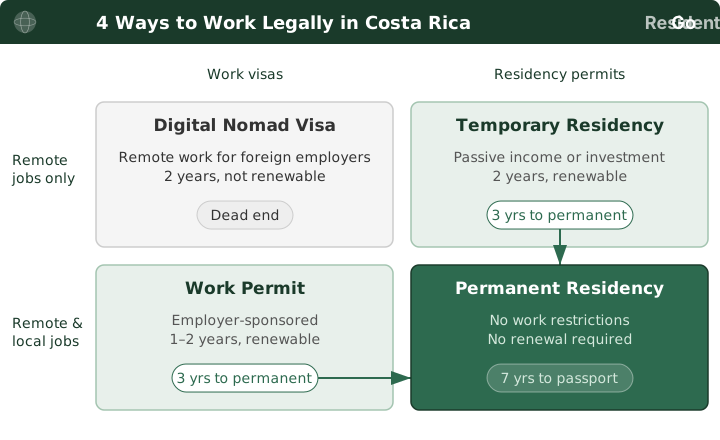
Which visa you need depends on where your money comes from. If you work remotely for foreign clients, the Digital Nomad Visa is the simplest option, though it maxes out at two years with no path forward. If a Costa Rican company is hiring you, you'll need an employer-sponsored work permit. And if you have your own income or capital, temporary residency lets you skip the job question entirely. Only the work permit and temporary residency tracks lead to permanent residency.
Comparing Work Visas in Detail
| Digital Nomad Visa | Employer-Sponsored Work Permit | |
|---|---|---|
| For | Remote workers and freelancers | Local employment |
| Legal basis | Law No. 8764 (2022 amendment) | Law No. 8764, Articles 100 and 108 |
| Who qualifies | Everyone | Specialized roles only |
| Key requirement | USD 3,000/month income | No qualified local candidate available |
| Duration | 1 year + 1 year renewal | 1–2 years, renewable |
| Processing time | ~15 days | 3–8 months |
| Government fees | USD 100 + USD 90 renewal | ~USD 480 |
| Remote work for foreign employer | Yes | - |
| Work for Costa Rican companies | No | Yes, sponsoring employer only |
| Change employer | - | Requires new authorization |
| Open bank account | Yes | Yes |
| Include dependents | Yes (USD 4,000/month threshold) | Yes (via family visa) |
| Path to permanent residency | No | Indirect, via residency |
Costa Rica Digital Nomad Visa
Costa Rica's Digital Nomad Visa, formally the "Stay for Remote Workers and Service Providers," is one of the more straightforward options in Latin America. No employer needed, no investment required, no cap on the number of visas issued. If you earn at least USD 3,000/month from clients or employers outside Costa Rica, you qualify. Panama has the same USD 3,000/month threshold but does not include dependents. If the income bar is too high, Colombia's Digital Nomad Visa starts at roughly USD 1,300/month.
Documents required
- Bank statements (12 months) proving the income requirement. Threshold increases to USD 4,000/month when including dependents.
- Sworn affidavit confirming income, notarized or certified by a CPA or public notary
- Health insurance valid in Costa Rica for the entire duration of stay (minimum USD 50,000 coverage)
- Valid passport
- All documents apostilled or legalized and translated into Spanish
Process
You can apply online, at a Costa Rican consulate, or from within Costa Rica. If approved, you have 90 days to enter and must register biometrics within three months of arrival. Renewal requires having spent at least 180 days in Costa Rica during the first year.
Tax treatment
Digital Nomad Visa holders are explicitly exempt from Costa Rican income tax on all foreign-sourced income. Since the visa prohibits local employment, most holders have zero local tax liability.
Employer-Sponsored Work Permit
Work permits are restricted to specialized roles: intra-company transfers, athletes, artists, IT professionals, healthcare workers, educators, and tourism specialists. The employer must be a registered legal entity enrolled with the Ministry of Labor (MTSS) and the Social Security Fund (CCSS), and must demonstrate the role could not be filled locally.
Documents required
- Signed employment contract detailing role, salary, and duration
- Employer's legal registration and CCSS enrollment proof
- Evidence of local recruitment effort (job posting, interview records)
- Valid passport and police clearance from home country
- Professional credentials relevant to the role
- Fingerprint registration with the Ministry of Public Security
- All documents apostilled or legalized and translated into Spanish
Process
Two steps: the employee first applies for a provisional visa at a Costa Rican consulate in their home country, then travels to Costa Rica and applies for the work permit through the Dirección General de Migración y Extranjería. No expedited option exists. Processing takes 3 to 8 months.
Due to the long processing time, some employers initially hire foreign workers as consultants under "servicio profesional" arrangements, though this requires leaving and re-entering Costa Rica every 90 days until the permit is granted.
Tax treatment
Work permit holders pay progressive income tax on their Costa Rican salary and are enrolled in the CCSS social security system. See the tax section below for brackets and rates.
For long-term residency pathways, see our Costa Rica Residency Guide.
Taxes and Health Insurance
Costa Rica operates a territorial tax system. Only income earned from Costa Rican sources is subject to local tax. Foreign income (from foreign clients, employers, or investments) is not taxed, regardless of how long you stay or which visa you hold. Panama, Paraguay, and Bolivia apply the same territorial principle.
For locally employed workers, progressive income tax rates apply to annual salary (as of 2026): the first ~CRC 4,820,000 (~USD 8,800) is tax-free, then 10% up to ~CRC 7,180,000 (~USD 13,100), 15% up to ~CRC 12,000,000 (~USD 21,900), 20% up to ~CRC 24,000,000 (~USD 43,800), and 25% above that.
On top of income tax, all locally employed workers and their employers contribute to the CCSS (Caja Costarricense de Seguro Social). Employee contributions total approximately 10.5% of gross salary. Employer contributions add approximately 26.3% on top of the employee's salary. These are not optional and are withheld at source.
Costa Rica has no double taxation treaty with the United States. US citizens working in Costa Rica may owe US tax on their worldwide income, with a Foreign Earned Income Exclusion of approximately USD 126,500 (2025 figure) potentially offsetting some or all of the Costa Rican liability. Costa Rica does have treaties with Spain, Germany, and Mexico, among others.
Digital Nomad Visa holders are not enrolled in CCSS and have no local social security obligation. They must carry private health insurance instead (minimum USD 50,000 coverage), which typically costs USD 75 to 200/month depending on age and coverage level.
Regardless of visa type, tax obligations in your home country may still apply. Holding a Costa Rican visa does not automatically end tax residency elsewhere.
Starting a Business in Costa Rica
None of the work visas covered above allow you to run a local business. The Digital Nomad Visa restricts you to foreign clients, and the work permit ties you to a single sponsoring employer. If you want to start or invest in a Costa Rican company, you need a residency permit.
The most common path is Temporary Residency under the Inversionista (investor) category, which requires an investment of at least USD 150,000 in a Costa Rican business or real estate. Rentista visa holders (who qualify through passive income of USD 2,500/month) can own shares in a Costa Rican company but cannot be employed by it or draw a salary. In practice, many foreign entrepreneurs set up a Sociedad de Responsabilidad Limitada (S.R.L.) or Sociedad Anónima (S.A.) and operate as shareholders rather than employees.
Registering a company is straightforward and does not require residency. Any foreigner can incorporate a Costa Rican entity, but actually working in or managing the business day-to-day requires a visa that authorizes local activity. For a detailed breakdown of residency categories, see our Costa Rica Residency Guide.
Tourist Visa and Work Rights
Most nationalities can enter Costa Rica visa-free for up to 90 days. The stay cannot be extended, and no form of paid work is permitted, including remote work for a foreign employer.
Enforcement for remote workers has historically been minimal, and "border runs" (leaving for 72 hours and re-entering for a fresh 90 days) remain common. The Digital Nomad Visa was introduced partly to formalize this gray area. Since the Digital Nomad Visa costs just USD 100 and processes in about 15 days, there's little reason to work on a tourist visa anymore.
Frequently Asked Questions (FAQ)
🛂 Visa & Legal
Can US citizens work in Costa Rica?
Yes, but not on a tourist visa. US citizens need either a Digital Nomad Visa (remote work) or an employer-sponsored work permit (local employment). No special privileges apply to US nationals.
Can I work in Costa Rica on a tourist visa?
No. The 90-day tourist entry does not authorize any paid work. The Digital Nomad Visa (USD 100, ~15 days processing) is the legal path for remote workers.
Can freelancers work legally in Costa Rica?
Yes, if serving international clients. Freelancers qualify for the Digital Nomad Visa with USD 3,000/month income. Freelancers serving Costa Rican clients need a visa with local work authorization.
How long does it take to get a work visa in Costa Rica?
Digital Nomad Visa: approximately 15 calendar days. Employer-sponsored work permit: 3 to 8 months. No expedited processing for employer-sponsored permits.
Can I switch from a tourist visa to a work visa inside Costa Rica?
For the Digital Nomad Visa, yes. You can apply from within Costa Rica. Employer-sponsored work permits typically require leaving the country to apply at a consulate first.
💰 Money & Tax
What is the average salary in Costa Rica?
Approximately USD 1,150/month on average. Minimum wage for unskilled workers is around USD 710/month (the highest in Latin America). Tech professionals earn USD 20,000 to 45,000/year.
Does Costa Rica tax foreign income?
No. Costa Rica uses a territorial tax system. Only income from Costa Rican sources is taxed. Digital Nomad Visa holders are explicitly exempt from local income tax on foreign earnings.
How much does it cost to apply for a Costa Rica work visa?
Government fees range from USD 100 (Digital Nomad Visa) to approximately USD 480 (employer-sponsored work permit). Additional costs for apostilles, certified translations, and legal assistance are separate.
🏠 Practical
Do I need to speak Spanish to work in Costa Rica?
Not for remote work. English is widely spoken in expat hubs. For employer-sponsored roles, Spanish is often expected. All visa documents must be submitted in Spanish (translations accepted).
Is health insurance mandatory for work visa holders in Costa Rica?
Yes, but the type differs. Digital Nomad Visa holders need private insurance (minimum USD 50,000 coverage). Work permit holders are enrolled in the public CCSS system, with ~10.5% withheld from salary.
Can I include my family in a Costa Rica work visa application?
Yes. Digital Nomad Visa: income threshold rises to USD 4,000/month with dependents. Work permit: dependents apply through a separate family visa.
Can I work for a Costa Rican company on a Digital Nomad Visa?
No. The Digital Nomad Visa only permits work for foreign employers or clients. Local employment requires an employer-sponsored work permit.
Does the Digital Nomad Visa lead to residency or citizenship?
No. Maximum duration is two years. Time on the Digital Nomad Visa does not count toward residency or citizenship. You must switch to a separate residency track (Rentista, Inversionista, or work permit). Ecuador is the only country in the region where the Digital Nomad Visa itself counts toward permanent residency.
Is the internet fast enough for remote work?
Yes. Urban areas and popular remote work destinations offer 10 to 50 Mbps, with fiber up to 1,000 Mbps in some areas. Coworking spaces are generally more reliable than residential setups.
What types of jobs qualify for a Costa Rica work permit?
Specialized roles only: intra-company transfers, athletes, artists, IT professionals, healthcare workers, educators, and tourism specialists. The employer must prove no qualified local candidate is available.
Compare all 12 countries in our Working Abroad Guide. Looking for residency instead? See our Latin America Residency Guide.