Ecuador is the only country in Latin America where you earn, save, and spend in US dollars, which eliminates exchange rate risk entirely. The Digital Nomad Visa costs USD 450, requires just USD 1,446/month in foreign income, and is a full temporary residency visa, meaning it leads to permanent residency after 21 months and citizenship after three more years. That makes Ecuador one of the few countries in the region where a remote worker can go from Digital Nomad Visa to passport without switching visa tracks. For local employment, the path is more restrictive: employer-sponsored work permits require company sponsorship, IESS (social security) enrollment, and processing times of one to two months.
Work Options at a Glance
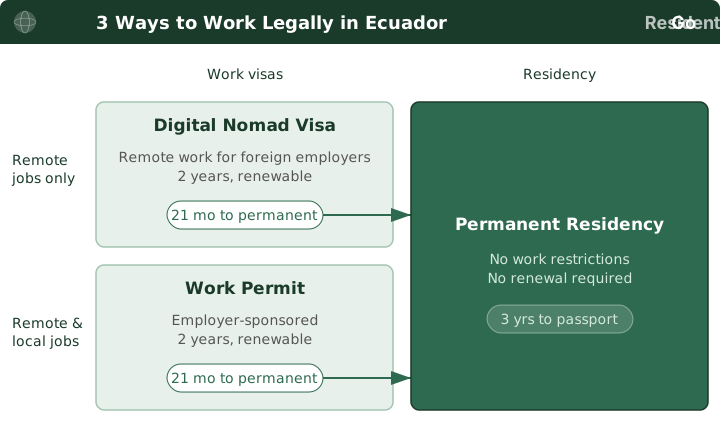
If you work remotely for foreign clients or employers, the Digital Nomad Visa is the simplest and cheapest option. Unlike Colombia, Costa Rica, or Panama, Ecuador's version is a temporary residency visa, not a standalone permit, so it counts toward permanent residency. If a local Ecuadorian company is hiring you, you need an employer-sponsored work permit, which is also a form of temporary residency. Both paths lead to permanent residency after 21 months of continuous presence and, eventually, to citizenship.
Comparing Work Visas in Detail
| Digital Nomad Visa | Employer-Sponsored Work Permit | |
|---|---|---|
| For | Remote workers and freelancers | Local employment |
| Legal basis | Ley Orgánica de Movilidad Humana (2022 amendment) | Ley Orgánica de Movilidad Humana, Art. 60–63 |
| Who qualifies | Citizens of 183 eligible countries | Skilled workers with employer sponsorship |
| Key requirement | USD 1,446/month income | Employment contract with Ecuadorian company |
| Duration | 2 years, renewable for 2 more | 2 years, renewable |
| Processing time | 2–8 weeks | 4–8 weeks |
| Government fees | USD 450 (USD 50 application + USD 400 visa) | ~USD 450 |
| Remote work for foreign employer | Yes | - |
| Work for Ecuadorian companies | No | Yes, sponsoring employer only |
| Change employer | - | Requires new authorization |
| Open bank account | Yes (after cédula) | Yes (after cédula) |
| Include dependents | Yes (+USD 250/month per dependent) | Yes (via dependent visa) |
| Path to permanent residency | Yes, after 21 months | Yes, after 21 months |
*Some nationals from restricted countries (including Afghanistan, Cuba, North Korea, and others) are not eligible for the Digital Nomad Visa. Check the Ministry of Tourism's eligibility list before applying.*
Ecuador Digital Nomad Visa
Ecuador's Digital Nomad Visa, officially the "Rentista Trabajador Nómada," stands apart from similar programs across the region for one reason: it is a temporary residency visa, not a standalone permit. That distinction matters because time spent on this visa counts toward permanent residency (21 months) and eventually citizenship. The income threshold of USD 1,446/month (three times Ecuador's minimum wage of USD 482) is among the lowest in Latin America, and the dollarized economy means you receive, hold, and spend everything in USD.
Documents required
- Bank statements (3 months) proving at least USD 1,446/month in foreign-source income, or a lump sum of USD 34,704 (36 times the minimum wage). Income threshold increases by USD 250/month per dependent.
- Employment contract, freelance agreement, or proof of business ownership showing remote work for a foreign entity
- Health insurance valid in Ecuador for the full visa duration
- Criminal record certificate from country of residence (issued within 180 days, apostilled, translated into Spanish)
- Valid passport with at least six months remaining validity
- All documents apostilled or legalized and translated into Spanish by a certified translator
Process
Applications are submitted through the Virtual Consulate of Ecuador (E-Visa portal). You create an account, select "Rentista Trabajador Nómada," upload digital copies of all documents, and pay the USD 50 application fee online. After submission, you schedule an appointment at the nearest Ecuadorian consulate to present physical copies. If approved, you pay the USD 400 visa issuance fee. Processing takes approximately 2 to 8 weeks depending on caseload and document completeness.
You can also apply from within Ecuador during your 90-day tourist stay. After approval, you receive an Orden de Cedulación to obtain your cédula (Ecuadorian identity card) at the Civil Registry, which unlocks banking and other services. To maintain eligibility for permanent residency, you must not leave Ecuador for more than 90 cumulative days per year during your temporary residency period.
Tax treatment
Digital Nomad Visa holders are exempt from Ecuadorian income tax on foreign-sourced income. Since the visa prohibits local employment, most holders have zero local tax liability. Panama, the only other dollarized economy in the region, offers a similar exemption on foreign income through its territorial tax system. See the tax section below for important nuances around tax residency after 183 days.
Employer-Sponsored Work Permit
Ecuador's employer-sponsored work permit is a temporary residency visa issued to foreign nationals hired by a registered Ecuadorian company. The employer must be enrolled with the IESS (Instituto Ecuatoriano de Seguridad Social) and must provide a formal employment contract that meets Ecuadorian labor law requirements. Unlike some neighbors, Ecuador does not formally restrict work permits to a defined list of shortage occupations, but the employer must justify hiring a foreign worker.
Documents required
- Signed employment contract compliant with Ecuadorian labor law, specifying role, salary, and duration
- Written request from the employer's legal representative addressed to the Ministry of Foreign Affairs and Human Mobility
- Employer's certificate of no outstanding debts to IESS
- Proof of the employee's enrollment in IESS
- Criminal record certificate from country of origin (apostilled, translated into Spanish)
- Valid passport with at least six months remaining validity
- Professional credentials or university degree (if applicable, registered with SENESCYT)
- All documents apostilled or legalized and translated into Spanish
Process
The employer initiates the process by gathering company-side documentation. The foreign employee contacts the Ecuadorian consulate in their home country, confirms the document list, and submits the application. Processing takes approximately four to eight weeks. After approval, the employee travels to Ecuador and registers at the Civil Registry for a cédula. Alternatively, applicants already in Ecuador on a tourist visa can apply in-country through the E-Visa system before their 90-day stay expires.
Tax treatment
Work permit holders pay progressive income tax on their Ecuadorian salary and are enrolled in the IESS social security system. See the tax section below for brackets and contribution rates.
For long-term residency pathways, see our Ecuador Residency Guide.
Taxes and Health Insurance
Ecuador taxes residents on worldwide income. You become a tax resident if you spend more than 183 days in Ecuador within a calendar year or across two consecutive years. Non-residents are taxed only on Ecuadorian-source income at a flat 25% withholding rate. Countries like Paraguay, Bolivia, and Uruguay use purely territorial systems where foreign income is never taxed regardless of length of stay. Digital Nomad Visa holders receive an exemption on foreign-source income under the terms of the visa, but should be aware that extended stays beyond 183 days can create worldwide tax obligations under general tax law. In practice, the Digital Nomad Visa exemption has been applied consistently, but the interaction between visa-level exemption and general tax residency rules is an area to monitor.
For locally employed workers, progressive income tax brackets apply to annual income (2026): the first USD 12,208 is tax-free, then 5% up to USD 15,549, 10% up to USD 20,188, 12% up to USD 26,700, 15% up to USD 35,136, 20% up to approximately USD 46,400, 25% up to approximately USD 61,900, 30% up to approximately USD 81,800, 35% up to approximately USD 108,800, and 37% above that.
All locally employed workers and their employers contribute to the IESS. Employee contributions total 9.45% of gross salary. Employer contributions add 12.15%. After one year of continuous employment, the employer must also contribute 8.33% to the Reserve Fund (Fondo de Reserva), bringing total employer costs to approximately 20.5%. Ecuador also mandates annual profit-sharing: companies must distribute 15% of pre-tax profits to employees.
Ecuador has double taxation treaties with Germany, Spain, France, Italy, Belgium, Canada, Switzerland, the United Kingdom, China, Japan, South Korea, Singapore, Mexico, Brazil, Chile, Uruguay, Qatar, UAE, Romania, Belarus, Russia, and the Andean Community members (Colombia, Peru, Bolivia). Ecuador has no double taxation treaty with the United States. US citizens working in Ecuador may owe US tax on worldwide income, with the Foreign Earned Income Exclusion of approximately USD 126,500 (2025 figure) potentially offsetting some or all liability.
Digital Nomad Visa holders are not enrolled in IESS and have no local social security obligation. They must carry private health insurance valid in Ecuador for the full duration of the visa. Typical costs range from USD 45 to 200/month depending on age and coverage level. Ecuador's public healthcare system (IESS) is available to work permit holders through mandatory contributions.
Regardless of visa type, tax obligations in your home country may still apply. Holding an Ecuadorian visa does not automatically end tax residency elsewhere.
Starting a Business in Ecuador
Neither the Digital Nomad Visa nor the employer-sponsored work permit allows you to run a local business. The Digital Nomad Visa restricts you to foreign clients, and the work permit ties you to a single sponsoring employer. If you want to start or invest in an Ecuadorian company, the most common path is the Investor Visa (Inversionista), which requires a minimum investment of USD 48,200 (100 times the 2026 minimum wage) in Ecuadorian real estate, a certificate of deposit at an Ecuadorian bank, or shares in an Ecuadorian company.
Foreigners can incorporate an Ecuadorian company without residency. The most common structures are the Sociedad Anónima (S.A.) and the Compañía de Responsabilidad Limitada (Cía. Ltda.). However, actually working in the business day-to-day requires a visa that authorizes local activity. The Investor Visa grants both residency and the right to work in Ecuador, and leads to permanent residency after 21 months.
For a detailed breakdown of residency categories, see our Ecuador Residency Guide.
Tourist Visa and Work Rights
Most nationalities receive a 90-day tourist stamp (T-3) upon arrival in Ecuador, extendable for another 90 days through an online application. No form of paid work is permitted on a tourist visa, including remote work for a foreign employer.
Ecuador does enforce immigration rules, and overstaying can result in fines of several hundred dollars and a potential two-year entry ban. Since the Digital Nomad Visa costs USD 450 and processes in a few weeks, and the income threshold is one of the lowest in the region, there is little practical reason to work on a tourist visa.
Frequently Asked Questions (FAQ)
🛂 Visa & Legal
Can US citizens work in Ecuador?
Yes. US citizens are eligible for both the Digital Nomad Visa (remote work) and employer-sponsored work permits (local employment). The US is on Ecuador's eligible country list for the Digital Nomad Visa. Ecuador has no special fast-track program for US nationals, but the standard visa process applies equally.
Can I work in Ecuador on a tourist visa?
No. The 90-day tourist entry (extendable to 180 days) does not authorize any paid work, including remote work. The Digital Nomad Visa (USD 450, 2 to 8 weeks processing) is the legal path for remote workers.
Can freelancers work legally in Ecuador?
Yes, if serving international clients. Freelancers qualify for the Digital Nomad Visa by proving USD 1,446/month in foreign-source income. Freelancers serving Ecuadorian clients need a work permit or a residency visa that authorizes local activity.
How long does it take to get a work visa in Ecuador?
Digital Nomad Visa: 2 to 8 weeks, depending on document completeness and consulate workload. Employer-sponsored work permit: 4 to 8 weeks. The E-Visa portal has made applications faster but is stricter about document formatting.
Can I switch from a tourist visa to a work visa inside Ecuador?
Yes. Both the Digital Nomad Visa and employer-sponsored work permit can be applied for from within Ecuador during your 90-day tourist stay, through the E-Visa online system. You do not need to leave the country to apply.
Can I work for an Ecuadorian company on a Digital Nomad Visa?
No. The Digital Nomad Visa exclusively permits remote work for foreign employers or clients. Local employment requires an employer-sponsored work permit. Working for an Ecuadorian company on a Digital Nomad Visa violates the visa terms and can result in revocation.
Does the Digital Nomad Visa lead to residency or citizenship?
Yes. Unlike most Latin American countries, Ecuador's Digital Nomad Visa is a temporary residency visa. After 21 months of continuous presence (no more than 90 days outside Ecuador per year), you can apply for permanent residency. Citizenship is available approximately 3 years after obtaining permanent residency.
Can I include my family in an Ecuador work visa application?
Yes. Digital Nomad Visa: dependents (spouse and children) can be included; the income threshold increases by USD 250/month per dependent. Work permit: dependents apply through a separate dependent visa linked to the principal applicant's residency status.
What types of jobs qualify for an Ecuador work permit?
Ecuador does not formally restrict work permits to a defined shortage list, unlike Costa Rica. However, the employer must justify hiring a foreign worker and demonstrate compliance with labor law. Roles requiring specialized skills or qualifications are approved more readily. The Professional Visa (separate from the work permit) is available to foreign professionals with recognized university degrees.
💰 Money & Tax
What is the average salary in Ecuador?
Approximately USD 475 to 550/month on average. The minimum wage is USD 482/month (2026), one of the lowest in the region but offset by Ecuador's low cost of living. Software developers employed locally earn roughly USD 15,000 to 48,000/year depending on seniority and company, though those working remotely for international firms earn significantly more.
Does Ecuador tax foreign income?
It depends on your status. Digital Nomad Visa holders are exempt from Ecuadorian tax on foreign-source income. However, Ecuador generally taxes worldwide income for tax residents (those present more than 183 days/year). Non-residents pay 25% on Ecuadorian-source income only. Ecuador uses the US dollar, so all tax brackets and thresholds are already in USD.
How much does it cost to apply for an Ecuador work visa?
The Digital Nomad Visa costs USD 450 in government fees (USD 50 application + USD 400 visa issuance). An employer-sponsored work permit costs approximately USD 450 in government fees. Additional costs for apostilles, certified translations, and legal assistance are separate.
🏠 Practical
Do I need to speak Spanish to work in Ecuador?
Not for remote work. English is spoken in expat hubs like Cuenca and Quito. For local employment, most employers expect professional-level Spanish. All visa documents must be submitted in Spanish (certified translations accepted). Citizenship requires demonstrated Spanish proficiency.
Is health insurance mandatory for work visa holders in Ecuador?
Yes, but the type differs. Digital Nomad Visa holders must carry private health insurance valid in Ecuador for the full visa duration; typical costs range from USD 45 to 200/month. Work permit holders are enrolled in the public IESS system, with 9.45% of gross salary withheld for social security contributions.
Is the internet fast enough for remote work?
Yes, in urban areas. Ecuador's median fixed broadband speed is approximately 99 Mbps nationally, with fiber connections in Quito and Guayaquil reaching 150 Mbps or higher through providers like Netlife and Claro. Cuenca, the most popular expat city, has reliable fiber coverage. Rural and coastal areas can be slower (10 to 30 Mbps), though Starlink is increasingly available as a backup.
Compare all 12 countries in our Working Abroad Guide. Looking for residency instead? See our Latin America Residency Guide.