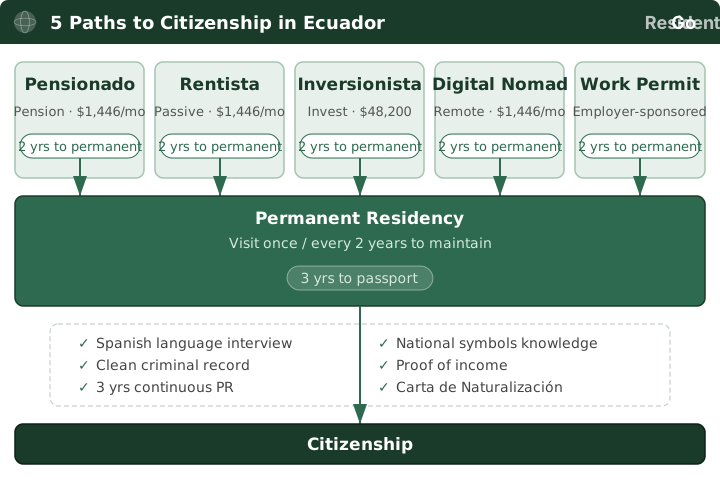
Ecuador is one of the most accessible residency destinations in Latin America, combining unusually low investment thresholds, a dollarized economy, and one of the fastest paths from temporary residency to citizenship on the continent. Unlike many countries in the region where citizenship requires a decade or more of legal residency, Ecuador allows naturalization after as few as three years of permanent residency - only Argentina and Peru, at two years, are faster. All residency-related costs, income requirements, and investment thresholds are denominated in US dollars, which eliminates currency risk and simplifies long-term financial planning for international applicants.
Ecuador Residencies Overview
| Residency Path | Exists | Minimum Requirement | Duration | Leads to Permanent Residency | Key Insight |
|---|---|---|---|---|---|
| Pensionado | Yes | USD 1,446 / month lifetime pension | 2 years | Yes | Must be guaranteed for life |
| Rentista | Yes | USD 1,446 / month passive income | 2 years | Yes | Income need not be lifelong |
| Inversionista | Yes | USD 48,200 investment | 2 years | Yes | Bank deposit, real estate, or shares |
| Asset-based | No | — | — | — | Not available |
| Digital Nomad | Yes | USD 1,446 / month remote income | 2 years | Yes | Requires remote work contract |
| Work Permit | Yes | Employer-sponsored | 2 years | Yes | Local employment only |
*Thresholds are based on Ecuador's 2026 SBU (Salario Básico Unificado) of USD 482 per month. Income-based visas require 3× SBU; the investment visa requires 100× SBU. Thresholds adjust annually when the SBU changes.*
Step-by-Step Guide from Resident to Passport
Prepare documents in your home country
The following documents must be obtained in your home country before applying for residency in Ecuador:
- Birth certificate
- Police clearance certificate (covering the last five years, from each country of residence)
- Marriage certificate (if applicable)
- Birth certificates of dependents (if applicable)
- Valid passport with at least six months of remaining validity
- Residency-specific proof of eligibility (such as pension confirmation, bank statements, investment documentation, or remote employment contract)
All official documents issued outside of Ecuador require either an apostille (for countries that are party to the Hague Apostille Convention) or consular legalization. Documents not in Spanish must be accompanied by a certified Spanish translation. In practice, this means obtaining the original document, arranging a certified translation, and having both apostilled or legalized before departure.
Submit the application through the E-Visa system
As of 2026, all residency visa applications in Ecuador must be submitted online through the national E-Visa platform. Immigration offices no longer accept in-person visa applications. Applications can be submitted from within Ecuador or from abroad.
- Create an account on Ecuador's E-Visa platform
- Upload all required documents in PDF format with correct labeling
- Pay the USD 50 non-refundable application fee
The E-Visa system is strict about document formatting, file quality, and completeness. Documents that are unclear, incorrectly labeled, or missing required apostilles will cause delays or outright rejection. Many applicants choose to work with local immigration professionals familiar with the platform's requirements.
Application review and waiting period
Once the application is submitted, it enters an administrative review period during which the applicant should be prepared for delays and follow-up requests.
- Wait for the application to be reviewed by immigration authorities
- Provide additional documents or clarifications if requested
- Attend an in-person interview if required by immigration
The estimated processing time is approximately 60 days, but delays are common due to system issues, document review backlogs, and requests for additional information. Immigration authorities may request original documents to be presented in person even though the application was filed online.
Temporary residency approval and cédula
Once the application is approved, the applicant must complete the process locally in Ecuador:
- Pay the USD 400 visa issuance fee upon approval
- Obtain the Ecuadorian cédula (national identification card), which costs approximately USD 15
- Register with local authorities and enroll in or provide proof of health insurance
Temporary residency is granted for two years. The cédula serves as the primary identification document in Ecuador and is required for opening bank accounts, signing contracts, enrolling in the public social security system (IESS), and accessing senior citizen benefits (for applicants over 65).
Transition to permanent residency
After holding temporary residency for at least 21 months, applicants can apply for permanent residency, provided they have not been absent from Ecuador for more than 90 days during the temporary residency period.
- Apply for permanent residency after 21 months of continuous temporary residency
- Submit updated versions of original visa documents (for example, a current apostilled pension letter for Pensionado holders)
- Demonstrate compliance with the 90-day absence limit
Once permanent residency is granted, presence requirements become more flexible. During the first two years of permanent residency, the holder may be absent for up to 180 days per year. After the second year, the holder may remain outside Ecuador for up to two consecutive years without losing permanent residency status.
Path to citizenship
Ecuadorian citizenship can be obtained through naturalization after three years of continuous permanent residency. Ecuador has one of the shortest naturalization timelines in Latin America. The requirements are:
- Hold permanent residency in Ecuador for at least three continuous years
- Demonstrate basic proficiency in Spanish
- Recognize Ecuador's patriotic symbols (flag, coat of arms, national anthem)
- Attend an interview explaining the reasons for seeking Ecuadorian nationality
- Provide proof of income and a clean criminal record
- Submit a separate naturalization application (Carta de Naturalización)
Ecuador recognizes dual citizenship without restriction. Applicants are not required to renounce their previous nationality to become Ecuadorian citizens. In total, the fastest theoretical path from first temporary residency to citizenship is approximately five years (two years temporary, then three years permanent), though practical timelines are often longer due to processing delays.
Overview of Ecuador Visas
Residencies that are based on Working Permits or Working visas are described in detail here:
→ Working Visas in Ecuador
Ecuador offers several well-established residency pathways based on retirement income, passive income, investment, or remote work. All options initially grant temporary residency for two years and may lead to permanent residency after 21 months. Ecuadorian citizenship can then be obtained after three years of continuous permanent residency. All financial thresholds are tied to Ecuador's annual minimum wage (SBU), which is set at USD 482 per month for 2026.
Pensionado Visa (Retiree Residency)
The Pensionado visa is intended for retirees who receive a guaranteed lifetime pension of at least USD 1,446 per month (3× SBU). The pension must be permanent, guaranteed for life, and sourced from abroad. Social Security payments, corporate pensions, annuities, and similar instruments typically qualify, provided they meet the lifetime requirement.
Proof typically requires:
- Official pension statements or letters issued by the pension provider confirming a minimum monthly pension of at least USD 1,446
- Documentation confirming that the pension is lifetime and permanent, not fixed-term or discretionary
- Bank statements showing pension payments have been received consistently, typically covering at least three to six months
- If applicable, an official letter from the pension authority (for example, the Social Security Administration for US applicants)
- For each dependent (spouse or child), proof of an additional USD 250 per month in income
Rentista Visa (Passive Income Residency)
The Rentista visa is designed for financially independent individuals who have stable passive income of at least USD 1,446 per month (3× SBU) but do not qualify through a lifetime pension. Unlike the Pensionado visa, the income does not need to be guaranteed for life. Rental income, trust payouts, portfolio dividends, and other recurring foreign-sourced income generally qualify.
Proof typically requires:
- Bank statements showing passive income of at least USD 1,446 per month, covering the last three to six months
- Documentation demonstrating that the income is stable and recurring, such as rental contracts, dividend statements, trust distribution letters, or similar instruments
- Proof that the income is sourced from outside Ecuador
- For each dependent, proof of an additional USD 250 per month in income
Inversionista Visa (Investment Residency)
The Inversionista visa is available to applicants who make a qualifying investment of at least USD 48,200 (100× SBU) in Ecuador. Qualifying investments include a certificate of deposit at an Ecuadorian bank, real estate property, or shares in an Ecuadorian company. The investment must be maintained for the duration of temporary residency and may only be withdrawn after permanent residency is obtained.
Proof typically requires:
- For bank deposits: certificate of deposit from a recognized Ecuadorian financial institution confirming a deposit of at least USD 48,200
- For real estate: property deed and registration confirming an assessed value of at least USD 48,200, along with a visa lien placed on the property
- For company shares: corporate ownership documentation and proof of share value of at least USD 48,200
- Bank statements demonstrating a minimum monthly income of USD 482 (1× SBU) over the last six months, in addition to the investment
- For each dependent, proof of an additional USD 250 per month in income
Digital Nomad Visa (Rentista for Remote Work)
Ecuador introduced a dedicated digital nomad visa framework in 2022, allowing remote workers and freelancers to obtain legal temporary residency. The visa requires proof of remote employment or freelance contracts with foreign clients or employers, combined with a minimum monthly income of USD 1,446 (3× SBU). This visa is a path to permanent residency under the same 21-month timeline as other temporary visa categories.
Proof typically requires:
- Bank statements showing a minimum income of USD 1,446 per month for the last three months
- Employment contract, freelance contract, or documentation proving that the applicant works remotely for a foreign employer or client
- Valid health insurance covering the full two-year visa period, with confirmed coverage in Ecuador
- A passport-style photograph and completed online application form
- For each dependent, proof of an additional USD 250 per month in income
Tax Residency Considerations in Ecuador
From a tax perspective, Ecuador may be of interest to individuals who receive most of their income from foreign sources, particularly retirees with foreign pensions or remote workers with foreign-sourced earnings. Ecuador's tax framework distinguishes between immigration residency and tax residency, and a new temporary tax residency regime introduced in 2024 provides favorable treatment for newcomers during their first years in the country.
- Tax residency in Ecuador is triggered by physical presence exceeding 183 days within a fiscal year or a rolling 12-month period, or by establishing a habitual domicile in Ecuador
- Immigration residency (holding a visa) does not automatically create tax residency; the two are assessed separately
- Tax residents are in principle subject to tax on worldwide income at progressive rates from 0% to 37%
- Since January 2024, a temporary tax residency regime allows individuals without prior Ecuadorian tax residency to pay income tax only on Ecuador-sourced income for a period of five years - a similar concept to Chile's 6-year foreign income exemption and Uruguay's 10-year Tax Holiday
- Foreign pensions, Social Security payments, and other foreign-sourced retirement income are in practice not subject to Ecuadorian income tax when received by foreign residents
- Ecuador uses the US dollar as its official currency, which eliminates currency conversion risk for income and tax calculations - Panama is the only other country in this guide that also uses the dollar
- There is no wealth tax in Ecuador, and property taxes are among the lowest in Latin America
Income generated within Ecuador is subject to progressive personal income tax, with rates starting at 0% on the first approximately USD 12,000 of annual income and reaching up to 37% on income exceeding approximately USD 109,000 per year. Non-residents pay a flat 25% withholding tax on Ecuador-sourced income. These rates apply only to locally sourced income and are subject to periodic adjustment. Ecuador's standard value-added tax (IVA) rate is 15% on most goods and services, though residents over 65 may apply for partial IVA reimbursements.
Residency Status Comparison
| Status | Typical Duration | Status Renewal | Identification | Minimum Presence to Maintain Status | Counts Toward Citizenship |
|---|---|---|---|---|---|
| Tourist | 90 days (extendable to 180) | Via extension or re-entering | Passport | None | No |
| Temporary Residency | 2 years (renewable) | Via application | Cédula | Max. 90 days absent for PR eligibility | Yes |
| Permanent Residency | Indefinite | Not needed | Cédula | Max. 180 days / year (first 2 years), then max. 2 years absent | Yes |
| Citizenship | Permanent | Not needed | National ID / Passport | None | — |
Ecuador's Dollarized Economy
There is no exchange rate risk. Ecuador uses the US dollar as its sole currency, adopted in 2000. All salaries, rents, government fees, income requirements, and investment thresholds are in USD. For applicants earning in dollars, what you see is what you pay, with no conversion needed and no peso fluctuations to monitor.
How the SBU Drives Visa Thresholds
Every visa financial requirement is a multiple of the national minimum wage (SBU), set each December. Income visas require 3× SBU; the Inversionista visa requires 100× SBU. When the SBU rises, all thresholds rise automatically.
The increases have been modest: USD 460 in 2024, USD 470 in 2025, USD 482 in 2026. A pension that met the 3× SBU threshold in 2024 (USD 1,380/month) still comfortably exceeds the 2026 level (USD 1,446/month). Anyone investing at exactly the minimum should build in a 10% buffer, since a bank CD opened at a prior year's threshold may fall short at renewal.
The 5% Tax on Outbound Transfers
Moving money out of Ecuador costs 5%. Every bank wire, foreign credit card purchase, and cash departure above the exemption thresholds is taxed at a flat 5% (the Impuesto a la Salida de Divisas). A resident wiring USD 50,000 to a foreign account pays USD 2,500.
Exemptions exist for small amounts: bank transfers up to USD 1,446 per biweekly period, foreign card spending up to USD 5,188 per year, and carried cash up to USD 1,446. Since January 2025, the ISD is no longer a tax credit, only a deductible expense. Factor in the cost of eventually moving money back out before moving large sums in.
Senior Citizen Benefits
Foreign residents aged 65 and older receive the same legally mandated benefits as Ecuadorian seniors. These include discounted domestic airfares, reduced utility bills, partial reimbursement of value-added tax (IVA), and property tax exemptions on homes below a set threshold. Combined with Ecuador's low cost of living and the public health system (IESS), these benefits make Ecuador one of the most cost-effective retirement destinations in Latin America.
Frequently Asked Questions
✅ Eligibility
What is the most common residency path for expats in Ecuador?
The Pensionado (retiree) visa and the Rentista (passive income) visa are the most popular options. Both require proof of at least $1,446/month in income and grant two-year temporary residency that leads to permanent residency after 21 months.
Can I include my family in an Ecuador residency application?
Yes. Spouses and children can be included as dependents on any temporary residency visa. You must show an additional $250/month in income for each dependent. Parents and grandparents can only be sponsored once you hold permanent residency.
What is the minimum income required for Ecuador residency?
Income-based visas (Pensionado, Rentista, Digital Nomad) require a minimum of $1,446/month, which equals 3× Ecuador's 2026 minimum wage (SBU) of $482. For the Inversionista visa, you need to show at least $482/month in income on top of the investment.
What is the minimum investment amount required for Ecuador residency?
The Inversionista visa requires a minimum investment of $48,200 (100× SBU). Qualifying investments include a certificate of deposit at an Ecuadorian bank, real estate, or shares in an Ecuadorian company. The investment must be maintained through the temporary residency period.
📝 Process & Timeline
How much does it cost to apply for Ecuador residency?
About $465. This includes a $50 non-refundable application fee, a $400 visa issuance fee upon approval, and roughly $15 for the cédula (national ID card). Additional costs for apostilles, certified translations, and legal assistance are separate.
What documents do I need to apply for Ecuador residency?
All applicants need a valid passport (6+ months validity), birth certificate, police clearance certificate (covering the last five years), and visa-specific proof such as pension letters, bank statements, or investment documentation. All documents must be apostilled and translated into Spanish.
Can I apply for Ecuador residency while visiting as a tourist?
Yes. Applications are submitted online through Ecuador's E-Visa platform and can be filed from within Ecuador or from abroad. However, once approved, you must be in Ecuador to pay the visa fee, collect your cédula, and complete registration.
Do I need to open a bank account in Ecuador to apply for residency?
Only if you are applying for the Inversionista visa via a certificate of deposit, which requires an Ecuadorian bank account. For all other visa types (Pensionado, Rentista, Digital Nomad), a local bank account is not required for the application.
How long does it take to get temporary residency in Ecuador?
The estimated processing time is approximately 60 days after submission through the E-Visa system. However, delays are common due to document review backlogs and requests for additional information, and some applications take several months.
How long does it take to get Ecuador citizenship?
The fastest theoretical path is about five years: two years of temporary residency, then three years of permanent residency. You must also pass a Spanish language interview and demonstrate knowledge of Ecuador's national symbols. Practical timelines are often longer due to processing delays.
🏠 Living in Ecuador
Do I need to live in Ecuador to maintain residency?
During temporary residency, you cannot be absent for more than 90 days total or you risk losing eligibility for permanent residency. Once permanent, you may be absent up to 180 days/year for the first two years, and after that you can stay abroad for up to two consecutive years.
Can I work in Ecuador as a foreign resident?
The Digital Nomad visa only permits remote work for foreign employers or clients. Local employment in Ecuador requires a separate work visa sponsored by an Ecuadorian employer. Permanent residents and citizens may work locally without restriction.
Does Ecuador tax foreign income?
Tax residents (183+ days/year) are in principle taxed on worldwide income at rates from 0% to 37%. However, a temporary tax residency regime introduced in 2024 lets newcomers pay tax only on Ecuador-sourced income for five years. Foreign pensions are in practice not taxed.
Is health insurance mandatory for residents in Ecuador?
Yes. All temporary residents must hold valid health insurance covering the full two-year visa period. This can be obtained through Ecuador's public social security system (IESS) or a private health insurance plan with coverage in Ecuador.
Can I have dual citizenship with Ecuador?
Yes. Ecuador recognizes dual citizenship without restriction. You are not required to renounce your previous nationality when you become an Ecuadorian citizen through naturalization.