No country in Latin America offers a cheaper combination of residency, tax savings, and path to citizenship than Paraguay. Foreign income is completely untaxed, the Temporary Residency permit costs roughly USD 350 and processes in 2 to 4 months, and you can reach permanent residency in just two years with no minimum stay requirement beyond one annual visit. The tradeoff: Paraguay has no dedicated Digital Nomad Visa, so remote workers apply for the same standard residency as everyone else. For local employment, the process adds an employer-sponsored work permit through the Ministry of Labor, which takes 1 to 2 months on top of the residency application.
Work Options at a Glance
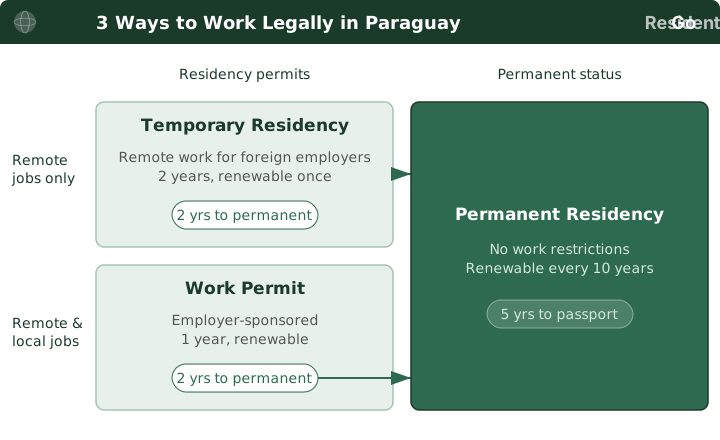
Paraguay does not have a Digital Nomad Visa. If you work remotely for foreign clients, you apply for Temporary Residency, the same permit used by retirees, investors, and family-based applicants. The territorial tax system means your foreign income is untaxed regardless of how long you stay. If you prefer a country with a dedicated digital nomad program, Uruguay's Digital Nomad Permit costs just USD 11 with no income minimum, and Argentina's starts at USD 200. If a Paraguayan company is hiring you, you need both Temporary Residency and a separate work permit (Permiso Laboral) from the Ministry of Labor (MTESS). Both paths lead to permanent residency after two years, and citizenship becomes available three years after that.
Comparing Work Visas in Detail
| Temporary Residency | Employer-Sponsored Work Permit | |
|---|---|---|
| For | Remote workers and freelancers | Local employment |
| Legal basis | Law No. 6.984/2022 | Law No. 6.984/2022 + Labour Code |
| Who qualifies | Everyone | Workers with a Paraguayan employer |
| Key requirement | Proof of financial solvency | Job offer from a registered employer |
| Duration | 2 years, renewable once | 1 year, renewable up to 5 times |
| Processing time | 2–4 months | 1–2 months (after residency) |
| Government fees | ~USD 350 | ~USD 130 + ~USD 350 residency |
| Remote work for foreign employer | Yes | - |
| Work for Paraguayan companies | No | Yes, sponsoring employer only |
| Change employer | - | Requires new authorization |
| Open bank account | Yes | Yes |
| Include dependents | Yes (spouse and children apply separately) | Yes (via family residency) |
| Path to permanent residency | Yes, after 2 years | Yes, after 2 years |
Temporary Residency for Remote Workers
Paraguay has no dedicated visa for digital nomads, but the standard Temporary Residency permit functions as one. Since the country taxes only Paraguayan-source income, remote workers earning from abroad owe zero local income tax. The permit is valid for two years and renewable once, and you must physically visit Paraguay at least once per year to maintain it. After two years, you can apply for permanent residency.
Documents required
- Valid passport with at least 6 months remaining
- Criminal background check from your home country, apostilled and translated into Spanish (valid for 6 months)
- Birth certificate, apostilled and translated into Spanish
- Proof of financial solvency: bank statements or proof of income. No fixed threshold is set by law, but roughly USD 1,200/month is the commonly cited minimum.
- Medical certificate from a physician authorized by the Paraguayan Ministry of Health
- Certificate of Life and Residence from the local Paraguayan police station where you live
- Two passport-sized photos
Process
You must apply in person at the Dirección General de Migraciones (DGM) in Asunción. There is no online or consular application option. Most applicants enter Paraguay visa-free (EU, US, and most South American citizens qualify), then file for residency after arrival. Plan for at least one week in-country: you will need to visit the police department for fingerprinting, a clinic for the medical exam, and the DGM office for biometrics and document submission. Processing takes 2 to 4 months. Once approved, you return to collect your Cédula (national ID card), which requires a separate visit.
Tax treatment
Temporary residents earning exclusively from foreign sources owe zero Paraguayan income tax. The territorial system exempts all income generated outside the country, regardless of where the funds are deposited.
Employer-Sponsored Work Permit
Foreign nationals hired by a Paraguayan company need both Temporary Residency and a separate work permit (Permiso Laboral) from the Ministry of Labor, Employment and Social Security (MTESS). The employer must be a registered legal entity with a tax identification number (RUC) and must provide a formal employment contract. There are no profession-specific restrictions, but the employer plays a central role in the application.
Documents required
- All documents required for Temporary Residency (see above)
- Signed employment contract with salary, role, and duration, certified before a public notary
- Employer's company registration documents (incorporation act, RUC certificate)
- Employer's tax declarations for the last three months (from SET)
- Employer's identity document and proof of authority to sign
- Professional credentials or qualifications relevant to the role
Process
The employee first obtains Temporary Residency through the DGM, then the employer submits the work permit application to the MTESS. Processing takes 1 to 2 months after residency is granted. Once issued, the work permit is tied to the sponsoring employer. Changing jobs requires a new authorization. The total timeline from entry to working legally is typically 3 to 6 months when combining both steps.
Tax treatment
Work permit holders pay progressive income tax on their Paraguayan salary (8% to 10%) and are enrolled in the IPS social security system. See the tax section below for brackets and rates.
For long-term residency pathways, see our Paraguay Residency Guide.
Taxes and Health Insurance
Paraguay operates a territorial tax system. Only income from Paraguayan sources is taxed. Foreign income is completely exempt regardless of visa type, length of stay, or whether the funds enter a Paraguayan bank account. This is the single most attractive feature for remote workers and the reason Paraguay draws thousands of residency applicants each year. Panama, Costa Rica, and Bolivia apply the same territorial principle.
For locally employed workers, personal income tax (IRP) is progressive: individuals earning less than approximately PYG 80 million/year (~USD 10,950, equal to 36 monthly minimum wages) are entirely exempt. Above that threshold, rates are 8% on the lower bracket and 10% on the upper bracket. Even at the maximum rate, this is one of the lowest personal income tax rates in Latin America. Paraguay does not impose any wealth tax, inheritance tax, or gift tax.
All locally employed workers and their employers contribute to the Instituto de Previsión Social (IPS). Employee contributions total 9% of gross salary. Employer contributions add 16.5% on top of the employee's salary. These fund public healthcare and pensions and are withheld at source. Employers must also pay a mandatory 13th-month bonus (aguinaldo) each December, calculated as one-twelfth of annual earnings.
Paraguay has double taxation treaties with Chile, Spain (effective January 2025), Qatar, Taiwan, the UAE, and Uruguay. There is no treaty with the United States, Germany, or most EU countries. US citizens working in Paraguay may owe US tax on worldwide income, with the Foreign Earned Income Exclusion of approximately USD 130,000 (2026 figure) potentially offsetting some or all liability.
Temporary residents who are not locally employed are not enrolled in IPS and have no social security obligation. Paraguay does not legally require private health insurance for residency holders, but carrying coverage is strongly recommended. Private health plans typically cost USD 50 to 150/month. Locally employed workers receive public healthcare through IPS.
Regardless of visa type, tax obligations in your home country may still apply. Holding a Paraguayan visa does not automatically end tax residency elsewhere.
Starting a Business in Paraguay
Neither Temporary Residency nor the employer-sponsored work permit allows you to run a local business. Temporary Residency for remote workers is designed for foreign-source income, and the work permit ties you to a single employer. If you want to start or invest in a Paraguayan company, you need a different path.
The most direct route is the SUACE investor program, which grants permanent residency in exchange for a projected investment of USD 70,000 in a Paraguayan business over 10 years. This covers a wide range of activities: agriculture, commerce, real estate, and services all qualify. The SUACE application processes in roughly 90 days, and permanent residents can work without restrictions, including running their own company.
Registering a company does not require residency. Any foreigner can incorporate a Sociedad de Responsabilidad Limitada (S.R.L.) or Sociedad Anónima (S.A.) in Paraguay. But actually working in or managing the business day-to-day requires a residency permit that authorizes local activity. For a detailed breakdown of residency categories, see our Paraguay Residency Guide.
Tourist Visa and Work Rights
Most nationalities, including EU and US citizens, can enter Paraguay visa-free for up to 90 days. No form of paid work is permitted on a tourist entry, including remote work for a foreign employer.
Enforcement has historically been minimal for laptop-based remote work. However, since Paraguay has no Digital Nomad Visa to formalize the gray area, the legal path for remote workers is Temporary Residency. Given that the residency application requires in-person presence anyway, most remote workers file for residency shortly after arrival rather than relying on tourist status long-term.
Frequently Asked Questions (FAQ)
🛂 Visa & Legal
Can US citizens work in Paraguay?
Yes. US citizens can enter Paraguay visa-free for 90 days and apply for Temporary Residency from within the country. For remote work, Temporary Residency combined with the territorial tax system means zero local tax on foreign income. For local employment, you also need a work permit from the MTESS, sponsored by a Paraguayan employer.
Can I work in Paraguay on a tourist visa?
No. The 90-day tourist entry does not authorize any paid work, including remote work for a foreign employer. Temporary Residency is the legal path for remote workers, costing approximately USD 350 with processing times of 2 to 4 months.
Can freelancers work legally in Paraguay?
Yes, if serving international clients. Freelancers apply for Temporary Residency and prove financial solvency (roughly USD 1,200/month). Since freelance income from foreign clients is not Paraguayan-source, it is completely untaxed. Freelancers serving Paraguayan clients need a work permit or investor residency.
How long does it take to get a work visa in Paraguay?
Temporary Residency for remote workers takes 2 to 4 months. Employer-sponsored work permits take 1 to 2 months after residency is granted. The total timeline for a locally employed worker is 3 to 6 months from entry to working legally.
Can I switch from a tourist visa to a work visa inside Paraguay?
Yes. Most applicants enter Paraguay visa-free and then apply for Temporary Residency in person at the DGM in Asunción. There is no requirement to leave the country or apply at a consulate first. You must be physically present in Paraguay to submit the application and provide biometrics.
Can I work remotely in Paraguay without a work visa?
Not legally. While enforcement for laptop-based remote work on a tourist visa has been light, Paraguay has no Digital Nomad Visa to formalize the arrangement. Temporary Residency is the legal option and also unlocks tax residency, bank accounts, and a path to permanent residency.
What visa do remote workers use in Paraguay?
Temporary Residency (Residencia Temporaria) under Law No. 6.984/2022. This is Paraguay's standard residency permit, not a dedicated digital nomad category. It costs roughly USD 350 and is valid for two years. Combined with the territorial tax system, remote workers pay zero Paraguayan tax on foreign income.
Can I include my family in a Paraguay work visa application?
Yes, but each family member files a separate application. Spouses and dependent children can apply for Temporary Residency on their own, using the main applicant's financial solvency as supporting documentation. Each dependent pays the same government fee (~USD 350).
What types of jobs qualify for a Paraguay work permit?
There are no profession-specific restrictions. Any role with a legitimate Paraguayan employer qualifies, as long as the employer provides a formal employment contract and is registered with the tax authority (SET) and the MTESS. Sectors with particular demand for foreign workers include IT, healthcare, engineering, and agriculture.
💰 Money & Tax
What is the average salary in Paraguay?
The average gross salary is approximately USD 520 to 560/month (~USD 6,500/year). The minimum wage is PYG 2,899,048/month (~USD 365) as of July 2025. Software developers employed locally earn roughly USD 10,000 to 18,000/year, though those working remotely for international companies earn significantly more.
Does Paraguay tax foreign income?
No. Paraguay operates a territorial tax system: only income from Paraguayan sources is taxed. Foreign income is untaxed regardless of visa type, length of stay, or whether you deposit the funds in a Paraguayan bank. For locally earned salary, progressive rates apply: 0% below ~USD 10,950/year, then 8% and 10% on higher brackets.
How much does it cost to apply for a Paraguay work visa?
Temporary Residency costs approximately USD 350 in government fees. An employer-sponsored work permit adds roughly USD 130 in MTESS fees. The Cédula (national ID) requires an additional fee of approximately USD 30 to 50. Additional costs for apostilles, certified translations, and legal assistance are separate.
🏠 Practical
Do I need to speak Spanish to work in Paraguay?
Not for remote work, but daily life is much harder without it. Paraguay is bilingual: Spanish and Guaraní are both official languages. English is not widely spoken outside Asunción's business district. For local employment, professional-level Spanish is expected by virtually all employers. All visa documents must be submitted in Spanish.
Is health insurance mandatory for work visa holders in Paraguay?
For locally employed workers, yes: enrollment in the IPS social security system is mandatory, with 9% withheld from salary and 16.5% paid by the employer. This covers public healthcare. For Temporary Residency holders not employed locally, there is no legal insurance requirement, but private coverage (USD 50 to 150/month) is strongly recommended.
Compare all 12 countries in our Working Abroad Guide. Looking for residency instead? See our Latin America Residency Guide.