Paraguay is one of the few countries in the Americas that combines a nearly barrier-free temporary residency process with a territorial tax system that does not tax foreign-sourced income. Since the implementation of Law No. 6984/2022, temporary residency no longer requires proof of income, investment, or a bank deposit, making Paraguay’s entry-level residency one of the most accessible in Latin America - comparable only to Bolivia, which requires approximately $300/mo in solvency. At the same time, Paraguay remains the only country in the region that offers a direct path to permanent residency through asset-based solvency, such as a bank deposit, alongside separate investor and retiree programs.
Paraguay Residencies Overview
| Residency Path | Exists | Minimum Requirement | Duration | Leads to Permanent Residency | Key Insight |
|---|---|---|---|---|---|
| Pensionado | Yes | ~USD 1,300 / month lifetime pension | Permanent | Yes (directly) | pension must be lifetime |
| Rentista | Limited | No fixed minimum; passive income recommended | Temporary | Yes | No formal rentista program |
| Inversionista | Yes | USD 70,000 investment via SUACE | Permanent | Yes (directly) | Company formation required |
| Asset-based | Yes | ~USD 5,000 bank deposit | Permanent | Yes | Deposit can be withdrawn after approval |
| Work Permit | Yes | Employer-sponsored | 1 year (renewable) | Yes | Tied to sponsoring employer |
| Digital Nomad | No | — | — | — | No dedicated program |
*Indicative minimum thresholds shown as of 2026. Interpretation and documentation standards may vary.*
Step-by-Step Guide from Resident to Passport
Prepare documents in your home country
The following documents must be obtained in your home country before traveling to Paraguay:
- Valid passport
- Birth certificate
- Police clearance certificate (from country of origin or country of residence for the last 3 years)
- Marriage certificate (if applicable)
- Passport-sized photographs
- Residency-specific proof of eligibility (such as pension confirmation or investment documentation, if applying directly for permanent residency)
All official documents require an apostille issued in the country of origin (for countries party to the Hague Convention). Once in Paraguay, apostilled documents must be translated into Spanish by a licensed public translator (Traductor Público) and notarized. Documents not in Spanish or Portuguese require certified translation.
Enter Paraguay and file the application
Once all documents are prepared, the residency application must be filed in person in Paraguay, which includes:
- Submitting the full application to the Dirección General de Migraciones (DGM) in Asunción
- Paying government filing fees (approximately USD 350–400 for temporary residency)
- Registration of fingerprints, photographs, and biometric data
- Obtaining local certificates: Interpol clearance, Paraguayan police background check, and a life and residence certificate from the local police station
All applications are processed in Spanish and follow local administrative procedures. Applicants should plan to spend at least 5 to 7 business days in Asunción to complete the in-person steps, although some steps may require return visits. Many applicants choose to work with local immigration professionals to navigate filings and ongoing correspondence.
Application review and waiting period
After filing, the application enters a formal review phase with immigration authorities:
- Wait for the application to be reviewed by the DGM
- Provide additional documents or clarifications if requested
- Attend follow-up appointments if required
During this period, the applicant is generally covered by a precautionary residency status (residente precario), which allows legal stay in Paraguay while the application is being processed. Temporary residency applications are typically processed within 2 to 4 months, though timelines may vary depending on case complexity and administrative workload.
Temporary residency approval
Once the application is approved, temporary residency is granted and must be completed locally.
- Obtain the temporary residency card issued by the DGM
- Apply for the Cédula de Identidad (national ID card) within 180 days of residency approval
- Comply with ongoing residency conditions
Temporary residency is granted for a period of 2 years. Paraguay does not impose a strict minimum stay requirement, but temporary residents should not be absent from Paraguay for more than 12 consecutive months, as this may result in loss of residency status. In practice, visiting Paraguay at least once per year is recommended to maintain active status.
Renewals and transition to permanent residency
Temporary residency in Paraguay is granted for a fixed 2-year period. After completing this period with uninterrupted status, applicants may apply for permanent residency.
- Apply for permanent residency approximately 3 months before the temporary residency expires (at around the 21-month mark)
- Provide updated documentation, including renewed Paraguayan police clearances and proof of financial solvency (for example, a bank statement showing at least approximately USD 5,000)
- Maintain uninterrupted residency status throughout the temporary period
Once permanent residency is granted, it is valid for 10 years and is renewable. Permanent residents do not need to renew their status annually and have fewer restrictions. The primary maintenance requirement is to not be absent from Paraguay for more than 3 consecutive years without authorization.
Path to citizenship
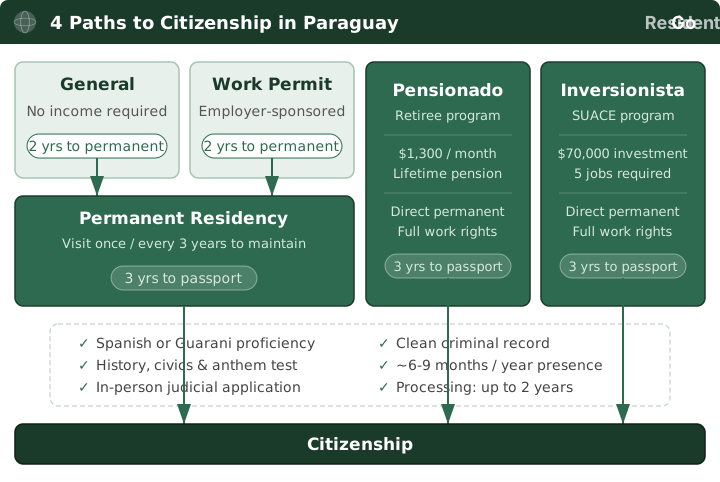
Paraguayan citizenship can be obtained through naturalization after long-term legal residency. For most applicants, this means:
- Hold permanent residency in Paraguay for at least 3 consecutive years
- Demonstrate physical presence in Paraguay for a significant portion of each year during those 3 years (at least 6 to 9 months per year, depending on the judicial interpretation applied)
- Demonstrate proficiency in at least one of Paraguay’s official languages: Spanish or Guaraní
- Demonstrate knowledge of Paraguay’s national anthem, history, and civic structure
- Maintain a clean criminal record
- Submit a separate citizenship (naturalization) application in person to the competent judicial authority
Residency obtained through temporary, asset-based, or investment residency can therefore serve as the starting point toward a Paraguayan passport. The total path from initial temporary residency to citizenship eligibility takes a minimum of approximately 5 years (2 years temporary + 3 years permanent), making it one of the faster naturalization timelines in the region - though Argentina and Peru offer citizenship after just 2 years.
Overview of Paraguay Visas
Residencies that are based on Working Permits or Working visas are described in detail here:
→ Working Visas in Paraguay
Paraguay offers several residency pathways based on general eligibility, retirement income, or investment. The standard route begins with temporary residency that leads to permanent residency after 2 years. Alternatively, the pensionado and investor (SUACE) programs grant direct permanent residency. Paraguayan citizenship can then be pursued after 3 years of permanent residency.
General Temporary Residency
Since the implementation of Law No. 6984/2022, Paraguay’s general temporary residency no longer requires proof of income, investment, or a bank deposit. The program is open to most nationalities and serves as the standard entry point for anyone seeking legal residency in Paraguay. It grants the right to live, work, study, and conduct business in the country for 2 years.
Proof typically requires:
- A valid passport with legal entry stamp
- Apostilled birth certificate from the country of origin
- Apostilled police clearance certificate (from country of origin or last 3 years of residence)
- Sworn declarations regarding intended activity and local address in Paraguay, submitted before the DGM
- Local certificates obtained in Paraguay: Interpol clearance, Paraguayan police background check, and life and residence certificate
Pensionado (Retiree Permanent Residency)
The Pensionado residency is intended for individuals who receive a lifetime pension. Applicants must demonstrate a monthly pension income equivalent to approximately 100 minimum wages, currently around USD 1,300 per month. There is no age requirement. This path grants direct permanent residency without requiring an initial temporary phase, and includes import duty exemptions on personal household goods.
Proof typically requires:
- Official pension statements or letters from the pension provider confirming a lifetime monthly pension of at least approximately USD 1,300
- Documentation confirming that the pension is permanent and guaranteed, not fixed-term or discretionary
- Pension payment history (for example bank statements) showing consistent receipt of pension income
- A health certificate from the country of origin or last residence
Inversionista (SUACE Investment Residency)
Residency by investment is available through the SUACE program (Sistema Unificado de Apertura y Cierre de Empresas), Paraguay’s unified system for company formation. The program grants direct permanent residency to foreign investors who commit to investing at least USD 70,000 in a Paraguayan business and creating local employment (typically at least 5 jobs). The full investment amount does not need to be paid upfront; a business plan committing to invest this amount over up to 10 years is sufficient at the application stage.
Proof typically requires:
- A business plan outlining the intended investment of at least USD 70,000 and job creation
- Investor certificate (Constancia de Inversionista) issued by the Ministry of Industry and Commerce through SUACE
- Company registration documents in Paraguay (the company must be established through SUACE)
- Standard personal documentation (passport, birth certificate, police clearance, apostilled and translated)
Asset-based Residency (Bank Deposit)
Paraguay is the only country in the region that offers a path to permanent residency supported primarily by demonstrating financial solvency through a bank deposit. When transitioning from temporary to permanent residency, applicants must show proof of financial means, which can be satisfied by a bank deposit of approximately USD 5,000 in a Paraguayan bank account. This deposit can be withdrawn after residency approval is granted. Alternatively, proof of solvency can include employment in Paraguay, business ownership, a university degree, or other evidence of economic ties.
Proof typically requires:
- Bank statement from a Paraguayan bank showing a deposit of at least approximately USD 5,000
- Alternatively: proof of employment, business activity, property ownership, or a professional qualification demonstrating financial solvency
- Completed 2-year temporary residency period with uninterrupted status
- Updated police clearances and personal documentation
Tax Residency Considerations in Paraguay
From a tax perspective, Paraguay is one of the most considered destinations in Latin America for individuals who earn income abroad, hold international assets, or are seeking a residency base without triggering worldwide taxation. Paraguay’s territorial tax system and absence of wealth-related taxes make it particularly relevant for retirees, remote workers, and international entrepreneurs.
However, tax outcomes depend on personal circumstances, and the following points help assess this in practice:
- Paraguay applies a strict territorial tax system under Law No. 6380/2019, taxing only income sourced within Paraguay - similar to Panama and Costa Rica
- Foreign-sourced income, including pensions, dividends, rental income, and business profits earned abroad, is not subject to Paraguayan income tax
- Immigration residency and tax residency are separate concepts; holding a residency card does not automatically create tax residency
- Tax residency requires obtaining a RUC (tax identification number) from the DNIT (national tax authority) and formally applying for a tax residency certificate
- There is no legally mandated minimum number of days of physical presence required to establish or maintain tax residency, though establishing a local domicile (for example, spending 120 days per year) supports the claim of genuine economic ties
- There is no wealth tax, inheritance tax, gift tax, or exit tax in Paraguay
- Annual tax returns must be filed even if all income is foreign-sourced and the declared Paraguayan income is zero
Income generated within Paraguay is subject to personal income tax (IRP) at a rate of 8% for incomes below 120 monthly minimum wages, and 10% for incomes at or above that threshold. Dividends distributed by Paraguayan companies are subject to a 5% withholding tax. These rates apply only to Paraguay-sourced income and do not extend to foreign-sourced income under the territorial system. VAT is applied at a standard rate of 10%, with a reduced rate of 5% on certain goods and services. Tax brackets and thresholds are adjusted periodically.
Residency Status Comparison
| Status | Typical Duration | Status Renewal | Identification | Minimum Presence to Maintain Status | Counts Toward Citizenship |
|---|---|---|---|---|---|
| Tourist | 90 days | Via re-entering or extension | Passport | None | No |
| Temporary Residency | 2 years | Via application | Cédula de Identidad | Not absent more than 12 consecutive months | No (must transition to PR first) |
| Permanent Residency | 10 years (renewable) | Card renewal every 10 years | Cédula de Identidad | Not absent more than 3 consecutive years | Yes |
| Citizenship | Permanent | Not needed | National ID / Passport | None | — |
Banking: The Cédula-First Rule
You cannot open a bank account in Paraguay without a Cédula de Identidad. No passport-only accounts exist. Since the asset-based path requires a USD 5,000 bank deposit, and the bank requires a Cédula, and the Cédula requires approved residency, the deposit happens after temporary residency is granted, not before.
Even with a Cédula, initial accounts are restricted to roughly USD 1,000 in guaraníes with no dollar accounts. Full functionality, including USD accounts and international transfers, requires a RUC (tax ID) and six months of declared tax activity, even if all income is foreign-sourced and the declared amount is zero. Factor this ramp-up into your timeline.
Dual Citizenship: Law vs. Practice
Paraguay's Constitution permits dual nationality only with countries that have reciprocity agreements. As of 2026, that means only Spain and Italy. In theory, a German, American, or Brazilian citizen who naturalizes could be required to renounce.
In practice, Paraguay does not enforce renunciation. No mechanism exists to verify whether a new citizen has surrendered a foreign nationality, and no known revocations have occurred on these grounds. But this is permissive practice, not a statutory guarantee.
Frequently Asked Questions
✅ Eligibility
What is the most common residency path for expats in Paraguay?
General temporary residency is the standard entry point. Since Law No. 6984/2022, it requires no proof of income, investment, or bank deposit, making it one of the most accessible residency programs in Latin America. It is valid for 2 years and grants the right to live, work, study, and conduct business in Paraguay.
Can I include my family in a Paraguay residency application?
Yes. Your spouse and dependent children (under 18) can be included in your residency application. Each family member must provide their own set of documents (birth certificates, police clearances, etc.), but the applications are coordinated together.
What is the minimum income required for Paraguay residency?
General temporary residency has no minimum income requirement. The Pensionado (retiree) path requires a lifetime pension of approximately USD 1,300 per month. There is no formal rentista program with a fixed income threshold.
What is the minimum investment amount required for Paraguay residency?
The Inversionista (SUACE) program requires a commitment to invest at least USD 70,000 in a Paraguayan business and create at least 5 local jobs. The full amount does not need to be paid upfront; a business plan committing to invest over up to 10 years is sufficient at the application stage.
📝 Process & Timeline
How much does it cost to apply for Paraguay residency?
About $375. This covers government filing fees for temporary residency. Additional costs for apostilles, certified translations, and legal assistance are separate.
What documents do I need to apply for Paraguay residency?
You need a valid passport, apostilled birth certificate, apostilled police clearance certificate (from your country of origin or country of residence for the last 3 years), passport-sized photographs, and sworn declarations regarding your intended activity and local address. Marriage certificates are required if applicable. All documents must be translated into Spanish and notarized once in Paraguay.
Can I apply for Paraguay residency while visiting as a tourist?
Yes. Most applicants enter Paraguay as tourists and file the residency application in person at the Dirección General de Migraciones (DGM) in Asunción. Plan to spend at least 5 to 7 business days in Asunción to complete the in-person steps, though some steps may require return visits.
Do I need to open a bank account in Paraguay to apply for residency?
Not for temporary residency. However, you cannot open a bank account without a Cédula de Identidad (national ID), which is only issued after residency is approved. For the asset-based permanent residency path, a USD 5,000 bank deposit is required, but this happens after temporary residency is granted, not before.
How long does it take to get temporary residency in Paraguay?
Temporary residency applications are typically processed within 2 to 4 months. After approval, the new chip-based Cédula takes approximately 45 additional days to process. Applicants are covered by a precautionary residency status (residente precario) while waiting.
How long does it take to get Paraguay citizenship?
The minimum path is approximately 5 years: 2 years of temporary residency, then 3 years of permanent residency. After that, you can apply for naturalization, though citizenship processing itself can take up to 2 additional years. You must demonstrate significant physical presence (6 to 9 months per year), language proficiency in Spanish or Guaraní, and knowledge of Paraguay's history and civic structure.
🏠 Living in Paraguay
Do I need to live in Paraguay to maintain residency?
There is no strict minimum stay, but temporary residents must not be absent for more than 12 consecutive months, and permanent residents must not be absent for more than 3 consecutive years. In practice, visiting Paraguay at least once per year is recommended to maintain active status.
Can I work in Paraguay as a foreign resident?
Yes. General temporary residency grants the right to live, work, study, and conduct business in Paraguay. You can work in the public or private sector, register a business, open bank accounts, and sign contracts once you hold a valid residency permit and Cédula.
Does Paraguay tax foreign income?
No. Paraguay applies a strict territorial tax system under Law No. 6380/2019, taxing only income sourced within Paraguay. Foreign-sourced income, including pensions, dividends, rental income, and business profits earned abroad, is not subject to Paraguayan income tax. There is also no wealth tax, inheritance tax, gift tax, or exit tax.
Is health insurance mandatory for residents in Paraguay?
No, there is no mandatory health insurance system in Paraguay. Public healthcare is available to residents free of charge, but quality and wait times can be limited, especially outside Asunción. Most expats opt for private health insurance, with local plans typically costing USD 30–100 per month.
Can I have dual citizenship with Paraguay?
Paraguay's Constitution permits dual nationality only with countries that have reciprocity agreements, which as of 2026 means only Spain and Italy. In practice, however, Paraguay does not enforce renunciation. No mechanism exists to verify whether a new citizen has surrendered a foreign nationality, and no known revocations have occurred on these grounds.