Colombia has the lowest entry bar for remote workers of any Digital Nomad Visa in Latin America. The income threshold sits at just three times the minimum wage (roughly USD 1,300/month), the application is fully online, and approval typically comes within one to two weeks. Medellín alone has become one of the largest digital nomad hubs in the Americas, with fiber internet, dozens of coworking spaces, and a cost of living that stretches a remote salary further than almost anywhere in the region. The catch: unlike Costa Rica or Panama, Colombia taxes worldwide income once you spend more than 183 days in the country, which most two-year visa holders will. For local employment, the process is more conventional: employers sponsor a Visa M-5, valid for up to three years, with no profession restrictions but a requirement to justify hiring a foreigner over a local candidate.
Work Options at a Glance
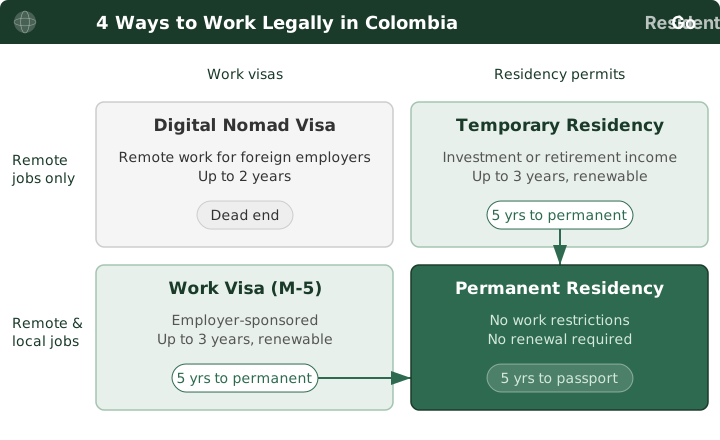
Which visa you need depends on where your income comes from. If you work remotely for foreign clients or employers, the Digital Nomad Visa is the simplest path, though it caps out at two years with no route to residency. If a Colombian company is hiring you, you need an employer-sponsored Work Visa (M-5). And if you have investment capital or retirement income, a Temporary Residency M visa lets you live and work without tying yourself to a single employer. Only the Work Visa and Temporary Residency tracks lead to Permanent Residency, which requires five consecutive years on an M visa.
Comparing Work Visas in Detail
| Digital Nomad Visa | Work Visa (M-5) | |
|---|---|---|
| For | Remote workers and freelancers | Local employment |
| Legal basis | Resolution 5477 of 2022 (Visa V) | Resolution 5477 of 2022 (Visa M) |
| Who qualifies | Citizens of visa-exempt countries | Anyone with an employer offer |
| Key requirement | 3x minimum wage (~USD 1,300/month) | Employment contract + employer justification |
| Duration | Up to 2 years | Up to 3 years (tied to contract) |
| Processing time | 1–4 weeks | 2–4 weeks |
| Government fees | ~USD 231 (USD 54 study + USD 177 issuance) | ~USD 324 (USD 54 study + USD 270 issuance) |
| Remote work for foreign employer | Yes | - |
| Work for Colombian companies | No | Yes, sponsoring employer only |
| Change employer | - | Requires new visa |
| Open bank account | Yes (with Cédula de Extranjería) | Yes |
| Include dependents | Yes (with additional documentation) | Yes (via beneficiary visa) |
| Path to permanent residency | No | Yes, after 5 years on M visa |
*The Digital Nomad Visa income threshold is set in Colombian pesos (3x SMLMV). The USD equivalent fluctuates with the exchange rate. For 2026, the SMLMV is COP 1,750,905, making the threshold COP 5,252,715/month.*
Colombia Digital Nomad Visa
Colombia's Digital Nomad Visa (Visa V - Nómadas Digitales) stands out for its low barrier to entry. At roughly USD 1,300/month in income, it requires less than half of what Costa Rica, Brazil, or Panama demand. The visa is valid for up to two years, lets you get a Cédula de Extranjería (foreigner ID), open a bank account, and sign rental contracts. The trade-off: it is strictly for remote work with foreign clients or employers. Any local employment or Colombian-source income is prohibited.
Documents required
- Valid passport from a visa-exempt country (including the US, Canada, EU, UK, Australia) with at least six months of validity
- Bank statements from the past three months showing income of at least 3x the Colombian minimum wage (COP 5,252,715/month for 2026, roughly USD 1,300)
- Letter from your employer confirming remote work arrangement, or a motivation letter for freelancers and entrepreneurs (in Spanish or English)
- Private health insurance valid in Colombia covering accidents, illness, maternity, disability, hospitalization, and repatriation
- Criminal background check from your country of residence, apostilled or legalized
- Passport-size photo on white background
- All foreign documents apostilled and translated into Spanish by a certified translator
Process
The entire application is online through the Ministry of Foreign Affairs portal. You pay the USD 54 study fee, upload your documents, and wait for a decision. Most applications are processed within one to two weeks, though the official window is up to 30 business days. If approved, you pay the USD 177 issuance fee and receive the visa electronically. After arriving in Colombia, you must register your visa and apply for a Cédula de Extranjería within 15 days.
You can apply from outside Colombia or while already in the country on a tourist entry. Applying in-country is common: many remote workers enter on the standard 90-day tourist stamp and file the Digital Nomad Visa once settled.
Tax treatment
Digital Nomad Visa holders who stay fewer than 183 days in any 365-day period are non-residents and owe no Colombian tax on foreign income. Exceed 183 days, and Colombia considers you a tax resident subject to progressive rates on worldwide income (up to 39%). See the tax section below for the full breakdown.
Employer-Sponsored Work Visa (M-5)
The Work Visa (Visa M, category 5) covers foreigners employed by a Colombian company. Unlike Costa Rica, Colombia does not restrict work permits to a short list of professions. Any role can qualify, provided the employer can justify hiring a foreigner and the applicant's credentials match the position. The visa is tied to the specific employer and role: changing jobs means applying for a new visa.
Documents required
- Employment contract in the official Ministry of Foreign Affairs format, signed by both parties
- Employer's certificate of existence and legal representation from the Chamber of Commerce (issued within the previous three months)
- Employer's bank statements from the past four months showing average monthly income of at least 100x the minimum wage (~USD 43,000/month)
- Motivation letter from the employer explaining the role, why the foreigner is suitable, and the number of direct jobs the company generates
- Professional degrees or experience certificates matching the position
- For regulated professions (engineering, medicine, law, accounting): permit or license from the relevant Colombian professional council
- Valid passport with at least six months of validity
- Criminal background check, apostilled
- Health insurance valid in Colombia
Process
The employer initiates the process by preparing the supporting corporate documents. The application is filed online through the same Ministry of Foreign Affairs portal. Processing typically takes two to four weeks. Once approved, the visa is issued electronically for up to three years, matching the employment contract duration. The visa expires automatically if the holder leaves Colombia for more than six consecutive months.
Foreigners can begin the process while in Colombia on a tourist entry (valid for up to 180 days). If the visa is not yet approved when the tourist stay expires, the applicant must leave the country.
Tax treatment
Work Visa holders employed locally are typically tax residents from their first year, since full-time employment in Colombia virtually guarantees exceeding the 183-day threshold. Progressive income tax rates from 0% to 39% apply, plus mandatory social security contributions. See the tax section below.
For long-term residency pathways, see our Colombia Residency Guide.
Taxes and Health Insurance
Colombia's tax system hinges on a single number: 183 days. Spend fewer than 183 days in any rolling 365-day period and you are a non-resident, taxed only on Colombian-source income (at a flat rate of 35%, or 20% withholding on labor income). Exceed 183 days and you become a tax resident, subject to progressive rates on your worldwide income. For Digital Nomad Visa holders planning to use the full two-year stay, worldwide taxation is effectively unavoidable. If keeping foreign income untaxed is a priority, Panama, Paraguay, and Costa Rica all use territorial tax systems that exempt foreign earnings regardless of how long you stay.
Progressive income tax rates for residents (fiscal year 2025, 1 UVT = COP 49,799): the first ~COP 54,281,000 (~USD 13,200) is tax-free, then 19% up to ~USD 20,600, 28% up to ~USD 49,800, 33% up to ~USD 105,300, 35% up to ~USD 230,500, 37% up to ~USD 377,000, and 39% above that. Thresholds are adjusted annually using the UVT (Unidad de Valor Tributario).
Social security contributions are mandatory for all locally employed workers. Employees contribute approximately 8% of gross salary (4% pension + 4% health). Employers contribute approximately 20.5% (12% pension + 8.5% health), plus 0.5% to 7% for occupational risk insurance. Digital Nomad Visa holders working only for foreign clients are not enrolled in Colombia's social security system.
Health coverage differs by visa type. Work Visa holders are enrolled in the national health system (EPS) through mandatory employer and employee contributions, providing access to Colombia's public healthcare network. Digital Nomad Visa holders must carry private health insurance covering accidents, illness, maternity, disability, hospitalization, and repatriation. Typical private plans cost USD 50 to 200/month depending on age and coverage.
Colombia has double taxation treaties with Spain, Canada, Chile, France, India, Mexico, Portugal, South Korea, Switzerland, the UK, Italy, and Japan, among others. The Andean Community agreement (CAN) covers Bolivia, Ecuador, and Peru. Colombia has no double taxation treaty with the United States. US citizens who become Colombian tax residents may owe tax to both countries, though the Foreign Earned Income Exclusion (~USD 130,000 for 2025) and Foreign Tax Credit can offset some or all of the overlap.
Regardless of visa type, tax obligations in your home country may still apply. Holding a Colombian visa does not automatically end tax residency elsewhere.
Starting a Business in Colombia
Neither visa covered above allows you to run a local business. The Digital Nomad Visa restricts you to foreign clients, and the Work Visa ties you to a single employer. If you want to start or invest in a Colombian company, you need a residency-track M visa.
The most common path is the Investor M visa, which requires a minimum investment of approximately COP 130 million (~USD 33,000) in a Colombian business that creates local jobs. For real estate investors, the threshold is higher: approximately COP 460 million (~USD 117,000). Both lead to Permanent Residency after five years. Colombia's preferred entity type for foreign entrepreneurs is the SAS (Sociedad por Acciones Simplificada), which can be formed by a single shareholder with no minimum capital requirement.
Incorporating a company does not require Colombian residency. Any foreigner can register a SAS, obtain a tax ID (NIT), and open a corporate bank account. But working in the business day-to-day requires a visa that authorizes local activity. For a detailed breakdown of residency categories, see our Colombia Residency Guide.
Tourist Visa and Work Rights
Most nationalities enter Colombia visa-free for 90 days, extendable once to a total of 180 days per calendar year. No form of paid work is permitted on a tourist entry, including remote work for a foreign employer.
Enforcement for laptop-based remote work has been minimal in practice, and "border runs" to reset the 90-day clock were common before the Digital Nomad Visa existed. Since the Digital Nomad Visa costs roughly USD 231, processes in under two weeks, and gives you a Cédula de Extranjería for banking and contracts, there is limited reason to operate in the gray area of a tourist stamp.
Frequently Asked Questions (FAQ)
🛂 Visa & Legal
Can US citizens work in Colombia?
Yes. The US is on Colombia's visa-exempt list, so US citizens qualify for both the Digital Nomad Visa (remote work) and the Work Visa M-5 (local employment). No special privileges or fast-track options apply to US nationals specifically.
Can I work in Colombia on a tourist visa?
No. The 90-day tourist entry (extendable to 180 days) does not permit any paid work. The Digital Nomad Visa (~USD 231, 1 to 2 weeks processing) is the legal path for remote workers.
Can freelancers work legally in Colombia?
Yes, if serving foreign clients. Freelancers qualify for the Digital Nomad Visa by showing bank statements with at least 3x the minimum wage (~USD 1,300/month) and submitting a motivation letter describing their work. Freelancers serving Colombian clients need a visa with local work authorization.
How long does it take to get a work visa in Colombia?
Digital Nomad Visa: typically 1 to 2 weeks, officially up to 30 business days. Work Visa M-5: 2 to 4 weeks for the visa itself, though gathering employer documentation often adds time before filing.
Can I switch from a tourist visa to a work visa inside Colombia?
Yes, for both visa types. You can enter Colombia on a tourist stamp and apply for either the Digital Nomad Visa or the Work Visa M-5 from within the country through the online Ministry of Foreign Affairs portal. You must apply before your tourist stay expires.
Can I work for a Colombian company on a Digital Nomad Visa?
No. The Digital Nomad Visa strictly prohibits local employment or providing services to Colombian clients. All income must come from foreign sources. To work for a Colombian company, you need a Work Visa M-5 sponsored by that employer.
Does the Digital Nomad Visa lead to residency or citizenship?
No. The Digital Nomad Visa is a Visitor (V) category visa and does not count toward residency. Maximum duration is two years. For permanent residency, you need an M-category visa (work, investment, or family), held for five consecutive years, to qualify for the Resident (R) visa.
Can I include my family in a Colombia work visa application?
Yes, for both visa types. The Digital Nomad Visa allows dependents with additional documentation (birth or marriage certificates, proof of financial support). Work Visa holders can sponsor dependents through a separate beneficiary visa. Dependents do not automatically receive work authorization.
What types of jobs qualify for a Colombia work permit?
Colombia does not restrict work visas to specific professions. Any role can qualify, provided the employer demonstrates why a foreigner is needed and the applicant's qualifications match the position. Regulated professions (engineering, medicine, law, accounting) require an additional license or permit from the relevant Colombian professional council.
Can I work remotely without a work visa?
Not legally. Even remote work for a foreign employer is not authorized on a tourist entry. The Digital Nomad Visa was created specifically for this purpose and costs approximately USD 231 with fast online processing.
What visa do remote workers use in Colombia?
The Digital Nomad Visa (Visa V - Nómadas Digitales), introduced in late 2022. It allows remote workers, freelancers, and digital entrepreneurs to live in Colombia for up to two years while working for foreign clients or employers. Before this visa existed, most remote workers used tourist entries informally.
💰 Money & Tax
What is the average salary in Colombia?
Approximately USD 775/month (~COP 3,100,000) on average nationally. The minimum wage for 2026 is COP 1,750,905/month (~USD 450) plus a transport subsidy. Software developers employed locally earn roughly USD 25,000 to 65,000/year depending on seniority, though those working remotely for international companies can earn significantly more.
Does Colombia tax foreign income?
It depends on how long you stay. Non-residents (fewer than 183 days in any 365-day period) are taxed only on Colombian-source income. Tax residents (183+ days) are taxed on worldwide income at progressive rates from 0% to 39%. Unlike Costa Rica or Panama, Colombia does not have a purely territorial system.
How much does it cost to apply for a Colombia work visa?
The Digital Nomad Visa costs approximately USD 231 (USD 54 study fee + USD 177 issuance fee). The Work Visa M-5 costs approximately USD 324 (USD 54 study fee + USD 270 issuance fee). Additional costs for apostilles, certified translations, and legal assistance are separate.
🏠 Practical
Do I need to speak Spanish to work in Colombia?
Not for remote work. English is common in coworking spaces and digital nomad communities, especially in Medellín and Bogotá. For local employment, most employers expect professional-level Spanish. All visa documents can be submitted in Spanish or English, though foreign documents need certified Spanish translations.
Is health insurance mandatory for work visa holders in Colombia?
Yes, for both visa types. Digital Nomad Visa holders must carry private health insurance covering accidents, illness, maternity, disability, hospitalization, and repatriation. Typical costs range from USD 50 to 200/month. Work Visa holders are enrolled in the public health system (EPS) via mandatory employer and employee contributions (12.5% of salary combined).
Is the internet fast enough for remote work?
Yes, in major cities. Bogotá and Medellín average 60 to 95 Mbps on fixed broadband, with fiber plans from Movistar and Claro reaching 300 Mbps or higher. Coworking spaces typically offer dedicated fiber connections. Smaller cities and rural areas have slower and less reliable coverage, though Starlink is available as a backup.
Compare all 12 countries in our Working Abroad Guide. Looking for residency instead? See our Latin America Residency Guide.