Mexico is the most popular destination for digital nomads in Latin America, and the 180-day visa-free entry gives remote workers more time than any other country in the region before paperwork becomes necessary. For longer stays, the Temporary Resident Visa lets you live and work remotely for up to four years with a path to permanent residency, though the income threshold is steep at roughly USD 3,700/month. The trade-off is tax: Mexico taxes worldwide income once you pass 183 days in a calendar year, making it one of the few Latin American countries where foreign earnings are not automatically exempt. For local employment, work permits are employer-driven and typically process in 4 to 8 weeks.
Work Options at a Glance
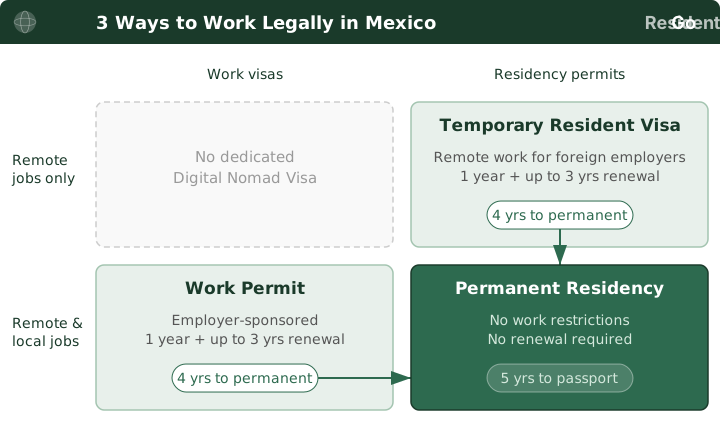
Mexico has no dedicated Digital Nomad Visa. If you want a formal digital nomad program, Colombia (from ~USD 1,300/month), Brazil (from USD 1,500/month), and Costa Rica (USD 3,000/month) all offer one. If you work remotely for foreign clients and want to stay beyond 180 days, you need a Temporary Resident Visa under the economic solvency category. If a Mexican company is hiring you, the employer applies for a work permit through the Instituto Nacional de Migración (INM), and you receive a Temporary Resident Visa with work authorization. Both tracks lead to permanent residency after four consecutive years.
Comparing Work Visas in Detail
| Temporary Resident Visa | Employer-Sponsored Work Permit | |
|---|---|---|
| For | Remote workers and freelancers | Local employment |
| Legal basis | Ley de Migración, Art. 52 (VII) | Ley de Migración, Art. 52 (VII) + INM work authorization |
| Who qualifies | Anyone meeting income/savings threshold | Anyone with a job offer from a registered employer |
| Key requirement | ~USD 3,700/month income or ~USD 73,000 savings | Employer registered with INM; no qualified local candidate |
| Duration | 1 year + up to 3 yrs renewal | 1 year + up to 3 yrs renewal |
| Processing time | 1–10 days (consulate) + 2–3 weeks (INM card) | 4–8 weeks |
| Government fees | ~USD 56 (consulate) + ~USD 600 (INM card) | ~USD 56 (consulate) + ~USD 600 (INM card) + ~USD 235 (work authorization) |
| Remote work for foreign employer | Yes | Yes |
| Work for Mexican companies | No | Yes, sponsoring employer only |
| Change employer | - | Requires new authorization |
| Open bank account | Yes | Yes |
| Include dependents | Yes (additional ~USD 1,400/month per dependent) | Yes (separate application) |
| Path to permanent residency | Yes, after 4 years | Yes, after 4 years |
*Income and savings thresholds are based on multiples of the UMA (Unidad de Medida y Actualización) and vary slightly by consulate. Amounts shown are approximate 2025/2026 figures in USD.*
Mexico Temporary Resident Visa
Mexico's Temporary Resident Visa (Residente Temporal) under the economic solvency category is the closest equivalent to a Digital Nomad Visa. You can live anywhere in Mexico and work remotely for foreign clients or employers for up to four years, with full access to banking and the public healthcare system. Unlike most digital nomad programs in Latin America, this visa builds toward permanent residency: after four consecutive years, you can convert to Residente Permanente. Chile offers a similar residency path in two years, and Ecuador's Digital Nomad Visa uniquely counts toward permanent residency after 21 months.
Documents required
- Bank statements (6 months) proving monthly income of approximately USD 3,700 after tax, or bank statements (12 months) showing a minimum balance of approximately USD 73,000. Thresholds increase by roughly USD 1,400/month per dependent.
- Valid passport with at least 6 months' validity
- Completed visa application form and passport-sized photo
- Proof of legal residence in the country where you are applying (if not a citizen of that country)
Process
You must apply at a Mexican consulate or embassy outside of Mexico. The process starts with booking an appointment (wait times vary from days to weeks depending on the consulate), attending an in-person interview, and submitting financial documentation. Most consulates issue the visa within 1 to 10 business days. Once you enter Mexico, you have 30 days to visit an INM office to exchange the visa sticker for a Temporary Resident card, which involves biometrics and paying the card fee of approximately MXN 11,141 (~USD 600).
You cannot switch from a tourist entry to a Temporary Resident Visa from inside Mexico. If you are already in the country on a tourist permit, you must leave, apply at a consulate abroad, and re-enter with the approved visa.
Tax treatment
Temporary residents who spend 183 or more days per calendar year in Mexico become tax residents and owe Mexican income tax on worldwide income. See the tax section below for rates and implications.
Employer-Sponsored Work Permit
The employer drives the process. The Mexican company must hold a valid Constancia de Inscripción de Empleador (Employer Registration Certificate) with INM and demonstrate that the role could not be filled by a Mexican candidate. Mexico does not impose a hard cap on the number of foreign workers per company, but INM reviews each application individually. The resulting visa is a Temporary Resident Visa with work authorization, valid for one year and renewable for up to three additional years.
Documents required
- Signed employment contract specifying role, salary, and duration
- Employer's INM registration certificate (Constancia de Inscripción de Empleador)
- INM authorization letter with NUT (Número Único de Trámite)
- Valid passport with at least 6 months' validity
- Certified copies of educational and professional qualifications
- Criminal background check from home country
- Passport-sized photo and completed visa application form
Process
The employer submits the work permit application to INM, which reviews and issues an authorization letter (NUT). The employee then takes this letter to a Mexican consulate in their home country to obtain the visa. After entering Mexico, the employee registers at a local INM office within 30 days to receive the Temporary Resident card with work authorization. Total processing time is typically 4 to 8 weeks from the employer's initial submission to the employee holding the card.
Work permits are tied to a specific employer and role. Changing jobs requires the new employer to file a fresh work authorization application. For short-term assignments under 180 days, a Visitor Visa with permission for paid activities may be a faster alternative.
Tax treatment
Work permit holders are employed locally and subject to progressive Mexican income tax on their salary. IMSS social security contributions are withheld at source. See the tax section below for brackets and rates.
For long-term residency pathways, see our Mexico Residency Guide.
Taxes and Health Insurance
Mexico uses a worldwide tax system for residents. If you spend 183 or more days in a calendar year in Mexico, or if your center of vital interests is in Mexico, you are a tax resident and owe income tax on all income regardless of where it is earned. This is a critical difference from countries like Panama, Paraguay, and Costa Rica, which use territorial systems that exempt foreign income entirely.
Progressive income tax rates (ISR) for residents range from 1.92% to 35%. Key thresholds in approximate USD: the first ~USD 450/year is taxed at 1.92%, rates rise through several brackets, and income above ~USD 195,000/year is taxed at 35%. The most relevant bracket for typical salaries: income between ~USD 4,200 and ~USD 12,000/year is taxed at around 17% to 21%, and income between ~USD 12,000 and ~USD 42,000/year at approximately 21% to 30%.
Social security contributions (IMSS) are mandatory for locally employed workers. Employees contribute approximately 2.8% of their salary, while employers contribute between 25% and 38%, depending on the company's risk classification. These contributions cover healthcare, disability, pensions, and retirement savings. Employers also pay 5% of salary to the national housing fund (INFONAVIT) and a state payroll tax of 1% to 3% depending on location.
Mexico has double taxation treaties with more than 60 countries, including the United States, Canada, Germany, the United Kingdom, Spain, France, and Japan. US citizens can use the Foreign Earned Income Exclusion (approximately USD 130,000 for 2026) and/or the Foreign Tax Credit to offset double taxation. The US-Mexico treaty provides reduced withholding rates on dividends, interest, and royalties.
Temporary Resident Visa holders (remote workers) who do not work for a Mexican employer are not enrolled in IMSS through payroll. They may still access public health services through voluntary IMSS enrollment (~MXN 14,000 to 16,000/year depending on age, approximately USD 770 to 875) or purchase private insurance, which typically costs USD 100 to 300/month. Private insurance is not legally required for the Temporary Resident Visa but is strongly recommended.
Regardless of visa type, tax obligations in your home country may still apply. Holding a Mexican visa does not automatically end tax residency elsewhere.
Starting a Business in Mexico
Neither the Temporary Resident Visa (economic solvency) nor the employer-sponsored work permit allows you to run a local business. The Temporary Resident Visa restricts work to foreign clients, and the work permit ties you to a single employer. To operate a Mexican business day-to-day, you need either a Temporary Resident Visa with work authorization (sponsored by your own company) or permanent residency.
The most common path for foreign entrepreneurs is to incorporate a company first, then have that company sponsor your work authorization through INM. Mexico's two main business structures are the Sociedad Anónima (S.A. de C.V.) and the Sociedad de Responsabilidad Limitada (S. de R.L. de C.V.). There is no minimum capital requirement, and incorporation can be completed within 2 to 4 weeks through a Mexican notary. A foreigner can own 100% of a Mexican company in most sectors, though restricted industries (broadcasting, land transport, certain agriculture) have foreign ownership limits.
Incorporating a company does not require residency. Any foreigner can form a Mexican entity. But to actually work in or manage the business, you need a visa with local work authorization. For a detailed breakdown of residency categories, see our Mexico Residency Guide.
Tourist Visa and Work Rights
Most nationalities enter Mexico visa-free for up to 180 days, the longest tourist entry in Latin America. No paid work of any kind is legally permitted on a tourist entry, including remote work for a foreign employer.
Enforcement against remote workers operating from laptops has historically been minimal, and Mexico's large digital nomad communities in Mexico City, Playa del Carmen, and Oaxaca are built primarily on people using tourist entries. The Temporary Resident Visa exists for those who want to formalize their status, but at roughly USD 3,700/month in provable income and a mandatory consular application from outside Mexico, the barrier is significantly higher than most Latin American digital nomad programs.
Frequently Asked Questions (FAQ)
🛂 Visa & Legal
Can US citizens work in Mexico?
Yes. US citizens can enter visa-free for 180 days but cannot work on a tourist entry. For remote work beyond 180 days, apply for a Temporary Resident Visa at a Mexican consulate. For local employment, the Mexican employer sponsors a work permit through INM. The US-Mexico double taxation treaty helps prevent being taxed twice on the same income.
Can I work in Mexico on a tourist visa?
No. The 180-day tourist entry does not authorize any form of paid work, including remote work for a foreign employer. For stays under 180 days, many remote workers use the tourist entry in practice. For longer or legally formalized stays, the Temporary Resident Visa is the correct path.
Can freelancers work legally in Mexico?
Yes, if serving international clients. Freelancers qualify for the Temporary Resident Visa by demonstrating approximately USD 3,700/month in income or USD 73,000 in savings. Freelancers who bill Mexican clients need a Temporary Resident Visa with work authorization and must register with Mexico's tax authority (SAT) for local tax obligations.
How long does it take to get a work visa in Mexico?
The Temporary Resident Visa for remote workers processes in 1 to 10 business days at the consulate, plus 2 to 3 weeks for the INM card upon arrival. Employer-sponsored work permits take 4 to 8 weeks in total. Wait times for consular appointments can add several weeks depending on location and season.
Can I switch from a tourist visa to a work visa inside Mexico?
No. Mexico does not allow in-country changes from tourist status to temporary residency. You must leave Mexico, apply at a Mexican consulate in your home country (or country of residence), and re-enter with the approved visa. The only exceptions are applications under family unity rules or humanitarian grounds.
Can I include my family in a Mexico work visa application?
Yes. For the Temporary Resident Visa, each dependent increases the income threshold by approximately USD 1,400/month. Dependents can include a spouse and minor children. For employer-sponsored work permits, dependents apply separately for their own Temporary Resident Visa under family unity provisions, which comes with a 50% fee discount.
What types of jobs qualify for a Mexico work permit?
Most jobs qualify, provided the employer can demonstrate the role cannot be filled by a Mexican candidate. There is no formal restricted professions list as in some Latin American countries, though certain regulated professions (medicine, law, notary services) require Mexican credentials or licensing. The employer must hold a valid INM registration to sponsor foreign workers.
Can I work remotely in Mexico without a work visa?
Legally, no. Even remote work for a foreign employer is not authorized on a tourist entry. In practice, enforcement for laptop-based remote work is minimal during the 180-day tourist period. For stays beyond 180 days, the Temporary Resident Visa formalizes your status and provides access to banking, healthcare, and a path to permanent residency.
What visa should I use for remote work in Mexico?
The Temporary Resident Visa under economic solvency. Mexico has no dedicated Digital Nomad Visa. The Temporary Resident Visa allows you to live in Mexico for up to four years while working remotely for foreign clients or employers. It requires proving approximately USD 3,700/month in income and must be applied for at a consulate outside Mexico.
💰 Money & Tax
What is the average salary in Mexico?
The average salary is approximately USD 1,450/month (~USD 17,400/year). Mexico's general minimum wage is MXN 315/day (~USD 480/month), rising to MXN 441/day (~USD 725/month) in the northern border zone. Software developers employed locally earn roughly USD 25,000 to 57,000/year depending on seniority and location, with Mexico City and Monterrey paying the highest rates.
Does Mexico tax foreign income?
Yes, if you are a tax resident. Mexico uses a worldwide tax system: residents (183+ days per year or center of vital interests in Mexico) pay income tax on all income regardless of source. Progressive rates range from 1.92% to 35%. Non-residents pay tax only on Mexican-source income. This makes Mexico unusual among Latin American countries, most of which use territorial systems that exempt foreign earnings.
How much does it cost to apply for a Mexico work visa?
The consular visa fee is USD 56. The INM card fee for one year of temporary residency is approximately MXN 11,141 (~USD 600). Work authorization adds approximately MXN 4,341 (~USD 235). Total government fees for a first-year employer-sponsored work permit are approximately USD 890. Renewal fees for a 3-year extension run approximately MXN 21,143 (~USD 1,150). Additional costs for apostilles, certified translations, and legal assistance are separate.
🏠 Practical
Do I need to speak Spanish to work in Mexico?
Not for remote work. English is widely understood in digital nomad hubs like Mexico City (Roma, Condesa), Playa del Carmen, and San Miguel de Allende. For local employment, most employers expect professional Spanish, especially outside multinational companies. All immigration documents are submitted in Spanish.
Is health insurance mandatory for work visa holders in Mexico?
Not legally required for the Temporary Resident Visa (unlike many Digital Nomad Visa programs). However, temporary residents can voluntarily enroll in IMSS public healthcare for approximately USD 770 to 875/year. For work permit holders employed locally, IMSS enrollment is mandatory and funded through employer and employee contributions. Private insurance (USD 100 to 300/month) is recommended for faster access and broader provider networks.
Is the internet fast enough for remote work?
Yes, in urban areas. Mexico's median fixed broadband speed is approximately 83 Mbps nationally, with fiber plans in Mexico City, Guadalajara, and Monterrey reaching 150+ Mbps through providers like Totalplay and Telmex. Coworking spaces are widely available in major cities. Rural areas and smaller beach towns can be significantly slower, though Starlink coverage is expanding rapidly across Mexico.
Compare all 12 countries in our Working Abroad Guide. Looking for residency instead? See our Latin America Residency Guide.