Colombia stands out among Latin American residency destinations because its visa thresholds are pegged to the national minimum wage (SMMLV), which is adjusted every January. The 23 % increase in the 2026 SMMLV to COP 1,750,905 pushed all income and investment requirements upward overnight, meaning that eligibility numbers published even one year earlier may already be outdated. Unlike countries with fixed-dollar thresholds, applicants planning a move to Colombia must track local economic policy in addition to immigration law.
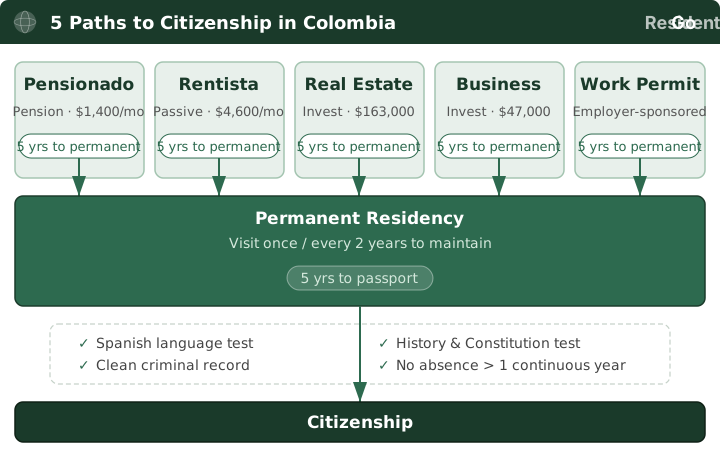
Colombia Residencies Overview
| Residency Path | Exists | Minimum Requirement | Duration | Leads to Permanent Residency | Key Insight |
|---|---|---|---|---|---|
| Pensionado | Yes | 3 SMMLV / month pension (~USD 1,400) | Up to 3 years | Yes | No age requirement; pension must be lifetime |
| Rentista | Yes | 10 SMMLV / month passive income (~USD 4,600) | Up to 3 years | Yes | High threshold; employment income does not qualify |
| Inversionista (Real Estate) | Yes | 350 SMMLV investment (~USD 163,000) | Up to 3 years | Yes | Property value must still meet threshold at renewal |
| Inversionista (Business) | Yes | 100 SMMLV investment (~USD 47,000) | Up to 3 years | Yes | Requires registered Colombian company |
| Work Permit | Yes | Employer-sponsored | Up to 3 years | Yes | No profession restrictions |
| Asset-based | No | — | — | — | Not available |
| Digital Nomad | Yes | 3 SMMLV / month income (~USD 1,400) | Up to 2 years | No | Visitor (V) visa; does not count toward PR |
*Thresholds shown as of January 2026 based on the 2026 SMMLV of COP 1,750,905. USD equivalents are approximate and fluctuate with the exchange rate. All visa thresholds are legally defined in COP, not USD.*
Step-by-Step Guide from Resident to Passport
Prepare documents in your home country
The following documents must be obtained in your home country before applying for a Colombian visa:
- Valid passport with at least six months of remaining validity
- Police clearance certificate from your country of residence for the past three years
- Birth certificate
- Marriage certificate (if applicable)
- Medical certificate confirming psychophysical fitness
- Health insurance policy valid in Colombia covering accident, illness, maternity, disability, hospitalization, death, and repatriation for at least one year
- Residency-specific proof of eligibility (pension certification, passive income proof, investment documentation, or company registration)
All foreign documents must be apostilled in the country of origin and, if not in Spanish, officially translated by a certified translator recognized in Colombia. The pension certification, for example, must be issued by the paying authority, include the monthly amount, and confirm that the benefit is permanent and ongoing.
Submit the visa application online
Since the 2022 reform (Resolution 5477), Colombia processes visa applications primarily through the online portal of the Ministry of Foreign Affairs (Cancillería). The process includes:
- Creating an account on the Cancillería visa portal and completing the electronic application form
- Uploading all required documents in the specified format
- Paying the visa study fee (approximately USD 55)
Applications can also be submitted through Colombian consulates abroad.
Application review and processing
After the application is submitted, the Cancillería reviews the documentation and verifies eligibility. During this period:
- The Cancillería has up to 30 calendar days to process a visa application, though in practice many decisions are issued within 5 to 15 business days
- The ministry may request additional or corrected documents at any point during the review
- No interview or in-person appearance is required during the review phase
There is no way to expedite the process. The applicant can monitor the status through the online portal.
Visa approval and initial residency
Once the visa is approved, the applicant must complete the following steps to finalize their legal status in Colombia:
- Pay the visa issuance fee (approximately USD 177 to USD 270 depending on the visa category)
- Download the electronic visa (e-visa) from the portal
- Register with Migración Colombia and obtain a Cédula de Extranjería (foreigner identity card) within 15 calendar days of arrival or visa issuance if already in-country
The Cédula de Extranjería is the primary identification document for all administrative, banking, and legal interactions in Colombia. Without it, tasks such as opening a bank account, signing a lease, or registering investment with the Banco de la República are typically impossible.
Renewals and transition to permanent residency
M visas are issued for up to three years and must be renewed before expiration. Maintaining valid residency and progressing toward permanent residency requires ongoing compliance:
- Renew the visa before expiration, typically every one to three years
- Continue meeting the financial requirements of your visa category at all times
- Remain in Colombia for at least 180 days within any 365-day period (absence of more than six consecutive months invalidates the visa)
Because visa thresholds are tied to the SMMLV, the minimum income or investment requirement can increase each January even if your personal financial situation has not changed. Applicants with income or investments close to the threshold should plan for annual increases.
After holding an M visa continuously, applicants may apply for a Resident (R) visa. The required timeframe depends on the visa category:
- Apply for permanent residency after five years of continuous M visa status (for most categories including pensionado, rentista, and investment visas)
- Apply after three years if holding a marriage or partner visa with a Colombian national
- Apply after two years if holding a parent visa (parent of a Colombian national by birth)
The R visa is valid for five years and must be updated upon expiration, but the underlying permanent residency status does not expire as long as the holder does not remain outside Colombia for more than two consecutive years. R visa holders have no income or investment requirements and can work, invest, and operate businesses freely.
Path to citizenship
Colombian citizenship through naturalization is available after a period of continuous residence on an R visa. The required residency period varies:
- Hold an R visa and reside continuously in Colombia for five years (for most non-Latin American, non-Caribbean, non-Spanish foreigners)
- Two years of continuous residence on an R visa if married to a Colombian national, in a recognized domestic partnership with a Colombian, or if you have Colombian children
- One year of continuous residence on an R visa for nationals of Latin American and Caribbean countries
- Pass an exam on Colombian history, geography, and the Constitution
- Demonstrate Spanish language proficiency (applicants over 65 are exempt from the knowledge exam)
- Maintain a clean criminal record in Colombia
- Submit a naturalization application to the Ministry of Foreign Affairs
Colombia allows dual citizenship. Obtaining a Colombian passport does not require renouncing your existing nationality. The naturalization process, including review and oath, typically takes six to twelve months after application submission.
Overview of Colombia Visas
Residencies that are based on Working Permits or Working visas are described in detail here:
→ Working Visas in Colombia
Colombia organizes its immigration system into three visa categories: Visitor (V) for temporary stays, Migrant (M) for long-term residency, and Resident (R) for permanent status. The most relevant pathways for financially independent individuals are outlined below. All M visas are valid for up to three years, require renewal, and can lead to permanent residency after five years.
Pensionado Visa (M-11 – Retiree Residency)
The Pensionado visa is designed for retirees who receive a lifetime pension of at least three times the Colombian minimum wage (3 SMMLV). As of 2026, this threshold is COP 5,252,715 per month, approximately USD 1,400 - comparable to Ecuador's Pensionado at $1,446/mo. There is no age requirement. The pension must be permanent and issued by a recognized public or private pension authority.
Proof typically requires:
- Official pension certification issued by the paying entity (government agency or private pension fund), apostilled and translated, confirming the monthly amount and that the pension is permanent and ongoing
- The certification must not be older than 90 days at the time of application
- Police clearance certificate from the country of residence for the past three years, apostilled and translated
- Medical certificate confirming psychophysical fitness, issued by a certified physician
- Health insurance policy valid in Colombia covering all risks including repatriation, with at least one year of validity
Rentista Visa (V – Passive Income)
The Rentista visa targets financially independent individuals who receive stable, recurring passive income of at least ten times the Colombian minimum wage (10 SMMLV) per month. As of 2026, this is COP 17,509,050 per month, approximately USD 4,600. Employment income does not qualify. Acceptable sources include investment returns, rental income, dividends, and royalties. Note: Since Resolution 5477 (October 2022), the Rentista visa is classified as Visitor (V), not Migrant (M). Time on a V visa does not count toward permanent residency.
Proof typically requires:
- Certification from a recognized public entity or private company confirming the monthly income amount, source, and ongoing nature of the payments
- Bank statements or financial documentation demonstrating that income has been received consistently, typically covering the previous three to six months
- Documentation proving the income is passive and not derived from employment or labor services
- All supporting documents apostilled and translated into Spanish
Inversionista Visa – Real Estate Investment (M-10)
Residency by real estate investment requires a property investment of at least 350 SMMLV. As of 2026, this is COP 612,816,750, approximately USD 163,000. The investment must be registered with the Banco de la República.
Proof typically requires:
- Public deed (escritura pública) or certificate of property ownership (certificado de tradición y libertad) confirming the real estate investment
- Registration of foreign investment with the Banco de la República (Formulario 4)
- Evidence that the property value meets or exceeds the 350 SMMLV threshold at the time of application or renewal
- Purchase contract, appraisal, or commercial valuation showing the investment amount
Inversionista Visa – Business Investment (M-6)
Residency through business investment requires a capital contribution of at least 100 SMMLV in a Colombian company. As of 2026, this is COP 175,090,500, approximately USD 47,000. The company must be legally registered with the Colombian Chamber of Commerce.
Proof typically requires:
- Certificate of existence and legal representation (Certificado de Existencia y Representación Legal) from the Chamber of Commerce
- Registration of foreign investment with the Banco de la República
- Financial statements of the company demonstrating the investment amount
- Proof that the company is active and in good standing
Digital Nomad Visa (V – Visitor Category)
Colombia offers a Digital Nomad visa under the Visitor (V) category for remote workers employed by or contracting with foreign companies. It requires monthly income of at least 3 SMMLV, approximately USD 1,400 as of 2026. The visa is valid for up to two years but does not grant a path to permanent residency and does not count toward the accumulated time required for an R visa.
Proof typically requires:
- Employment contract or freelance agreements with foreign entities
- Bank statements or income certification demonstrating monthly earnings of at least 3 SMMLV over the previous six months
- Evidence of remote work history (at least six months of verifiable activity)
- Health insurance valid in Colombia with repatriation coverage
Tax Residency Considerations in Colombia
From a tax perspective, Colombia is often considered by individuals who want to establish a long-term base in Latin America while managing their global tax exposure. However, unlike countries with territorial tax systems (such as Costa Rica or Panama), Colombia applies worldwide taxation to its tax residents. This distinction is critical for anyone with income or assets outside Colombia.
- Tax residency trigger: Tax residency in Colombia is triggered by physical presence of 183 days or more within any rolling 365-day period, regardless of visa type or immigration status
- Day counting: The 183-day count includes days of entry and exit, does not need to be consecutive, and can span two calendar years
- Worldwide taxation: Tax residents are taxed on worldwide income, including income earned abroad, foreign rental income, and international investment returns
- Non-resident taxation: Non-residents (fewer than 183 days) are taxed only on income sourced within Colombia, typically at a flat rate of 35 %
- Immigration vs. tax residency: Immigration residency (M or R visa) and tax residency are separate concepts; holding a visa does not automatically create or prevent tax residency
- Double taxation treaties: Colombia has double taxation treaties with over 20 countries including Spain, France, the United Kingdom, Canada, Mexico, and Chile, but not with the United States
- Wealth tax: A wealth tax applies to individuals whose net assets exceed approximately COP 3.77 billion (72,000 UVT for 2026), though the threshold and rates may change under pending legislation
Income generated within Colombia or worldwide income for tax residents is subject to progressive personal income tax, with marginal rates currently ranging from 0 % to 39 %. For the highest-income taxpayers, the effective top rate reaches 39 % on income above approximately COP 1.54 billion. Tax brackets are defined in UVT (Unidades de Valor Tributario), a unit adjusted annually for inflation. Non-residents earning Colombian-source income face a flat withholding rate, typically 20 % for labor income or 35 % for other income types.
Residency Status Comparison
| Status | Typical Duration | Status Renewal | Identification | Minimum Presence to Maintain Status | Counts Toward Citizenship |
|---|---|---|---|---|---|
| Tourist | 90 days (extendable to 180) | Via new entry or extension | Passport | None | No |
| Visitor (V) Visa | Up to 2 years | Via new application | Cédula de Extranjería | Varies by category | No |
| Migrant (M) Visa | Up to 3 years (renewable) | Via renewal application | Cédula de Extranjería | 180 days per year / no absence > 6 months | No (but counts toward R visa eligibility) |
| Resident (R) Visa | 5 years (renewable) | Via renewal every 5 years | Cédula de Extranjería | Must not be absent > 2 consecutive years | Yes |
| Citizenship | Permanent | Not needed | Cédula de Ciudadanía / Passport | None | — |
Minimum Wage Indexing and Visa Thresholds
A property or pension that qualifies for your visa today may not qualify at renewal. Colombia indexes every visa financial threshold to the national minimum wage (SMMLV), renegotiated each December. The 2026 SMMLV rose 23% in a single adjustment, automatically raising every requirement by the same proportion.
At renewal, the Cancillería checks your eligibility against the current SMMLV, not the value when your visa was granted. Build in a buffer well above the published minimums to absorb future increases and COP exchange rate fluctuations.
Mandatory Health Affiliation After Visa Approval
You must enroll in Colombia's public health system (EPS) and pay monthly contributions once your visa and Cédula are issued, even if you already carry international private insurance. These are separate obligations: the Cancillería requires international coverage to approve the visa, but Colombian law independently requires EPS enrollment as a condition of residency. Proof of EPS affiliation may be checked at renewal.
Most expats declaring minimum income pay roughly COP 87,500 per month (12.5% of 40% of one minimum wage). EPS covers primary care, hospitalization, medications, and emergencies, but with public-system wait times. Most residents add private coverage (medicina prepagada), which requires active EPS enrollment as a prerequisite.
Cancillería Discretion and Visa Denials
Meeting every published requirement does not guarantee approval. The Cancillería holds explicit discretionary power to reject any application without disclosing reasons, and since mid-2024 applicants across all categories have reported more unexplained refusals. A formal denial triggers a six-month waiting period before reapplication and, if you are already in Colombia, a 30-day safe-conduct to leave.
Documenting finances well above the minimum threshold, ensuring every document is correctly apostilled and translated, and providing clear evidence of a genuine connection to Colombia all reduce exposure. Submitting at the bare minimum, in documentation quality or financial proof, increases the risk of an unexplained refusal. Anyone planning a move around a specific timeline should account for the possibility of at least one rejection cycle.
Frequently Asked Questions
✅ Eligibility
What is the most common residency path for expats in Colombia?
The most popular options are the Pensionado (retiree) visa requiring a lifetime pension of at least 3 SMMLV (~USD 1,400/month) and the Inversionista (real estate) visa requiring a property investment of at least 350 SMMLV (~USD 163,000). Both are Migrant (M) visas valid for up to three years that lead to permanent residency after five years.
Can I include my family in a Colombia residency application?
The article covers individual visa categories (Pensionado, Rentista, Inversionista, Digital Nomad) and mentions marriage and partner visas as a separate path to permanent residency after three years. Spouses married to a Colombian national can apply for their own M visa and qualify for an R visa on a shorter timeline.
What is the minimum income required for Colombia residency?
The lowest income-based threshold is 3 SMMLV per month (~USD 1,400), which applies to both the Pensionado visa (lifetime pension) and the Digital Nomad visa (remote work income). The Rentista visa for passive income holders requires 10 SMMLV per month (~USD 4,600). All thresholds are pegged to Colombia's national minimum wage and can rise each January.
What is the minimum investment amount required for Colombia residency?
Real estate investment requires at least 350 SMMLV (~USD 163,000 as of 2026), while business investment requires at least 100 SMMLV (~USD 47,000) in a registered Colombian company. The property value must still meet the threshold at renewal, and all investments must be registered with the Banco de la República.
📝 Process & Timeline
How much does it cost to apply for Colombia residency?
$230 to $325. The visa study fee is approximately $55 (non-refundable), and the visa issuance fee upon approval ranges from approximately $177 to $270 depending on the visa category. Additional costs for apostilles, certified translations, and legal assistance are separate.
What documents do I need to apply for Colombia residency?
Core documents include a valid passport (at least six months validity), police clearance certificate, birth certificate, medical certificate, and a health insurance policy valid in Colombia with explicit repatriation coverage. You also need residency-specific proof such as pension certification, passive income documentation, or investment registration. All foreign documents must be apostilled and translated into Spanish by a certified translator.
Can I apply for Colombia residency while visiting as a tourist?
Yes. Since the 2022 reform, Colombia processes visa applications primarily through the online portal of the Cancillería, and applications can be submitted from anywhere. If you are already in Colombia when the visa is approved, you must register with Migración Colombia and obtain your Cédula de Extranjería within 15 calendar days.
Do I need to open a bank account in Colombia to apply for residency?
A bank account is not listed as a requirement for the initial visa application. However, the Cédula de Extranjería (issued after visa approval) is needed for banking, signing leases, and registering investments. For investment visas, the foreign investment must be registered with the Banco de la República, which typically requires in-country banking infrastructure.
How long does it take to get temporary residency in Colombia?
The Cancillería has up to 30 calendar days to process a visa application, though in practice many decisions are issued within 5 to 15 business days. There is no way to expedite the process, and the ministry may request additional documents at any point during the review.
How long does it take to get Colombia citizenship?
For most non-Latin American foreigners, the path is five years on an M visa to qualify for the R visa, then five more years of continuous residence on the R visa before applying for citizenship, totaling roughly ten years. The naturalization process itself takes six to twelve months after submission. Shorter timelines apply if you are married to a Colombian national or hold citizenship from a Latin American or Caribbean country. Countries with much faster citizenship paths include Argentina (2 years) and Bolivia (3 years).
🏠 Living in Colombia
Do I need to live in Colombia to maintain residency?
M visa holders must remain in Colombia for at least 180 days within any 365-day period, and a single absence of more than six consecutive months automatically cancels the visa. R visa holders have more flexibility but must not remain outside Colombia for more than two consecutive years.
Can I work in Colombia as a foreign resident?
R visa holders can work, invest, and operate businesses freely in Colombia. The Digital Nomad visa permits remote work for foreign employers but is a Visitor (V) visa that does not lead to permanent residency. The article does not describe open work authorization for M visa holders outside of business investment categories.
Does Colombia tax foreign income?
Yes. Colombia applies worldwide taxation to tax residents, who are defined as individuals physically present for 183 days or more within any rolling 365-day period. Tax residents pay progressive income tax (0% to 39%) on all global income. Non-residents are taxed only on Colombian-source income, typically at a flat rate of 35%.
Is health insurance mandatory for residents in Colombia?
Yes, in two layers. The Cancillería requires international health insurance with repatriation coverage to approve the visa. Separately, Colombian law requires enrollment in the public health system (EPS) once your visa and Cédula are issued, even if you carry private insurance. Most expats declaring minimum income pay roughly COP 87,500 per month for EPS contributions.
Can I have dual citizenship with Colombia?
Yes. Colombia allows dual citizenship, and obtaining a Colombian passport does not require renouncing your existing nationality.