Bolivia is one of the most affordable and least bureaucratically demanding residency destinations in South America. Unlike countries that have developed highly marketed residency categories for retirees or investors, Bolivia uses a single, flexible visa framework — the Specific Purpose Visa (Visa de Objeto Determinado) — that serves as the gateway to both temporary and permanent residency. Combined with a territorial tax system that does not tax foreign-source income and one of the shortest naturalization timelines in the region at three years, Bolivia offers a straightforward and low-cost residency path that is particularly relevant for cost-conscious individuals and those who prioritize simplicity over program prestige. The only comparable low-barrier option in the region is Paraguay, which requires no income proof at all for temporary residency.
Bolivia Residencies Overview
| Residency Path | Exists | Minimum Requirement | Duration | Leads to Permanent Residency | Key Insight |
|---|---|---|---|---|---|
| Pensionado | No | — | — | — | No formal retiree visa |
| Rentista | No | — | — | — | No passive income visa |
| Inversionista | Yes | No fixed minimum (must be verifiable) | Temporary (1–2 years) | Yes | Via Specific Purpose Visa |
| Asset-based | No | — | — | — | No solvency-only option |
| Digital Nomad | No | — | — | — | No digital nomad framework |
| Specific Purpose Visa | Yes | ~USD 300 / month solvency | Temporary (1–2 years) | Yes | Single gateway to all residency |
| Work-based Residency | Yes | Employment contract in Bolivia | Temporary (1–2 years) | Yes | Requires approved contract |
| Family-based Residency | Yes | Marriage or children in Bolivia | Temporary (1–2 years) | Yes | Accelerated citizenship path |
*Indicative minimum thresholds shown as of 2026. Interpretation and documentation standards may vary.*
Step-by-Step Guide from Resident to Passport
Prepare documents in your home country
The following documents must be obtained in your home country before traveling to Bolivia:
- Birth certificate
- Police clearance certificate (from your country of origin or the country where you have lived for the last six months)
- Medical certificate (including proof of yellow fever vaccination if applicable)
- Marriage certificate (if applicable)
- Birth certificates and police clearance of spouse and children (if applicable)
- Proof of financial solvency (such as bank statements demonstrating at least USD 300 per month in available funds)
- Documentation supporting the purpose of your stay (such as a work contract, business registration, or proof of retirement income)
All official documents must be apostilled in the country of origin under the Hague Convention and translated into Spanish by a certified translator. In practice, translations are often completed or certified in Bolivia through a sworn translator recognized by local authorities. Documents older than three months may not be accepted by Bolivian immigration.
Enter Bolivia and file the application
Once all documents are prepared and the Specific Purpose Visa has been obtained, the residency application must be filed in person at the Dirección General de Migración (General Directorate of Migration) within 30 days of entering Bolivia, which includes:
- Submitting the full application at the immigration office in La Paz, Cochabamba, or Santa Cruz
- Paying government filing fees (approximately BOB 1,350 for a one-year residency or BOB 3,920 for a two-year residency)
- Obtaining a local INTERPOL clearance certificate and a FELCC (police) background check
- Completing a domicile registration (registro domiciliario), which includes a home inspection by authorities
- Undergoing a general medical examination, including blood tests
All applications are processed in Spanish. Officials will provide a list of requirements (lista de requisitos) that must be completed locally before the application can be finalized. Many applicants choose to work with a local lawyer to prepare the required memorial (formal written legal request), which is a standard part of the Bolivian application procedure.
Application review and waiting period
After filing, the application enters a review phase with the following steps:
- Wait for the application to be reviewed by Bolivian immigration
- Provide additional documents or clarifications if requested
- Attend follow-up appointments at the immigration office if required
During this period, applications are reviewed administratively and may take several weeks to process. In La Paz, the process for obtaining the foreigner’s identity card (Cédula de Extranjeros) typically takes around eight working days after approval, though timelines may be longer in other cities.
Temporary residency approval
Once the application is approved, temporary residency is granted and must be completed with local registration steps.
- Obtain the Cédula de Extranjeros (foreigner’s identity card) from the National Identification Service (SEGIP)
- Register your address with the local FELCC
- Comply with ongoing residency conditions, including physical presence requirements
Temporary residency is granted for one or two years depending on the initial application. The Cédula de Extranjeros functions as a national identification document and grants access to local banking, healthcare, and other services on the same terms as Bolivian citizens. There is a limited time window after residency approval to apply for the Cédula before a late fee is imposed.
Renewals and transition to permanent residency
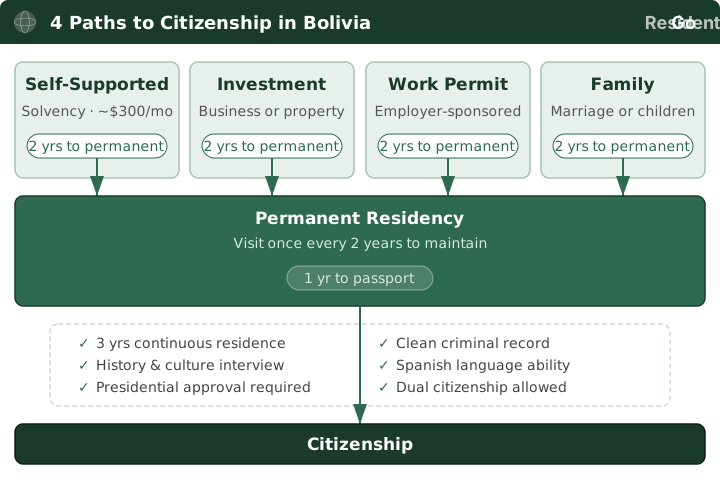
Temporary residency in Bolivia can be renewed, and after two years of continuous temporary residency, applicants become eligible to apply for permanent residency (residencia definitiva).
- Renew temporary residency before each expiration if the two-year threshold has not yet been reached
- Maintain uninterrupted residency status with no absence exceeding 90 consecutive days
- Apply for permanent residency after two years of continuous legal temporary residence
The permanent residency application costs approximately USD 560 (BOB 3,920) and requires updated documentation, including a new police clearance and medical certificate. Once permanent residency is granted, the absence restriction becomes more flexible: permanent residents may leave Bolivia for up to two consecutive years without losing their status.
Path to citizenship
Bolivian citizenship can be obtained through naturalization after continuous legal residency. Under the 2009 Constitution (Article 142), this means:
- Maintain legal residency in Bolivia for at least three uninterrupted years under state supervision
- Formally express the desire to obtain Bolivian nationality through a written application
- Demonstrate good conduct, including a clean criminal record
- Submit a separate naturalization application to the General Directorate of Migration, which is approved by resolution of the President of Bolivia
The three-year residency requirement is reduced to two years for individuals who are married to a Bolivian citizen, have Bolivian children, were adopted by Bolivian parents, or have performed military service in Bolivia. Bolivia’s 2009 Constitution explicitly permits dual citizenship: foreigners who acquire Bolivian nationality are not required to renounce their original citizenship.
Overview of Bolivia Visas
Residencies that are based on Working Permits or Working visas are described in detail here:
→ Working Visas in Bolivia
Bolivia does not offer the segmented visa categories (Pensionado, Rentista, Inversionista) that are common across Latin America. Instead, all long-term residency applications are channeled through the Specific Purpose Visa (Visa de Objeto Determinado), which serves as the mandatory entry point. Temporary residency can then be granted for one or two years and renewed, with permanent residency available after two years. Bolivian citizenship can be obtained after three years of legal residence.
Specific Purpose Visa (Visa de Objeto Determinado)
The Specific Purpose Visa is the mandatory prerequisite for all residency applications in Bolivia. It is a short-term visa obtained from a Bolivian consulate in the applicant’s home country, valid for 30 days, during which the applicant must enter Bolivia and begin the residency process. It is not possible to apply for residency while on a tourist visa.
Proof typically requires:
- A valid passport with at least six months of remaining validity
- A notarized letter specifying the purpose of the visa (for example: residency application, employment, investment, family reunification)
- Criminal record or background check from the country of origin, apostilled and translated into Spanish
- Medical certificate, including yellow fever vaccination if arriving from an endemic region
- Bank statements or other financial documentation demonstrating solvency (a commonly cited baseline is at least USD 300 per month)
Temporary Residency (Work-based)
Work-based temporary residency is available to foreigners who hold an employment contract with a Bolivian employer. The contract must be approved by the Ministry of Labour before the residency application can proceed. This path is relevant for individuals who have secured formal employment in Bolivia.
Proof typically requires:
- A valid work contract approved by the Bolivian Ministry of Labour
- A letter from the employer confirming the role, salary, and duration of employment
- All standard residency documents (passport, police clearance, medical certificate, apostilled and translated)
- Registration with the Bolivian tax authority (Servicio de Impuestos Nacionales) if applicable
Temporary Residency (Self-supported / Retiree)
Although Bolivia does not have a formal retiree or passive income visa, individuals who can demonstrate sufficient financial means may apply for temporary residency through the Specific Purpose Visa framework. Retirees, pensioners, and self-supported individuals can use bank statements or pension income documentation to prove solvency. The commonly cited minimum threshold is approximately USD 300 per month, though higher amounts improve the strength of the application.
Proof typically requires:
- Bank statements demonstrating sufficient funds or regular income to support the applicant’s stay in Bolivia
- Pension statements or letters from a pension provider (if applicable), showing ongoing retirement income
- A formal legal request (memorial) prepared by a Bolivian lawyer, specifying the purpose of the residency application
- All standard residency documents (passport, police clearance, medical certificate, apostilled and translated)
Temporary Residency (Investment / Business)
Bolivia does not offer a dedicated investment visa or golden visa program. However, foreigners who invest in Bolivian businesses, purchase qualifying real estate, or establish a company in Bolivia can use these activities as the basis for a temporary residency application under the Specific Purpose Visa framework. There is no fixed minimum investment amount defined by law, but the investment must be verifiable and genuine.
Proof typically requires:
- Ownership documentation for a Bolivian company or evidence of business registration
- Property title or purchase contracts for real estate investments (note: foreigners cannot purchase property within 50 km of Bolivia’s international borders or in rural areas)
- Evidence that the investment is operational and maintained, such as financial statements, employee records, or shareholder meeting minutes
- All standard residency documents (passport, police clearance, medical certificate, apostilled and translated)
Tax Residency Considerations in Bolivia
From a tax perspective, Bolivia may be considered by individuals who earn income abroad and want to avoid worldwide taxation on foreign-source income. Bolivia applies a strict territorial (source-based) tax system for income tax purposes, meaning only income generated within Bolivian territory is subject to personal income tax.
However, tax outcomes depend on personal circumstances, and the following points help assess this in practice:
- Bolivia applies a territorial tax system: only Bolivian-source income is subject to personal income tax (RC-IVA) - the same approach used by Paraguay, Panama, and Costa Rica
- Foreign-source income, including pensions, dividends, interest, and rental income earned abroad, is not subject to Bolivian income tax
- The personal income tax rate (RC-IVA) is a flat 13% on Bolivian-source income, with no progressive brackets
- Immigration residency and tax residency are separate concepts; holding residency does not automatically create a full tax obligation on worldwide income for income tax purposes
- Bolivia does impose a wealth tax (Impuesto a las Grandes Fortunas, IGF) on individuals with net wealth exceeding BOB 30 million (approximately USD 4.3 million), with progressive rates between 1.4% and 2.4%, and this wealth tax considers worldwide assets for individuals who are present in Bolivia for more than 183 days in a 12-month period
- There is a gift and inheritance tax in Bolivia, with rates of 1%, 10%, or 20% depending on the recipient’s relationship to the donor or deceased
Income generated within Bolivia is subject to a flat personal income tax (RC-IVA) of 13%. This rate applies to employment income, investment income from Bolivian sources, and other locally generated income. Employees can offset some of this through a basic consumption allowance and invoice-based deductions. Non-residents who earn Bolivian-source income, such as dividends or interest, are subject to a withholding tax of 12.5% on remitted amounts. Tax rates and thresholds are subject to change.
Residency Status Comparison
| Status | Typical Duration | Status Renewal | Identification | Minimum Presence to Maintain Status | Counts Toward Citizenship |
|---|---|---|---|---|---|
| Tourist | Up to 90 days per year | Via re-entering | Passport | None | No |
| Temporary Residency | 1–2 years (renewable) | Via application | Cédula de Extranjeros | No absence exceeding 90 consecutive days | Yes |
| Permanent Residency | Indefinite (conditional) | Not required | Cédula de Extranjeros | Must not be absent for more than 2 consecutive years | Yes |
| Citizenship | Permanent | Not required | National ID / Passport | None | — |
Dual Citizenship Rules
Bolivia allows dual citizenship. Foreigners who naturalize are not required to renounce their original nationality, and Bolivians who acquire foreign citizenship keep their Bolivian nationality. This is established in the 2009 Constitution (Article 143) and makes Bolivia one of the most permissive countries in the region on this point.
Property Restrictions for Foreigners
Foreigners cannot purchase real estate in rural areas or within 50 kilometers of any international border. These restrictions are constitutional and cannot be circumvented through corporate structures. Urban property in La Paz, Santa Cruz, and Cochabamba is available to foreign buyers, with prices among the lowest in South America.
The Parallel Exchange Rate and Your Income
If you earn in US dollars and spend in bolivianos, the exchange rate you actually receive determines your real purchasing power in Bolivia. Since 2011, the official rate has been fixed at BOB 6.96 per dollar. But Bolivia's foreign currency reserves collapsed after 2014, and by 2025 dollars had become nearly impossible to obtain at the official rate. A parallel market emerged where dollars traded at BOB 14–20 through much of 2025, meaning residents who converted dollars informally received roughly double the official rate in local currency.
Frequently Asked Questions
✅ Eligibility
What is the most common residency path for expats in Bolivia?
The Specific Purpose Visa (Visa de Objeto Determinado) is the single gateway to all residency in Bolivia. It is obtained from a Bolivian consulate before entry and is valid for 30 days, during which you must file your temporary residency application at the Dirección General de Migración.
Can I include my family in a Bolivia residency application?
Yes. Bolivia offers a family-based residency path for those who are married to a Bolivian citizen or have children in Bolivia. Spouses and children require their own apostilled birth certificates and police clearance documents as part of the application.
What is the minimum income required for Bolivia residency?
The commonly cited minimum is approximately USD 300 per month in demonstrable financial solvency, shown through bank statements or pension documentation. Higher amounts strengthen the application.
What is the minimum investment amount required for Bolivia residency?
Bolivia does not have a dedicated investment visa or a fixed minimum investment amount defined by law. However, foreigners who invest in a Bolivian business or purchase qualifying urban real estate can use that as the basis for a temporary residency application under the Specific Purpose Visa framework, provided the investment is verifiable and genuine.
📝 Process & Timeline
How much does it cost to apply for Bolivia residency?
$195 to $565. Government fees are approximately BOB 1,350 (about $195) for a one-year temporary residency, or BOB 3,920 (about $565) for a two-year term. Additional costs for apostilles, certified translations, and legal assistance are separate.
What documents do I need to apply for Bolivia residency?
You need a valid passport (six months remaining validity), birth certificate, police clearance certificate, medical certificate (including yellow fever vaccination if applicable), proof of financial solvency, and documentation supporting your purpose of stay. All documents must be apostilled and translated into Spanish.
Can I apply for Bolivia residency while visiting as a tourist?
No. Bolivia requires a Specific Purpose Visa (Visa de Objeto Determinado) obtained from a Bolivian consulate in your home country before entering. You cannot apply for residency while on a tourist visa.
Do I need to open a bank account in Bolivia to apply for residency?
No, a Bolivian bank account is not required for the residency application. You will need bank statements from your home country to prove financial solvency. However, you can only open a Bolivian bank account after you have received temporary residency and your Cédula de Extranjeros (foreigner's ID card).
How long does it take to get temporary residency in Bolivia?
After filing, the application is reviewed administratively over several weeks. In La Paz, the Cédula de Extranjeros is typically issued within about eight working days after approval, though timelines may be longer in other cities. Total processing depends on the completeness of the initial submission.
How long does it take to get Bolivia citizenship?
Bolivia requires three years of continuous legal residence for naturalization, which is one of the shortest timelines in Latin America. This is reduced to two years for those married to a Bolivian citizen or who have Bolivian children. In practice, the total process from first entry to citizenship typically takes four to six years when accounting for the temporary-to-permanent transition and processing times.
🏠 Living in Bolivia
Do I need to live in Bolivia to maintain residency?
Temporary residents cannot be absent from Bolivia for more than 90 consecutive days without risking loss of status. Permanent residents have more flexibility and may leave for up to two consecutive years. Permanent residency expires if the holder stays outside Bolivia for more than two consecutive years.
Can I work in Bolivia as a foreign resident?
Yes, but you need the Cédula de Extranjeros (foreigner's identity card), which is issued after temporary residency approval. Work-based residency specifically requires an employment contract approved by the Bolivian Ministry of Labour. Those on other residency types may need to adjust their status to add work authorization.
Does Bolivia tax foreign income?
No. Bolivia applies a strict territorial tax system, meaning only income generated within Bolivian territory is subject to personal income tax (RC-IVA at a flat 13%). Foreign-source income, including pensions, dividends, interest, and rental income earned abroad, is not taxed. However, a wealth tax (IGF) applies to individuals with net wealth exceeding BOB 30 million who are present in Bolivia for more than 183 days per year.
Is health insurance mandatory for residents in Bolivia?
Health insurance is not legally mandatory for residents. However, legal residents can access Bolivia's free public Universal Health System (SUS), and employed residents are required to contribute to the social security system (10% of salary). Private insurance is widely recommended due to the limited quality and availability of public healthcare.
Can I have dual citizenship with Bolivia?
Yes. Bolivia's 2009 Constitution (Article 143) explicitly permits dual citizenship. Foreigners who naturalize are not required to renounce their original nationality, and Bolivians who acquire foreign citizenship retain their Bolivian nationality.