Brazil has the lowest income threshold for a Digital Nomad Visa anywhere in Latin America: USD 1,500 per month, or USD 18,000 in savings. That makes it the most accessible entry point for remote workers who want to live legally in the region. The visa processes in 2 to 8 weeks, costs around USD 100 to 150, and covers a full two years. The trade-off is taxation: unlike Costa Rica, Panama, or Paraguay, Brazil taxes worldwide income once you stay longer than 183 days, with rates up to 27.5%. For local employment, the path runs through one of Latin America's most complex labor systems. Employers must get authorization from the Ministry of Justice before you can even apply, and Brazil caps foreign workers at one-third of a company's workforce.
Work Options at a Glance
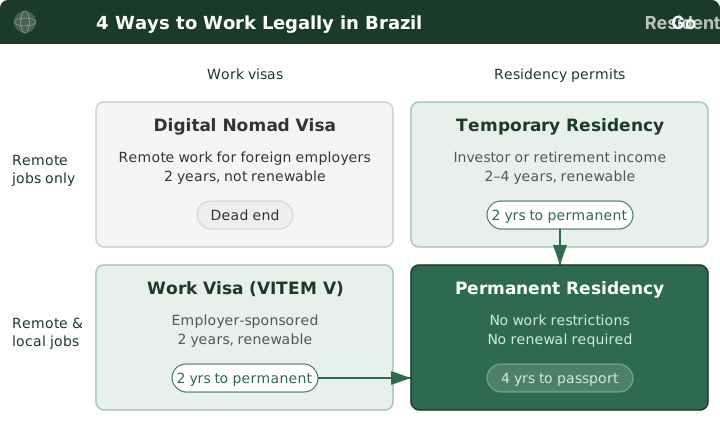
If you work remotely for foreign clients or employers, the Digital Nomad Visa (VITEM XIV) is the simplest path. It requires no employer sponsorship, no investment, and can be applied for from abroad or from within Brazil on a tourist entry. The catch: it maxes out at two years and leads nowhere. If a Brazilian company is hiring you, you need an employer-sponsored work visa (VITEM V), which requires the employer to obtain authorization from Brazil's Ministry of Justice before you can apply at a consulate. VITEM V holders can convert to permanent residency after two years with the same employer. If you bring capital, the investor visa (VIPER) offers a direct route to permanent residency through a business investment starting at BRL 500,000 (~USD 90,000).
Comparing Work Visas in Detail
| Digital Nomad Visa (VITEM XIV) | Employer-Sponsored Work Visa (VITEM V) | |
|---|---|---|
| For | Remote workers and freelancers | Local employment |
| Legal basis | CNIg Normative Resolution 45 (2022) | CNIg Normative Resolution 02/2017 |
| Who qualifies | Everyone | Qualified professionals only |
| Key requirement | USD 1,500/month income or USD 18,000 savings | Employer authorization from Ministry of Justice |
| Duration | 1 year + 1 year renewal | Up to 2 years, renewable |
| Processing time | 2–8 weeks | 2–4 months |
| Government fees | ~USD 100–150 (consular) or R$168 (in-country) | ~USD 200–400 |
| Remote work for foreign employer | Yes | - |
| Work for Brazilian companies | No | Yes, sponsoring employer only |
| Change employer | - | Requires new authorization |
| Open bank account | Yes (with CPF) | Yes |
| Include dependents | Yes (+USD 60/month per dependent) | Yes (via family reunion visa) |
| Path to permanent residency | No | Yes, after 2 years with same employer |
Brazil Digital Nomad Visa
Brazil's Digital Nomad Visa (VITEM XIV), introduced in January 2022 under CNIg Normative Resolution 45, has one of the lowest financial bars in Latin America. You need either USD 1,500 per month in provable foreign income or USD 18,000 in savings. Only Colombia (USD 1,300/month) sets a lower threshold among countries with dedicated digital nomad programs, while Uruguay and Argentina have no income minimum at all. No employer sponsorship, no cap on the number of visas issued, and you can apply from abroad or switch from a tourist entry while already in Brazil.
Documents required
- Bank statements (3 months) proving at least USD 1,500/month in income, or a bank balance of at least USD 18,000. Threshold increases by approximately USD 60/month per dependent.
- Employment or service contract with a foreign company, or a declaration confirming freelance work for foreign clients
- Private health insurance valid in Brazil for the entire duration of stay
- Criminal background check from your country of residence (apostilled and translated into Portuguese if applying in-country)
- Valid passport with at least two blank pages
- US, Canadian, and Australian citizens must first obtain a Brazilian eVisa before entering the country (as of April 2025)
Process
Two routes. From abroad: submit documents to a Brazilian consulate or embassy, pay the consular fee (approximately USD 100 to 150 depending on nationality), and wait 2 to 8 weeks for processing. From within Brazil: enter on a tourist visa or visa-free entry, then apply through the Federal Police's MigranteWeb system (GRU fee of R$168.13) and schedule an in-person appointment. Once approved, you must register with the Federal Police within 90 days and obtain your CRNM (foreign registration card) and CPF (tax ID number). Renewal for a second year requires applying through the Federal Police before the first year expires.
Tax treatment
Unlike most Latin American Digital Nomad Visas, Brazil's version does not grant an explicit tax exemption. If you stay fewer than 183 days in any 12-month period, you are treated as a non-resident and your foreign income is not taxed. If you exceed 183 days, you become a tax resident and owe Brazilian income tax on worldwide income. See the tax section below for rates.
Employer-Sponsored Work Visa (VITEM V)
VITEM V is the standard route for foreign professionals hired by a Brazilian company under a formal employment contract. The employer must be a legally registered entity in Brazil and must initiate the process by filing a work authorization with the General Coordination of Labor Immigration (CGIL) under the Ministry of Justice. Brazil requires that at least two-thirds of any company's workforce be Brazilian nationals, so hiring a foreigner requires justification.
Documents required
- Signed employment contract detailing role, salary, and duration
- Employer's corporate registration documents and proof of legal standing
- Proof the applicant meets qualification criteria: a university degree plus one year of relevant experience, or two years of experience plus nine years of formal education, or a postgraduate degree
- Criminal background check from every country the applicant has lived in during the past 5 years
- Valid passport with at least six months of validity and two blank pages
- All foreign documents must be apostilled and translated into Portuguese by a certified Brazilian sworn translator (tradutor juramentado)
Process
The employer files the work authorization application with the CGIL at the Ministry of Justice. Processing at the Ministry takes approximately 30 days (a fast-track option of 2 working days exists for technical assistance contracts under 180 days). Once approved, the Ministry of Foreign Affairs authorizes the consulate to issue the visa. The applicant then applies at the Brazilian consulate in their country of residence, where the visa is typically issued within 5 to 15 working days. After arriving in Brazil, the employee must register with the Federal Police within 90 days to obtain their CRNM card. Total timeline from application to arrival: 2 to 4 months in practice.
Tax treatment
VITEM V holders on a Brazilian payroll pay progressive income tax and mandatory social security contributions (INSS). Rates and brackets are detailed in the tax section below.
For long-term residency pathways, see our Brazil Residency Guide.
Taxes and Health Insurance
Brazil operates a worldwide tax system. Tax residents (anyone who holds a permanent visa or stays 183+ days in any 12-month period) owe income tax on all income, regardless of where it was earned. Non-residents are taxed only on Brazilian-source income at a flat 15% (or 25% if resident in a jurisdiction Brazil classifies as low-tax). For remote workers who want foreign income to remain permanently untaxed, Panama, Paraguay, and Costa Rica use territorial tax systems with no time limit on the exemption.
For locally employed workers, the progressive income tax (IRPF) applies to monthly salary. As of 2026, under the recently enacted Law 15,270/2025: monthly income up to BRL 5,000 (~USD 910) is completely tax-free. A gradual reduction applies between BRL 5,000 and BRL 7,350 (~USD 1,340). Above that, the standard progressive table applies with rates of 7.5%, 15%, 22.5%, and a top rate of 27.5%.
Social security contributions (INSS) are mandatory for all employees on a Brazilian payroll. Employee contributions are progressive, ranging from 7.5% to 14% of gross salary, capped at approximately BRL 951/month. Employer contributions add 20% to 28.8% on top of gross compensation (with no cap), covering social security and additional social charges. Combined with the mandatory 13th-month salary, paid vacation bonus, and severance fund (FGTS), total employer costs in Brazil typically run 60 to 80% above the employee's gross salary.
Brazil has no double taxation treaty with the United States. US citizens working in Brazil may owe US tax on worldwide income, though the Foreign Earned Income Exclusion (~USD 130,000 for 2025) and Foreign Tax Credit can offset some or all overlap. Brazil does recognize tax reciprocity with the US, UK, and Germany, allowing credits for taxes paid in those countries. Brazil has ratified treaties with over 35 countries, including France, Spain, Italy, Canada, Japan, Mexico, Argentina, and several others across Europe and Latin America.
Digital Nomad Visa holders are not enrolled in INSS and have no social security obligation. They must carry private health insurance valid in Brazil for the entire stay, which typically costs USD 50 to 200/month depending on age and coverage. VITEM V holders on local payroll are automatically enrolled in the public health system (SUS) through their INSS contributions and can also access private plans, which are a common employer benefit.
Regardless of visa type, tax obligations in your home country may still apply. Holding a Brazilian visa does not automatically end tax residency elsewhere.
Starting a Business in Brazil
Neither the Digital Nomad Visa nor VITEM V allows you to run a local business. The Digital Nomad Visa restricts you to foreign clients and employers, and the work visa ties you to a single sponsoring employer. If you want to start or invest in a Brazilian company, you need a residency permit.
The most common path is the investor visa (VIPER), which requires a minimum investment of BRL 500,000 (~USD 90,000) in a new or existing Brazilian company. Investments in technology or innovation sectors, or those that create 10 or more local jobs, may qualify at a reduced threshold of BRL 150,000 (~USD 27,000). Real estate investment is also an option, starting at BRL 700,000 for properties in the North or Northeast and BRL 1,000,000 elsewhere. Investor visa holders receive permanent residency and can apply for citizenship after four years.
Any foreigner can incorporate a Brazilian company (typically a Sociedade Limitada or Sociedade Anônima) without holding residency, but actually working in or managing the business day-to-day requires a visa that authorizes local activity. Registering a company in Brazil involves multiple government registrations, tax IDs (CNPJ), and typically takes 2 to 4 months. For a detailed breakdown of residency categories, see our Brazil Residency Guide.
Tourist Visa and Work Rights
EU citizens can enter Brazil visa-free for up to 90 days (extendable to 180 days per year). US, Canadian, and Australian citizens have needed an eVisa since April 10, 2025, which costs approximately USD 80 and allows stays of up to 90 days per visit (180 days maximum per 12-month period). No paid work is permitted on any tourist or visitor entry, including remote work for a foreign employer.
Enforcement for remote workers has historically been light, and many digital nomads worked from Brazil on tourist entries before 2022. The Digital Nomad Visa was introduced specifically to formalize this. Given the low income threshold (USD 1,500/month) and the ability to apply from within Brazil through the Federal Police, there is little reason to remain in the gray area.
Frequently Asked Questions (FAQ)
🛂 Visa & Legal
Can US citizens work in Brazil?
Yes. US citizens can apply for the Digital Nomad Visa for remote work (USD 1,500/month threshold) or seek an employer-sponsored VITEM V for local employment. Since April 2025, US citizens also need an eVisa (~USD 80) to enter Brazil, even before applying for a work visa.
Can I work in Brazil on a tourist visa?
No. Tourist and visitor entries (including the eVisa) do not authorize any paid work, including remote work for a foreign employer. The Digital Nomad Visa is the legal alternative for remote workers, with a low threshold of USD 1,500/month and processing times of 2 to 8 weeks.
Can freelancers work legally in Brazil?
Yes, if serving foreign clients. Freelancers qualify for the Digital Nomad Visa with USD 1,500/month in income or USD 18,000 in savings. A service contract or declaration of freelance activity is required. Freelancers serving Brazilian clients need a visa with local work authorization.
How long does it take to get a work visa in Brazil?
Digital Nomad Visa: 2 to 8 weeks depending on consulate workload. Employer-sponsored VITEM V: 2 to 4 months total, including approximately 30 days for Ministry of Justice review, then 5 to 15 working days at the consulate.
Can I switch from a tourist visa to a work visa inside Brazil?
For the Digital Nomad Visa, yes. You can enter Brazil on a tourist entry and apply through the Federal Police's MigranteWeb system. For VITEM V, the employer must first obtain authorization from the Ministry of Justice, and the visa is then issued at a consulate abroad. In practice, you need to leave Brazil to collect your VITEM V.
Can I work for a Brazilian company on a Digital Nomad Visa?
No. The Digital Nomad Visa is exclusively for remote work with foreign employers or clients. You cannot enter into an employment relationship with a Brazilian company or receive compensation from Brazilian sources. Local employment requires an employer-sponsored VITEM V.
Does the Digital Nomad Visa lead to residency or citizenship?
No. The Digital Nomad Visa caps out at two years (1 year + 1 year renewal) and does not establish residency status or count toward permanent residency or citizenship. Ecuador is the only country in the region where the Digital Nomad Visa itself counts toward permanent residency. For long-term residency in Brazil, the investor visa (VIPER) or an employer-sponsored VITEM V (which can convert to permanent residency after 2 years) are the standard routes.
Is the internet fast enough for remote work?
Yes, in urban areas. Brazil's average fixed broadband speed exceeds 100 Mbps nationally, with fiber plans in major cities like São Paulo, Rio de Janeiro, and Florianópolis reaching 300 to 1,000 Mbps. Smaller towns and rural areas can be significantly slower. Coworking spaces are widely available in tech hubs like Florianópolis, São Paulo, and Recife.
Can I include my family in a Brazil work visa application?
Yes. Digital Nomad Visa: dependents can be included with an additional ~USD 60/month per person added to the income threshold. VITEM V: dependents apply separately for a family reunion visa (VITEM XI). Both routes require additional documents such as birth or marriage certificates.
What types of jobs qualify for a Brazil work permit?
VITEM V covers professionals under an employment contract, intra-company transfers, technical assistance providers, technology transfer specialists, and certain maritime workers. Applicants must hold a university degree plus one year of experience, two years of experience plus nine years of education, or a postgraduate degree. The employer must justify hiring a foreign worker over a local candidate.
💰 Money & Tax
What is the average salary in Brazil?
Approximately USD 525/month (~BRL 3,000 net) on average nationally. The minimum wage is BRL 1,621/month (~USD 296) as of January 2026. Software developers employed locally earn roughly USD 20,000 to 60,000/year depending on seniority and city, with senior roles in São Paulo reaching higher.
Does Brazil tax foreign income?
Yes, for tax residents. Brazil uses a worldwide tax system. Anyone staying 183+ days in a 12-month period becomes a tax resident and owes income tax on all global income at progressive rates up to 27.5%. Non-residents are taxed only on Brazilian-source income at a flat 15%. Digital Nomad Visa holders who stay under 183 days avoid Brazilian tax on foreign earnings.
How much does it cost to apply for a Brazil work visa?
The Digital Nomad Visa costs approximately USD 100 to 150 in consular fees (or R$168 if applying in-country through the Federal Police). Employer-sponsored VITEM V costs approximately USD 200 to 400 in combined government and consular fees. Additional costs for apostilles, certified translations, and legal assistance are separate.
🏠 Practical
Do I need to speak Portuguese to work in Brazil?
Not for remote work. English is common in tech and expat communities in São Paulo, Florianópolis, and Rio. For employer-sponsored roles, most companies expect professional-level Portuguese. All visa documents submitted within Brazil must be translated into Portuguese by a certified sworn translator.
Is health insurance mandatory for work visa holders in Brazil?
Yes, but the type differs. Digital Nomad Visa holders must carry private health insurance valid in Brazil for the full duration of their stay, typically costing USD 50 to 200/month. Work visa holders on local payroll are enrolled in the public system (SUS) via mandatory INSS contributions, with private insurance often provided as an employer benefit.
Compare all 12 countries in our Working Abroad Guide. Looking for residency instead? See our Latin America Residency Guide.