Panama is one of the few countries in Latin America where your dollars are already the local currency. The Balboa is pegged 1:1 to the USD and both circulate freely, so remote workers earning in dollars face zero currency risk. Foreign income is not taxed, the Digital Nomad Visa costs USD 300 and is valid for up to 18 months, and the Friendly Nations Visa gives citizens of 50 countries a direct path to permanent residency. For local employment, the rules are stricter: several professions are constitutionally reserved for Panamanians, employers must stay within a 10% foreign worker quota, and the work permit process takes 2 to 6 months or longer.
>Work Options at a Glance
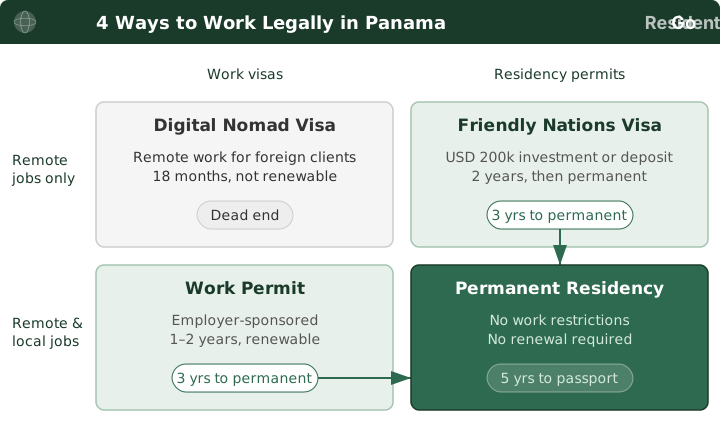
If you work remotely for foreign clients, the Digital Nomad Visa is the fastest option, but it caps out at 18 months with no path to residency and no family inclusion. If a Panamanian company is hiring you, you need residency status first (most commonly through the Friendly Nations Visa) and then a separate work permit from the Ministry of Labor. If you are a citizen of one of the 50 "friendly nations" and want a long-term solution, the Friendly Nations Visa leads to permanent residency after two years and enables a work permit. Only the Friendly Nations Visa and the employer-sponsored work permit tracks lead to permanent residency and, eventually, citizenship.
Comparing Work Visas in Detail
| Digital Nomad Visa | Employer-Sponsored Work Permit | |
|---|---|---|
| For | Remote workers and freelancers | Local employment |
| Legal basis | Executive Decree No. 198 (2021) | Labor Code; MITRADEL regulations; Decree No. 6 (2023) |
| Who qualifies | Anyone with foreign-source income | Foreigners with residency status and employer sponsor |
| Key requirement | USD 3,000/month income from abroad | Employer proves no qualified local candidate; 10% foreign worker quota |
| Duration | 9 months + 9 months renewal | 1–2 years, renewable |
| Processing time | ~40 working days | 2–6 months (up to 10 months outside Panama City) |
| Government fees | USD 300 (USD 250 + USD 50 card) | ~USD 500 |
| Remote work for foreign employer | Yes | - |
| Work for Panamanian companies | No | Yes, sponsoring employer only |
| Change employer | - | Requires new work permit |
| Open bank account | Yes | Yes |
| Include dependents | No | Yes (via underlying residency visa) |
| Path to permanent residency | No | Yes, through underlying residency |
*The Friendly Nations Visa, which enables the work permit, carries separate government fees of USD 1,050 (USD 250 + USD 800). Certain professions (law, engineering, accounting, psychology) are reserved for Panamanians regardless of work permit status.
Panama Digital Nomad Visa
Panama's Digital Nomad Visa, formally the Short-Stay Visa for Remote Workers, was created by Executive Decree No. 198 in May 2021. It is an individual visa only: dependents cannot be included, which makes Panama unusual among Latin American digital nomad programs. If you earn at least USD 3,000/month from foreign sources, you qualify. Costa Rica has the same USD 3,000/month threshold but includes dependents and processes faster (~15 days vs. ~40). The visa is classified as a non-resident permit, so it does not establish tax residency, residency status, or any path toward permanent residency or citizenship.
Documents required
- Notarized power of attorney authorizing a Panamanian lawyer to file the application on your behalf (you cannot self-file)
- Bank statements or employer letter proving at least USD 3,000/month (USD 36,000/year) in foreign income
- Proof of remote employment or freelance activity: employment contract with a foreign company, or a notarized statement detailing clients, services, and payment cycles
- Health insurance policy valid in Panama for the full duration of stay (travel insurance is not accepted)
- Criminal background certificate from your country of residence, apostilled
- Health certificate from a licensed physician
- Sworn affidavit declaring you will not accept employment or provide services within Panama
- Valid passport with at least six months remaining, five passport-size photos
Process
Applications must be filed through a licensed Panamanian immigration lawyer. You can apply from within Panama (if you entered on a tourist stamp) or at a Panamanian consulate abroad. Processing takes approximately 40 working days. Once approved, you receive a visa card valid for nine months. Renewal requires resubmitting the same documentation and extends the stay for another nine months, for a total maximum of 18 months.
Tax treatment
Digital Nomad Visa holders are not taxed on foreign-source income. The visa is classified as non-resident, so holders have no local income tax or social security obligations.
Employer-Sponsored Work Permit
To work for a Panamanian company, you need two things: a residency visa and a work permit. The residency visa comes from the National Immigration Service (Servicio Nacional de Migración), while the work permit is issued separately by the Ministry of Labor (MITRADEL). The most common residency path for work purposes is the Friendly Nations Visa, available to citizens of 50 countries. Panama enforces a strict 10% cap on foreign workers per company (15% for specialized technical roles), and four professions are constitutionally reserved for Panamanians: law, engineering, accounting, and psychology.
Documents required
- Valid residency visa or proof of pending residency application
- Signed employment contract registered with the Social Security Fund (CSS)
- Employer's company registration, business license, and CSS enrollment
- Apostilled university degree or professional certification
- Criminal background check from country of origin, apostilled
- Proof of compliance with the 10% foreign worker quota
- Power of attorney granted to a Panamanian attorney to handle the filing
- All documents apostilled and translated into Spanish if applicable
Process
The employer submits the work permit application to MITRADEL through a licensed attorney. The employer must demonstrate that the position cannot be filled by a Panamanian national. In Panama City, processing typically takes 2 to 6 months. Outside the capital, timelines stretch longer: filings in David (Chiriquí province) commonly take 9 to 10 months, with an additional 2 to 3 months for issuance of the physical work permit card. Work permits are typically granted for one to two years and are tied to the specific employer and position.
Temporary work permits also exist for short-term contracts (up to three months, extendable up to one year), which are used for project-based or seasonal work where a full work permit is not practical.
Tax treatment
Work permit holders pay progressive income tax on their Panamanian salary and are enrolled in the CSS social security system. See the tax section below for brackets and rates.
Friendly Nations Visa
The Friendly Nations Visa is Panama's most popular residency program for working-age foreigners and one of the features that sets Panama apart from the rest of Latin America. Citizens of 50 countries (including the US, Canada, the UK, all EU member states, and several Latin American nations) can apply for permanent residency by demonstrating economic ties to Panama. The visa was created by Executive Decree 343 in 2012 and modified by Decree 197 in 2021, which raised investment thresholds and introduced a two-year provisional phase before permanent residency.
Applicants must demonstrate one of three forms of economic connection: an employment contract with a Panamanian company, ownership of Panamanian real estate worth at least USD 200,000 (which can be financed locally), or a fixed-term deposit of at least USD 200,000 in a Panamanian bank for a minimum of three years. Government fees total USD 1,050 (USD 250 to the National Treasury + USD 800 to the Immigration Service). The process grants a two-year provisional residency, after which the holder can apply for permanent residency. Work permit holders under this visa still need a separate MITRADEL work permit to be employed.
Documents required
- Passport from one of the 50 eligible countries, valid for at least six months
- Notarized power of attorney
- Criminal background check, apostilled (valid for 180 days)
- Health certificate from a Panamanian doctor
- One of: employment contract with a Panamanian company, real estate deed (min. USD 200,000), or bank certificate of deposit (min. USD 200,000 for 3 years)
- Personal history affidavit
- Five passport-size photos
Process
You must apply in person after arriving in Panama. The initial application is submitted to the National Immigration Service by a Panamanian attorney. Processing for the provisional residency typically takes about six months. After two years of holding provisional residency, you can apply for permanent residency, which takes another six months or so. The entire process from application to permanent residency runs approximately three years. Dependents (spouse, children up to 25, and parents) can be included in the same application.
Tax treatment
Friendly Nations Visa holders are taxed only on Panamanian-source income under the territorial system. Foreign income remains untaxed. Once holding a work permit and employed locally, progressive income tax and social security contributions apply to the Panamanian salary.
For long-term residency pathways, see our Panama Residency Guide.
Taxes and Health Insurance
Panama operates a territorial tax system. Only income earned from Panamanian sources is subject to local tax. Foreign income is not taxed, regardless of visa type, how long you stay, or whether you deposit the funds in a Panamanian bank. This applies equally to Digital Nomad Visa holders, Friendly Nations Visa holders, and work permit holders. Paraguay and Costa Rica use the same territorial principle.
For locally employed workers, progressive income tax rates apply to annual salary: the first USD 11,000 is tax-free, income between USD 11,000 and USD 50,000 is taxed at 15%, and income above USD 50,000 is taxed at 25%. Panama uses the US dollar as legal tender (the Balboa is pegged 1:1), so there is no currency conversion involved in these thresholds.
All locally employed workers and their employers contribute to the Caja de Seguro Social (CSS). As of April 2025, employee contributions total 9.75% of gross salary, plus 1.25% for educational insurance (total employee deduction: 11%). Employer contributions are 13.25% for social security (rising to 14.25% in March 2027 and 15.25% by March 2029 under Law No. 462 of 2025), plus 1.50% for educational insurance and 0.56% to 5.67% for workplace risk insurance depending on the industry. These contributions are not optional and are withheld at source. Panama also mandates a 13th-month salary, paid in three installments (April, August, December).
Panama has no double taxation treaty with the United States and no social security totalization agreement. US citizens working in Panama may owe US tax on their worldwide income, with a Foreign Earned Income Exclusion of approximately USD 128,200 (2025 figure) potentially offsetting some or all of the liability. Panama does have treaties with Spain, Germany, France, the UK, Mexico, the Netherlands, Ireland, Italy, South Korea, Israel, Portugal, and several others (17 treaties in force as of 2025).
Digital Nomad Visa holders are not enrolled in CSS and have no local social security obligation. They must carry private health insurance valid in Panama for the full duration of their stay. Travel insurance is not accepted. Typical costs for international health insurance range from USD 75 to 250/month depending on age and coverage.
Regardless of visa type, tax obligations in your home country may still apply. Holding a Panamanian visa does not automatically end tax residency elsewhere.
Starting a Business in Panama
None of the work visas above allow you to run a local business. The Digital Nomad Visa restricts you to foreign clients, and the work permit ties you to a single sponsoring employer. If you want to start or invest in a Panamanian company, you need a residency permit that allows local economic activity.
The Friendly Nations Visa is the most common path for foreign entrepreneurs from eligible countries, with the real estate or bank deposit option (USD 200,000 minimum) satisfying the economic tie requirement without needing a local job offer. Alternatively, the Qualified Investor Visa (formerly Self-Economic Solvency Visa) grants immediate permanent residency through larger investments, typically USD 300,000 or more in real estate or other qualifying assets.
Registering a company in Panama is straightforward and does not require residency. Any foreigner can incorporate a Sociedad Anónima (S.A.) or Sociedad de Responsabilidad Limitada (S.R.L.), and Panama's legal system is widely used for international holding structures. However, actually working in or managing the business day-to-day requires a visa that authorizes local activity, plus a work permit from MITRADEL unless you qualify as an investor exempt from the work permit requirement. For a detailed breakdown of residency categories, see our Panama Residency Guide.
Tourist Visa and Work Rights
Most nationalities can enter Panama visa-free for up to 90 days. The stay can sometimes be extended at immigration offices, but no form of paid work is permitted on a tourist entry, including remote work for a foreign employer.
Enforcement for remote workers operating quietly from a laptop has historically been light, and "border runs" to Costa Rica or Colombia remain common. The Digital Nomad Visa was created partly to formalize this gray area. At USD 300 with processing in about 40 working days, it is a relatively affordable way to stay legal, though the requirement to hire a Panamanian lawyer adds to the overall cost.
Frequently Asked Questions (FAQ)
Visa & Legal
Can US citizens work in Panama?
Yes. The US is on Panama's "Friendly Nations" list, giving US citizens a direct path to permanent residency and a work permit. For remote work only, the Digital Nomad Visa is the faster option at USD 300 with no residency requirement. For local employment, US citizens can apply for the Friendly Nations Visa and then obtain a separate work permit from MITRADEL.
Can I work in Panama on a tourist visa?
No. Tourist entries allow stays of up to 90 days, but no form of paid work is permitted, including remote work for a foreign employer. Enforcement for laptop-based remote work has historically been light, but the Digital Nomad Visa was created specifically to formalize this gray area.
Can freelancers work legally in Panama?
Yes, through the Digital Nomad Visa. Freelancers must prove at least USD 3,000/month in foreign-source income and submit a notarized statement detailing their clients, services, and payment cycles. The visa is valid for 9 months, renewable once for a total of 18 months.
How long does it take to get a work visa in Panama?
The Digital Nomad Visa takes approximately 40 working days. Employer-sponsored work permits take 2 to 6 months in Panama City, and significantly longer outside the capital: filings in David (Chiriquí) commonly take 9 to 10 months, plus another 2 to 3 months for the physical card.
Can I switch from a tourist visa to a work visa inside Panama?
Yes, for the Digital Nomad Visa. You can enter Panama on a tourist stamp and file the Digital Nomad Visa application from within the country through a licensed Panamanian immigration lawyer. For employer-sponsored work permits, you must first obtain a residency visa (typically the Friendly Nations Visa), which also requires applying in person after arriving in Panama.
Can I work for a Panama company on a Digital Nomad Visa?
No. Digital Nomad Visa holders must sign a sworn affidavit declaring they will not accept employment or provide services within Panama. The visa is exclusively for remote work with foreign clients or employers. To work for a Panamanian company, you need a residency visa and a separate MITRADEL work permit.
Does the Digital Nomad Visa lead to residency or citizenship?
No. The Digital Nomad Visa is classified as a non-resident permit, so it does not establish residency status or create any path toward permanent residency or citizenship. It caps out at 18 months total. For long-term residency, the Friendly Nations Visa is the most common route, leading to permanent residency after approximately three years.
Can I include my family in a Panama work visa application?
Not on the Digital Nomad Visa, which is individual-only and cannot include dependents. This makes Panama unusual among Latin American digital nomad programs. However, the Friendly Nations Visa does allow inclusion of a spouse, children up to age 25, and parents in the same application.
What types of jobs qualify for a Panama work permit?
Most jobs qualify, but four professions are constitutionally reserved for Panamanians: law, engineering, accounting, and psychology. Employers must also prove that no qualified local candidate is available and comply with Panama's 10% foreign worker cap per company (15% for specialized technical roles). Temporary work permits exist for short-term contracts of up to three months, extendable to one year.
Money & Tax
What is the average salary in Panama?
The average salary is approximately USD 734/month (~USD 8,800/year). The minimum wage varies by sector and region, ranging from about USD 300/month in rural areas to USD 971/month in higher-paying urban sectors. Software developers employed locally earn roughly USD 35,000 to 55,000/year, though those working remotely for international companies can earn significantly more.
Does Panama tax foreign income?
No. Panama operates a territorial tax system: only income from Panamanian sources is taxed. Foreign income is untaxed regardless of visa type, length of stay, or whether you deposit the funds in a Panamanian bank. For locally earned salary, progressive rates apply: 0% on the first USD 11,000, 15% up to USD 50,000, and 25% above that.
How much does it cost to apply for a Panama work visa?
The Digital Nomad Visa costs USD 300 (USD 250 application fee + USD 50 visa card). An employer-sponsored work permit costs approximately USD 500 in government fees. The Friendly Nations Visa, often required before a work permit can be issued, adds another USD 1,050 (USD 250 + USD 800). Additional costs for apostilles, certified translations, and legal assistance are separate.
Practical
Do I need to speak Spanish to work in Panama?
There is no formal language requirement for any Panama visa or work permit. However, for local employment, most employers expect professional-level Spanish and prefer bilingual English-Spanish candidates. Remote workers on the Digital Nomad Visa do not need Spanish for their work, though basic conversational Spanish makes daily life significantly easier.
Is health insurance mandatory for work visa holders in Panama?
Yes, for Digital Nomad Visa holders. You must carry private health insurance valid in Panama for the full duration of your stay; travel insurance is not accepted. Typical costs range from USD 75 to 250/month. For work permit holders employed locally, health coverage is provided through the Caja de Seguro Social (CSS) via mandatory employer and employee contributions.
Is the internet fast enough for remote work?
Yes, in urban areas. Panama has the fastest fixed broadband in Central America, with average download speeds around 186 Mbps nationally. Fiber optic plans in Panama City reach 600 Mbps or higher. Rural and beach areas can be much slower (1 to 20 Mbps), though Starlink is widely available as a backup. If reliable internet is critical, choose a location with confirmed fiber optic coverage.
Compare all 12 countries in our Working Abroad Guide. Looking for residency instead? See our Latin America Residency Guide.