Bolivia is the cheapest place to live in South America, and it doesn't tax foreign income. For remote workers, that combination is hard to beat anywhere in Latin America. The catch: Bolivia has no Digital Nomad Visa, no freelancer visa, and no legal framework for location-independent work. Most remote workers enter on a 90-day tourist visa and work in a legal gray area. For local employment, the path is clearer but heavily restricted: employers must prove no Bolivian can fill the role, and foreign staff cannot exceed 15% of any company's workforce.
Work Options at a Glance
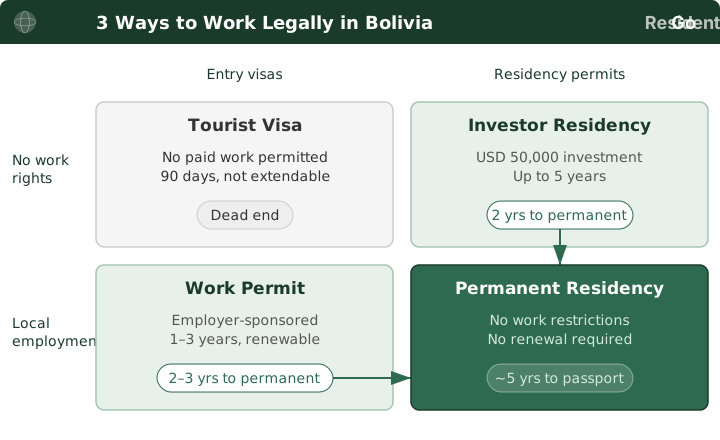
If you work remotely for foreign clients, Bolivia currently has no visa designed for you. Neighboring Argentina (USD 200, no income minimum) and Uruguay (USD 11) both offer dedicated digital nomad programs. Most remote workers in Bolivia use the 90-day tourist entry, which does not authorize any form of work. If a Bolivian company is hiring you, you need an employer-sponsored work permit, which requires a Specific Purpose Visa for entry and then conversion to Temporary Residency. If you plan to invest in or start a business, an Investor Visa (minimum USD 50,000) provides a more direct route to residency. Only the employer-sponsored and investor tracks lead to permanent residency.
Comparing Work Visas in Detail
| Employer-Sponsored Work Permit | Tourist Visa (no work rights) | |
|---|---|---|
| For | Local employment | Short-term visits only |
| Legal basis | General Law of Migration (Ley 370) | General Law of Migration (Ley 370) |
| Who qualifies | Sponsored employees in roles no local can fill | Citizens of Group 1 countries (US, EU, etc.) |
| Key requirement | Employer must prove no qualified Bolivian is available | Valid passport |
| Duration | 1–3 years, renewable | 90 days, not extendable |
| Processing time | 1–5 months | Visa-free on arrival |
| Government fees | ~USD 280–400 | Free (Group 1); USD 160 (US citizens, reciprocity fee) |
| Remote work for foreign employer | - | No |
| Work for Bolivian companies | Yes, sponsoring employer only | No |
| Change employer | Requires new authorization | - |
| Open bank account | Yes (with Foreigner's Identity Card) | No |
| Include dependents | Yes (via separate family visa) | - |
| Path to permanent residency | Yes, after 2–3 years | No |
*US citizens pay a reciprocity fee of USD 160 for tourist entry. Most EU and other Group 1 nationals enter free.
Employer-Sponsored Work Permit
Bolivia's work permit system is built around employer sponsorship with strong protections for the local labor market. Bolivian law requires that at least 85% of any company's workforce be Bolivian nationals. The employer must be registered with Bolivia's National Immigration Service (DIGEMIG) and the Ministry of Labor, and must demonstrate the role cannot be filled by a local candidate. The permit ties you to a single employer and a specific job.
Documents required
- Signed employment contract approved by the Bolivian Ministry of Labor, detailing role, salary, and duration
- Employer's proof of registration with DIGEMIG, the Ministry of Labor, and the tax authority (NIT)
- Evidence that no qualified Bolivian candidate is available for the position
- INTERPOL police clearance and criminal records from your country of last residence
- Professional credentials relevant to the role (apostilled or legalized)
- Valid passport with at least 6 months validity
- All documents translated into Spanish by a certified translator
Process
The employer first applies for a work permit (Permiso de Trabajo) through the Ministry of Labor's online system. Once approved, the employee applies for a Specific Purpose Visa (Visa de Objeto Determinado) at a Bolivian consulate, which is valid for 30 days of entry. After arriving in Bolivia, the employee registers with DIGEMIG for biometric processing and obtains a Foreigner's Identity Card (Cédula de Identidad de Extranjero). The employer then registers the employee with the Caja Nacional de Salud (public health system) and the pension fund. The full process typically takes 1 to 5 months from initial filing to having a valid Temporary Residence permit.
Some employees enter Bolivia and change their immigration status from within the country through a licensed immigration attorney, rather than applying at a consulate abroad. This approach avoids the need to wait outside Bolivia but requires careful coordination with DIGEMIG timelines.
Tax treatment
Work permit holders pay the flat 13% RC-IVA (income tax) on their Bolivian salary and are enrolled in the public social security system. See the tax section below for details on deductions and contributions.
For long-term residency pathways, see our Bolivia Residency Guide.
Taxes and Health Insurance
Bolivia operates a territorial tax system. Only income earned from Bolivian sources is taxed. Foreign income is not taxed, regardless of your visa type, how long you stay, or whether you deposit the money in a Bolivian bank account. This applies to everyone: residents, temporary workers, and digital nomads on tourist visas alike. Paraguay, Panama, and Costa Rica apply the same territorial principle.
For locally employed workers, Bolivia applies a flat 13% income tax called the RC-IVA (Régimen Complementario al Impuesto al Valor Agregado). Unlike most Latin American countries, there are no progressive brackets. The tax is calculated on gross salary minus mandatory social security contributions. Employees can reduce their RC-IVA liability by submitting personal consumption invoices (facturas) as a tax credit, and income up to four times the national minimum wage (~BOB 11,000/month, ~USD 1,600) is effectively exempt through a basic consumption allowance.
Employee social security contributions total approximately 12.71% of gross salary, covering pension (10%), disability and survivors (1.71%), and administrative fees (0.5%). Employees earning above BOB 13,000/month (~USD 1,880) pay an additional solidarity contribution on a sliding scale from 1% to 10%. Employer contributions add approximately 16.71% on top of gross salary, covering health insurance (10% to the CNS), occupational risk (1.71%), housing fund (2%), and other charges.
Health coverage for work permit holders is provided through the Caja Nacional de Salud (CNS), Bolivia's public health system. Enrollment is mandatory and funded through employer contributions. The CNS covers medical consultations, hospitalization, surgery, maternity, and medications, though quality varies by location. Many formally employed foreigners supplement CNS coverage with private health insurance, which typically costs USD 50 to 150/month. Remote workers on tourist visas are not enrolled in any Bolivian health system and should carry their own international health insurance.
Bolivia has double taxation treaties with the Andean Community countries (Colombia, Ecuador, Peru), Argentina, France, Germany, Spain, Sweden, and the United Kingdom. There is no treaty with the United States. US citizens working in Bolivia may owe US tax on worldwide income, with the Foreign Earned Income Exclusion of approximately USD 130,000 (2026 figure) potentially offsetting some or all of the Bolivian liability.
Regardless of visa type, tax obligations in your home country may still apply. Holding a Bolivian visa does not automatically end tax residency elsewhere.
Starting a Business in Bolivia
Work permits tie you to a single employer and do not authorize entrepreneurial activity. If you want to start or invest in a Bolivian company, you need a residency permit that allows self-directed economic activity.
The most common path is the Investor Visa (Visa de Inversionista), which requires a minimum investment of USD 50,000 in a Bolivian business or real estate. This visa is valid for up to five years and leads to permanent residency after two years. Foreigners can hold 100% ownership of a Bolivian company with no requirement to partner with local shareholders. The most common structure is the Sociedad de Responsabilidad Limitada (SRL), which requires two shareholders, one director who must be a Bolivian resident, and a minimum capital of just USD 1.
Registering a company does not require residency. Any foreigner can incorporate a Bolivian SRL or branch office through a legal representative with a power of attorney. However, actually working in the business day-to-day requires a visa that authorizes local economic activity. For a detailed breakdown of residency categories, see our Bolivia Residency Guide.
Tourist Visa and Work Rights
Citizens of Group 1 countries (most of the EU, Canada, Australia, Japan, and others) can enter Bolivia visa-free for 90 days. US citizens pay a reciprocity fee of USD 160 on arrival for the same 90-day stay. The tourist entry cannot be extended and does not authorize any form of paid work, including remote work for a foreign employer.
In practice, Bolivia has minimal enforcement against remote workers using laptops in cafés or coworking spaces, and the country's extremely low cost of living attracts a small but growing number of digital nomads. Unlike neighbors like Colombia, Brazil, or Costa Rica, Bolivia has not introduced a Digital Nomad Visa to formalize this, leaving remote workers in an unregulated gray area with no path to legal status, no access to the banking system, and no social security coverage.
Frequently Asked Questions (FAQ)
🛂 Visa & Legal
Can US citizens work in Bolivia?
Yes, but only with an employer-sponsored work permit. US citizens can enter Bolivia by paying a USD 160 reciprocity fee for a 90-day tourist stay, but this does not authorize work. For local employment, the sponsoring employer must obtain a work permit and the employee applies for a Specific Purpose Visa. There is no Digital Nomad Visa or freelancer visa available.
Can I work in Bolivia on a tourist visa?
No. The 90-day tourist entry does not authorize any paid work, including remote work for a foreign employer. Bolivia has no Digital Nomad Visa, so there is currently no quick legal path for remote workers. Enforcement for laptop-based work has historically been minimal, but you have no legal protections or access to banking while working informally.
Can freelancers work legally in Bolivia?
Not easily. Bolivia has no visa category for freelancers or self-employed foreign workers. Freelancers serving international clients from Bolivia typically use the 90-day tourist entry, which technically does not authorize work. To freelance legally for Bolivian clients, you would need residency and tax registration with the Servicio de Impuestos Nacionales (SIN).
How long does it take to get a work visa in Bolivia?
The work permit itself processes in 30 to 60 days through the Ministry of Labor. The full process, from initial employer filing through Specific Purpose Visa issuance and Temporary Residency registration, typically takes 1 to 5 months total depending on the consulate and completeness of documentation.
Can I switch from a tourist visa to a work visa inside Bolivia?
Yes, with attorney assistance. Some employees enter Bolivia on a tourist stamp and change their immigration status through DIGEMIG with the help of a licensed immigration attorney. This requires the employer to have already secured the work permit approval. The attorney coordinates document submission and biometric registration on your behalf.
Can I work remotely in Bolivia without a work visa?
There is no legal basis for it. Bolivia has no Digital Nomad Visa and the tourist entry explicitly does not authorize work. In practice, enforcement against remote workers earning foreign income is nearly nonexistent, but you operate without legal protections, cannot open a bank account, and have no access to the public health system.
What visa should remote workers use in Bolivia?
Bolivia offers no visa designed for remote workers. The 90-day tourist entry is what most use in practice, despite it not authorizing work. For stays beyond 90 days, you would need to leave the country and re-enter. The Investor Visa (USD 50,000 minimum) is the only realistic long-term option that provides residency without employer sponsorship.
💰 Money & Tax
What is the average salary in Bolivia?
The average salary is approximately USD 480/month (~USD 5,760/year), making Bolivia the lowest-wage country in South America. The national minimum wage is BOB 2,750/month (~USD 400). Software developers employed locally earn roughly USD 10,000 to 20,000/year, though those working remotely for international companies typically earn USD 45,000 to 65,000.
Does Bolivia tax foreign income?
No. Bolivia uses a territorial tax system. Only Bolivian-source income is subject to tax. Foreign income is untaxed regardless of your visa type, length of stay, or where you deposit the funds. Locally earned salary is taxed at a flat 13% (RC-IVA) after social security deductions.
How much does it cost to apply for a Bolivia work visa?
The work permit application fee is approximately BOB 2,000 (~USD 280). The Specific Purpose Visa and Temporary Residency registration add roughly USD 100 to 120 in additional government fees. Total government costs are typically USD 280 to 400. Additional costs for apostilles, certified translations, and legal assistance are separate.
🏠 Practical
Do I need to speak Spanish to work in Bolivia?
For local employment, yes. Almost all business is conducted in Spanish, and employers expect professional fluency. English is far less widely spoken than in neighboring Peru or Colombia. All visa documents must be submitted in Spanish. For remote workers, Spanish is not required for work but is essential for daily life outside major cities.
Is health insurance mandatory for work visa holders in Bolivia?
Yes. Work permit holders are automatically enrolled in the Caja Nacional de Salud (CNS) through mandatory employer contributions of approximately 10% of gross salary. The CNS covers basic medical care, hospitalization, and maternity. Many foreigners supplement this with private health insurance (USD 50 to 150/month). Remote workers on tourist visas have no public coverage and should carry international health insurance.
Can I include my family in a Bolivia work visa application?
Yes. Dependents (spouse and minor children) can apply for a separate family visa linked to the primary work permit holder. Each dependent files individually through DIGEMIG and receives their own Foreigner's Identity Card. The employer's sponsorship covers only the primary employee; family members apply under the family reunification provisions of Bolivia's migration law.
What types of jobs qualify for a Bolivia work permit?
Any role where the employer can demonstrate that no qualified Bolivian candidate is available. There is no published list of restricted occupations, but Bolivian law caps foreign workers at 15% of any company's total workforce. In practice, work permits are most common for specialized technical roles, senior management, and intra-company transfers in industries like mining, energy, and IT.
Compare all 12 countries in our Working Abroad Guide. Looking for residency instead? See our Latin America Residency Guide.