Peru is one of the harder places in Latin America to set up as a remote worker. There is no active Digital Nomad Visa, worldwide taxation kicks in once you spend more than 183 days in the country, and the only formal work authorization is an employer-sponsored visa tied to a single Peruvian company. What draws people anyway is the cost of living (USD 800–1,500/month for a comfortable setup in Lima or Cusco), near-perfect US time zone alignment (GMT-5), and a food scene that consistently ranks among the world's best. For local employment, Peru's 80% Peruvian-workforce rule and a 30% cap on foreign payroll make sponsorship harder to secure than in most neighboring countries.
Work Options at a Glance
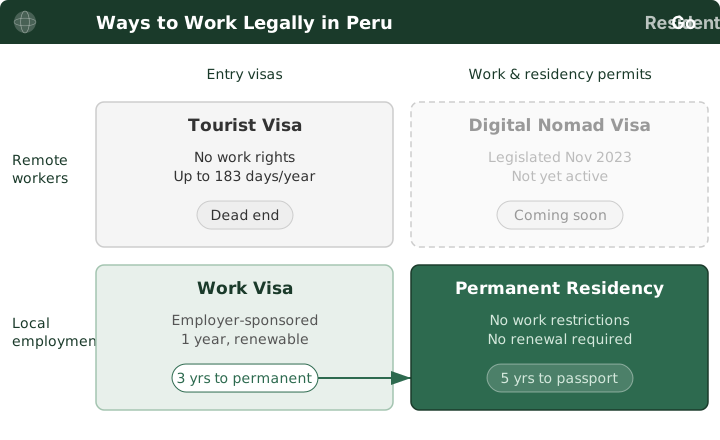
If a Peruvian company is hiring you, you need an employer-sponsored work visa (Visa de Trabajador Residente). The employer's contract must be approved by the Ministry of Labor (MTPE), and the company must prove it meets the 80/20 local-to-foreign workforce ratio. After three years of continuous legal residence, this path leads to permanent residency. Peru legislated a Digital Nomad Visa in November 2023 (Decreto Legislativo 1582), but the implementing regulations have not been published and the visa remains unavailable as of early 2026. Remote workers currently enter on tourist status (up to 183 days per year), which does not legally authorize any form of paid work.
Comparing Work Visas in Detail
| Employer-Sponsored Work Visa | Tourist Visa (no work rights) | |
|---|---|---|
| For | Local employment | Short-term stays only |
| Legal basis | Decreto Legislativo 1350, Decreto Supremo 007-2017-IN | Decreto Legislativo 1350 |
| Who qualifies | Foreign nationals with a Peruvian employer | Most nationalities (visa-free entry) |
| Key requirement | MTPE-approved contract, 80/20 workforce ratio | Valid passport, return ticket |
| Duration | 1 year, renewable (max 3-year contract) | Up to 183 days/year |
| Processing time | 1–3 months | On arrival |
| Government fees | ~USD 50–100 | Free (visa-exempt nationalities) |
| Remote work for foreign employer | No | Not permitted |
| Work for Peruvian companies | Yes, sponsoring employer only | No |
| Change employer | Requires new contract and authorization | - |
| Open bank account | Yes | Difficult without residency |
| Include dependents | Yes (via separate family visa) | - |
| Path to permanent residency | Yes, after 3 years | No |
*Peru legislated a Digital Nomad Visa in November 2023 (Decreto Legislativo 1582), but the implementing regulations and TUPA procedures have not been published. The visa is not yet available for applications.*
Employer-Sponsored Work Visa
Peru's work visa (Visa de Trabajador Residente) requires a Peruvian company to hire you under a formal employment contract approved by the Ministry of Labor (MTPE). The company must comply with Peru's foreign worker caps: no more than 20% of its workforce can be foreign nationals, and no more than 30% of total payroll can go to foreign employees. Contracts for foreign workers are limited to a maximum of three years, though they can be renewed. These rules are among the strictest in Latin America and make it significantly harder for small companies to sponsor foreign hires.
Documents required
- Signed employment contract (minimum 12 months) detailing role, salary, and duration, approved by the MTPE
- Employer's SUNAT registration (RUC) showing active status, plus company registration naming the legal representative
- Sworn declaration of no criminal record in Peru or abroad
- Interpol clearance (Ficha de Canje Internacional), valid within 6 months
- Valid passport with at least 6 months remaining
- If the contract was signed abroad, it must be legalized by the Peruvian consulate. If signed in Peru, you need a "permiso para firmar contratos" (permit to sign contracts), obtainable online since 2018.
- All foreign documents apostilled or legalized and translated into Spanish
Process
The process has two stages. First, the employer submits the employment contract to the MTPE for approval, which typically takes several weeks. Nationals of Colombia, Bolivia, Ecuador, and Spain are exempt from this approval requirement under bilateral agreements. Second, the employee applies for the work visa through Migraciones (Peru's immigration authority), either from within Peru (if on valid tourist status) or at a Peruvian consulate abroad. Total processing time ranges from one to three months depending on the office and completeness of the application.
If you are already in Peru on a tourist visa, you can apply for a change of immigration status to worker, but you must have a valid "permiso para firmar contratos" before signing any employment contract. Business travelers do not need this separate permit.
Tax treatment
Work visa holders are subject to progressive income tax on their Peruvian salary and are enrolled in the EsSalud public health system. If they stay more than 183 days, they become tax residents and owe tax on worldwide income. See the tax section below for brackets and rates.
Remote Work Without a Visa
Peru has no active Digital Nomad Visa. The legislation passed in November 2023 (Decreto Legislativo 1582) created a "Nómada Digital" residence category under the Migration Law, intended to allow remote workers earning foreign income to stay up to 365 days with a possible renewal. However, the Superintendencia Nacional de Migraciones has not published the implementing regulations (TUPA), so the visa cannot be applied for. As of early 2026, no timeline has been confirmed.
In practice, most remote workers enter Peru on visa-free tourist status (up to 183 days for US, EU, and most other nationalities). No form of paid work is legally permitted on tourist status, including remote work for a foreign employer. Enforcement against laptop-based remote work has been minimal, but the legal risk exists. Until the Digital Nomad Visa becomes available, remote workers needing a legal framework may find it in neighboring countries: Colombia (from ~USD 1,300/month), Ecuador (USD 1,446/month, and the DN visa counts toward permanent residency), or Brazil (USD 1,500/month).
For long-term residency pathways, see our Peru Residency Guide.
Taxes and Health Insurance
Peru uses a worldwide tax system for residents. If you spend more than 183 days in the country within a 12-month period, you become a tax-domiciled individual starting January 1 of the following year. From that point, all income, including income from foreign sources, is subject to Peruvian tax. Non-domiciled individuals pay a flat 30% rate only on Peruvian-source income.
For domiciled individuals, progressive income tax rates apply to employment and foreign income (2026 figures, where one Tax Unit/UIT = PEN 5,500, approximately USD 1,486). The first 7 UIT (~USD 10,400) of annual income is tax-free. Above that: 8% on the first 5 UIT of taxable income (~USD 7,400), 14% up to 20 UIT (~USD 29,700), 17% up to 35 UIT (~USD 52,000), 20% up to 45 UIT (~USD 66,900), and 30% on anything above. Up to 3 additional UIT can be deducted for qualifying expenses such as rent, restaurants, and professional services.
Employers contribute 9% of each employee's gross salary to EsSalud, Peru's public health insurance system. This is entirely employer-funded. Employees contribute 13% of their salary to the public pension system (ONP) or a variable percentage (around 12–13%) to a private pension fund (AFP), depending on their choice. These pension contributions are deducted from the employee's salary. There are no additional payroll taxes, but employers must also pay two mandatory bonus salaries per year (13th month in July, 14th month in December).
Peru has double taxation treaties with Brazil, Canada, Chile, Japan, South Korea, Mexico, Portugal, and Switzerland. An Andean Community agreement covers Bolivia, Colombia, and Ecuador. A treaty with the United Kingdom was signed in March 2025 and is pending ratification. Peru has no double taxation treaty and no totalization agreement with the United States. US citizens working in Peru may owe US tax on worldwide income, with the Foreign Earned Income Exclusion (approximately USD 130,000 for 2025) potentially offsetting some or all of the Peruvian liability.
Remote workers on tourist status are not enrolled in EsSalud and have no local social security obligation. Private health insurance in Peru is widely available, with plans from international and local providers typically costing USD 50 to 200/month depending on age and coverage level.
Regardless of visa type, tax obligations in your home country may still apply. Holding a Peruvian visa does not automatically end tax residency elsewhere.
Starting a Business in Peru
The employer-sponsored work visa ties you to a single company and does not allow you to run your own business. If you want to start or invest in a Peruvian company, you need a residency visa that authorizes local economic activity.
Foreigners can incorporate a company in Peru without residency. The most common structures are the Sociedad Anónima Cerrada (S.A.C.) and Sociedad Comercial de Responsabilidad Limitada (S.R.L.). Incorporation is relatively straightforward and can be completed through a Peruvian notary. However, to actually work in or manage the business day-to-day, you need a visa that authorizes local work. A practical workaround used by many foreign entrepreneurs: incorporate a Peruvian company, have it issue you a work contract, and apply for a work visa through that company. The company must be registered with SUNAT and be in active status. Minimum capital requirements are low (no statutory minimum for an S.A.C.), but you must pay yourself at least the minimum wage of PEN 1,130/month (~USD 305) and cover all associated employer contributions.
For a detailed breakdown of residency categories, including the Rentista (passive income) and Inversionista (investor) paths, see our Peru Residency Guide.
Tourist Visa and Work Rights
Most nationalities enter Peru visa-free for up to 183 days per year. Immigration officers typically stamp 90 days on arrival, extendable at a Migraciones office for an additional 90 days (total maximum 183 days per calendar year). No paid work of any kind is permitted, including remote work for a foreign employer.
Overstaying results in a fine of approximately USD 1.20 per day, payable at the airport on departure. Repeated overstays can lead to entry denials. Unlike Costa Rica or Panama, Peru does not have a low-cost Digital Nomad Visa to formalize remote work, so working on tourist status remains a legal gray area. Once the Digital Nomad Visa regulations are published, it will become the proper option for remote workers planning extended stays.
Frequently Asked Questions (FAQ)
🛂 Visa & Legal
Can US citizens work in Peru?
Yes, but only with an employer-sponsored work visa. US citizens enter Peru visa-free for up to 183 days, but tourist status does not permit any paid work. There are no special work privileges for US nationals. For remote work, there is currently no legal visa option; the Digital Nomad Visa has been legislated but is not yet active.
Can I work in Peru on a tourist visa?
No. Tourist status allows stays of up to 183 days per year but prohibits all forms of paid work, including remote work for foreign employers. Enforcement for laptop-based remote work has been light, but the legal prohibition is clear. The upcoming Digital Nomad Visa is intended to address this gap.
Can freelancers work legally in Peru?
Not easily. Peru has no active Digital Nomad Visa for freelancers serving foreign clients. Freelancers can work for Peruvian clients under a service contract (contrato de locación de servicios), which requires a work visa and registration with SUNAT for tax purposes. Freelancers serving exclusively foreign clients have no dedicated legal pathway until the Digital Nomad Visa becomes operational.
How long does it take to get a work visa in Peru?
Typically 1 to 3 months total. The MTPE contract approval takes several weeks, followed by the Migraciones visa application which takes another 30 to 60 business days. Completeness of documentation is the biggest factor in speed.
Can I switch from a tourist visa to a work visa inside Peru?
Yes. You can apply for a change of immigration status from tourist to worker at Migraciones in Lima, provided your tourist stay is still valid. Before signing any employment contract in Peru, you must first obtain a "permiso para firmar contratos" (permit to sign contracts), which can be done online.
Can I work remotely in Peru without a work visa?
There is no legal visa category for remote work in Peru as of early 2026. The Digital Nomad Visa was legislated in November 2023 but has not been activated. Most remote workers enter on tourist status (up to 183 days), though this does not legally authorize paid work. Once the Digital Nomad Visa regulations are published by Migraciones, it will offer a legitimate pathway.
What visa should remote workers use in Peru?
Until the Digital Nomad Visa becomes active, there is no dedicated visa for remote workers. Most use visa-free tourist entries (up to 183 days). For stays beyond 183 days, the only options are employer-sponsored work visas or residency visas (such as the Rentista visa for people with passive foreign income of at least USD 1,000/month). Neither is designed for remote work, but the Rentista visa allows long-term stays without local employment restrictions.
Can I include my family in a Peru work visa application?
Not on the work visa itself, but dependents can apply for a separate family visa (Visa de Familiar Residente) once the principal applicant has an approved work visa. This covers spouses and children. Dependents on a family visa are not authorized to work unless they obtain their own work authorization.
What types of jobs qualify for a Peru work permit?
Most jobs qualify in principle, but the 80/20 rule limits hiring: at least 80% of any company's workforce must be Peruvian, and foreign employees cannot receive more than 30% of total payroll. Exempt from these limits are foreign nationals married to Peruvians, permanent residents, nationals of Andean Community countries, and employees in managerial roles of companies with foreign investment. The employer must also demonstrate that the role requires specialized skills.
💰 Money & Tax
What is the average salary in Peru?
Approximately USD 700/month (~PEN 2,600–2,900). The minimum wage is PEN 1,130/month (~USD 305) as of January 2025, uniform across all sectors. Software developers employed locally earn roughly USD 15,000 to 40,000/year, with senior roles and those working remotely for international companies earning significantly more.
Does Peru tax foreign income?
Yes, if you are a tax resident. Peru uses worldwide taxation for domiciled individuals (those present more than 183 days in a 12-month period). All income, including foreign-sourced income, becomes taxable at progressive rates from 8% to 30%. Non-residents pay a flat 30% only on Peruvian-source income. This is a critical difference from territorial-tax countries like Costa Rica and Panama, where foreign income is never taxed.
How much does it cost to apply for a Peru work visa?
Government fees total approximately USD 50 to 100, covering the MTPE contract registration and the Migraciones visa application (PEN 165 for a temporary work visa). Additional costs for apostilles, certified translations, and legal assistance are separate.
🏠 Practical
Do I need to speak Spanish to work in Peru?
No formal language requirement exists for the work visa itself. However, for local employment, professional-level Spanish is expected by most employers. English-language roles exist primarily in international companies, tourism, and tech. All visa documents must be submitted in Spanish (certified translations accepted).
Is health insurance mandatory for work visa holders in Peru?
Yes. Work visa holders are enrolled in EsSalud, Peru's public health system, funded by a mandatory 9% employer contribution on gross salary. EsSalud provides access to public hospitals and clinics. Many employers supplement this with private health insurance (EPS) for better facilities and shorter wait times. Remote workers on tourist status have no mandatory coverage but should carry private health insurance.
Compare all 12 countries in our Working Abroad Guide. Looking for residency instead? See our Latin America Residency Guide.