Peru is one of the most accessible residency destinations in South America, combining a remarkably low income threshold for passive-income residency with a fast path to citizenship. Unlike many countries that require years of temporary renewals before granting long-term status, Peru’s Rentista visa already carries indefinite validity from the outset, and naturalization is possible after just two years of continuous legal residency - a timeline matched only by Argentina. These features, together with Peru’s low cost of living and one of the region’s richest cultural and geographic landscapes, make it an unusually practical option for individuals seeking a long-term base in Latin America.
Peru Residencies Overview
| Residency Path | Exists | Minimum Requirement | Duration | Leads to Permanent Residency | Key Insight |
|---|---|---|---|---|---|
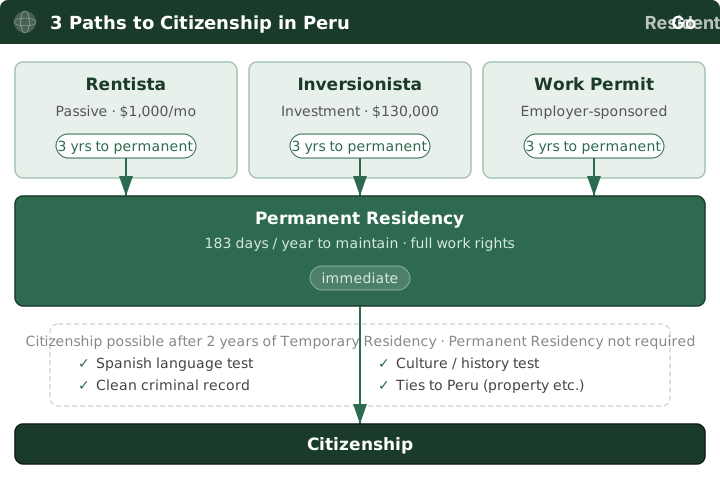
| Rentista | Yes | USD 1,000 / month passive income | Indefinite | Yes (after 3 years) | No employment permitted |
| Pensionado | No (separate) | — | — | — | Covered by Rentista visa |
| Inversionista | Yes | PEN 500,000 (~USD 130,000) | 1 year (renewable) | Yes (after 3 years) | Must hire 5 local employees |
| Work Permit | Yes | Employer-sponsored | 1 year (renewable) | Yes (after 3 years) | 80/20 local workforce rule |
| Asset-based | No | — | — | — | Not available |
| Digital Nomad | Legislated | To be defined | Up to 365 days | No | Not yet operational |
*Indicative minimum thresholds shown as of 2026. Interpretation and documentation standards may vary.*
Step-by-Step Guide from Resident to Passport
Prepare documents in your home country
The following documents must be obtained in your home country before traveling to Peru:
- Birth certificate
- Police clearance certificate (Interpol international record where applicable)
- Marriage certificate (if applicable)
- Birth certificates and police clearance of spouse and children (if applicable)
- Residency-specific proof of eligibility (such as income certification, pension statements, or investment documentation)
- Valid passport with at least six months remaining validity
All official documents issued outside Peru require legalization. For countries that are party to the Hague Apostille Convention, this means obtaining an apostille in the country of origin. Documents not in Spanish must be translated by a certified translator recognized by the Peruvian government. In practice, this means obtaining the original document, arranging a certified Spanish translation, and submitting both for apostille or consular legalization.
Enter Peru and file the application
Once all documents are prepared, the applicant typically enters Peru on a tourist status and then files a change of immigration status (Cambio de Calidad Migratoria) at the Superintendencia Nacional de Migraciones, which includes:
- Submitting the full application and supporting documents to Migraciones
- Paying the applicable government filing fees (approximately PEN 163 for a change of status)
- Registering fingerprints and biometric data
All applications are processed in Spanish and follow local administrative procedures. Communication, follow-ups, and requests for clarification take place at Migraciones offices in Peru, which is why many applicants choose to work with local immigration professionals or bilingual attorneys.
Application review and waiting period
After the application is submitted, Migraciones reviews the documentation and supporting evidence before issuing a decision.
- Wait for the application to be reviewed by Migraciones
- Provide additional documents or clarifications if requested
- Attend follow-up appointments if required
During this period, applications are reviewed administratively. Processing times vary depending on the visa category and current workload. Rentista applications are typically processed within 30 to 60 days, while Inversionista applications may take longer due to the verification of investment documentation and business plans.
Residency approval and carné de extranjería
Once the application is approved, the applicant must complete the registration process locally to obtain their formal identification.
- Obtain the carné de extranjería (foreign resident identification card) from Migraciones
- Register with SUNAT (Peru’s tax authority) if applicable
- Comply with ongoing residency conditions, including physical presence requirements
The Rentista visa is granted with indefinite validity but requires the holder to remain in Peru for at least 183 days per calendar year. Absences exceeding a cumulative total of six months in a calendar year may result in loss of residency status. The Inversionista visa is granted for one year and must be renewed annually.
Renewals and transition to permanent residency
The path to permanent residency differs depending on the visa category. The Rentista visa does not require periodic renewal due to its indefinite validity, but it does not automatically confer permanent residency either. Formal permanent residency must be applied for separately.
- For Inversionista visa holders: renew the visa annually by demonstrating that the investment has been maintained and that at least five local employees remain employed
- Maintain uninterrupted legal residency status throughout the qualifying period
- Apply for permanent residency after three years of continuous legal residency
Permanent residency, once granted, removes income or investment proof requirements and allows the holder to live and work in Peru indefinitely. Permanent residents must still not remain outside Peru for more than 183 days per year to maintain their status.
Path to citizenship
Peruvian citizenship can be obtained through naturalization after a relatively short period of legal residency. For most applicants, this means:
- Hold legal residency in Peru for at least 5 consecutive and uninterrupted years
- Demonstrate ties to Peru, such as owning residential property or holding a local membership (e.g. club or community organization)
- Pass a Spanish language assessment
- Demonstrate knowledge of Peruvian culture, history, and constitutional values
- Maintain a clean criminal record in both Peru and the country of origin
- Demonstrate a stable and guaranteed income source
- Submit a separate naturalization application to the Peruvian authorities
Peru recognizes dual citizenship without restriction. Applicants are not required to renounce their existing nationality when obtaining Peruvian citizenship. Under Law 32421 (August 2025), the residency requirement increased from 2 to 5 years. The period is counted from the date the initial residency permit is obtained and must be continuous.
Overview of Peru Visas
Residencies that are based on Working Permits or Working visas are described in detail here:
→ Working Visas in Peru
Peru offers several residency pathways based on passive income, investment, or employment. The most relevant categories for international individuals seeking long-term residency are the Rentista visa and the Inversionista visa. Peru does not distinguish between retirees and other passive-income recipients in a separate visa category; both are covered under the Rentista framework. Citizenship can be pursued after 5 years of legal residence (Law 32421, August 2025).
Rentista Visa (Passive Income / Retiree Residency)
The Rentista visa is Peru’s primary residency pathway for financially independent individuals, including retirees. It is designed for applicants who receive a permanent passive income from sources outside Peru of at least USD 1,000 per month - one of the lowest income thresholds in Latin America, comparable to Panama and Costa Rica's Pensionado programs. This income must be deposited into a Peruvian bank account. Holders of the Rentista visa are not permitted to work in Peru. The visa carries indefinite validity and does not require periodic renewal, but it is not formally classified as permanent residency.
Proof typically requires:
- Official certification of a permanent income from outside Peru of at least USD 1,000 per month (such as a pension letter, annuity contract, or income declaration from a financial institution)
- Documentation confirming that the income source is permanent and ongoing, not fixed-term or discretionary
- Commitment to transfer the qualifying income to a bank account held at a recognized Peruvian financial institution
- For each dependent (spouse or child under 25), proof of an additional USD 500 per month of income
- If documents are issued outside Peru, they must be legalized by the relevant Peruvian consulate and endorsed by Peru’s Ministry of Foreign Affairs, or apostilled under the Hague Convention
Inversionista Visa (Investment Residency)
The Inversionista visa is available to applicants who make a qualifying investment of at least PEN 500,000 (approximately USD 130,000) in a Peruvian company. Under Legislative Decree No. 1350, the investment must be made as a single bank transfer from an account held in the applicant’s name. Unlike some countries where personal assets like property or vehicles may qualify, Peru requires the investment to be directed into a registered business entity.
Proof typically requires:
- Notarized or DIGEMIN-authenticated documentation of the investment in a Peruvian company registered in the Public Registry, showing a minimum of PEN 500,000 in cash
- A business plan certified as viable by a local certified economist (for newly formed companies) or a two-year operational business plan (for existing companies)
- Commitment to create at least five employment positions for Peruvian nationals within the first year of operations
- International police clearance (Interpol redemption card)
- Evidence that the investment was made via a single international bank transfer from an account in the applicant’s name
Digital Nomad Visa (not yet operational)
In November 2023, Peru legislated a Digital Nomad residency category through Decreto Legislativo 1582, which modifies Peru’s existing immigration law. This visa is intended for individuals who work remotely for companies or clients based outside Peru using digital technologies. Holders would not be permitted to earn income from Peruvian sources or work for Peruvian employers.
As of early 2026, the Digital Nomad visa has not yet become operational. The administrative regulations (TUPA) defining specific eligibility requirements, documentation, fees, and application procedures have not been published by Migraciones. Until these regulations are finalized, applications for this visa category cannot be submitted. The legislated framework envisions a stay of up to 365 days with the possibility of extension, but specific income thresholds and documentation requirements remain undefined.
Tax Residency Considerations in Peru
From a tax perspective, Peru is relevant for individuals who are evaluating how physical presence interacts with tax obligations, particularly those who maintain income from foreign sources. Unlike territorial tax systems such as those in Costa Rica or Panama, Peru applies worldwide taxation to individuals who become tax-domiciled in the country, which makes careful planning essential.
- Peru determines tax domicile based on physical presence: individuals who spend more than 183 days in Peru within any 12-month period are considered tax-domiciled
- Tax domicile status takes effect on January 1 of the year following the year in which the 183-day threshold is met, meaning there is a one-year delay between qualifying and being taxed as a resident
- Domiciled individuals are subject to income tax on their worldwide income, including foreign-sourced earnings
- Non-domiciled individuals are only taxed on Peruvian-source income, generally at a flat rate of 30%
- Immigration residency and tax domicile are separate concepts; holding a Rentista visa does not automatically create tax domicile if the 183-day threshold is not met
- There is no wealth tax, no gift tax, and no inheritance tax in Peru
- Peru does not have a tax treaty with the United States, though it has agreements with several other countries including members of the Andean Community (CAN)
Income generated within Peru by domiciled individuals is subject to progressive personal income tax, with marginal rates ranging from 8% to 30%. The first seven tax units (UIT) of annual income are exempt from tax. For 2025, one UIT equals PEN 5,350, placing the annual exemption at approximately PEN 37,450 (roughly USD 10,000). Non-domiciled individuals face a flat 30% withholding on Peruvian-source employment income. Tax brackets and the UIT value are adjusted periodically by the government.
Residency Status Comparison
| Status | Typical Duration | Status Renewal | Identification | Minimum Presence to Maintain Status | Counts Toward Citizenship |
|---|---|---|---|---|---|
| Tourist | Up to 183 days per year | Via re-entering | Passport | None | No |
| Rentista Visa | Indefinite | Not required | Carné de Extranjería | At least 183 days per year | Yes |
| Inversionista Visa | 1 year (renewable) | Annual renewal | Carné de Extranjería | At least 183 days per year | Yes |
| Permanent Residency | Indefinite | Not required | Carné de Extranjería | At least 183 days per year | Yes |
| Citizenship | Permanent | Not required | DNI / Passport | None | — |
Peru's Path to Citizenship
You can apply for Peruvian citizenship after 5 years of continuous legal residency (Law 32421, August 2025, extended from the previous 2-year requirement). This applies to all visa categories including Rentista and Inversionista. Peru recognizes dual citizenship without restriction, so no renunciation is required.
The 5-year requirement is just the minimum. Applicants must also demonstrate ties to Peru (such as property ownership or community membership), pass assessments in Spanish and Peruvian culture, and wait 6 to 12 months for the application to be reviewed once submitted.
Rentista Tax Exemption and Its Limits
If your only foreign income is a traditional pension, Peru is effectively tax-free. Rentista visa holders are exempt from income tax on government pensions, private employment pensions, social security, and disability payments. They may also be exempt from the annual foreign resident tax and import duties on personal items.
The exemption stops at pensions. Dividends, capital gains, interest, and foreign rental income are not covered. If you spend more than 183 days in Peru and become tax-domiciled (effective January 1 of the following year), those non-pension streams are taxed at progressive rates of 8% to 30%. The pension stays exempt; everything else does not.
Opening a Bank Account as a Foreigner
You need a Peruvian bank account to apply for the Rentista visa, but most banks won't open one without a Carné de Extranjería, which you only get after residency is approved. This circular dependency is the most common practical obstacle reported by applicants.
Legally, a passport is sufficient. In practice, branches of BCP, BBVA Peru, Interbank, and Scotiabank each apply their own policies and many refuse without explanation. Branches in Lima's Miraflores and San Isidro districts are more experienced with foreign clients. Most immigration service providers include bank account facilitation in their packages specifically because of this bottleneck.
Frequently Asked Questions
✅ Eligibility
What is the most common residency path for expats in Peru?
The Rentista visa is Peru's primary residency pathway for financially independent individuals, including retirees. It requires proof of at least USD 1,000 per month in permanent passive income from outside Peru and grants indefinite validity without periodic renewal.
Can I include my family in a Peru residency application?
Yes. Main applicants can include a spouse and children under 25 as dependents. For each dependent, you must prove an additional USD 500 per month of qualifying passive income.
What is the minimum income required for Peru residency?
The Rentista visa requires a minimum of USD 1,000 per month in permanent passive income, such as a pension or annuity. This income must be deposited into a Peruvian bank account.
What is the minimum investment amount required for Peru residency?
The Inversionista visa requires an investment of at least PEN 500,000 (~USD 130,000) in a Peruvian company, made as a single bank transfer. You must also create at least five employment positions for Peruvian nationals within the first year.
📝 Process & Timeline
How much does it cost to apply for Peru residency?
About $42. The government filing fee for a change of immigration status is approximately PEN 163. Additional costs for apostilles, certified translations, and legal assistance are separate.
What documents do I need to apply for Peru residency?
Key documents include a valid passport (at least six months validity), birth certificate, police clearance certificate, proof of qualifying income or investment, and a marriage certificate if applicable. All foreign documents must be apostilled and translated into Spanish by a certified translator.
Can I apply for Peru residency while visiting as a tourist?
Yes. Since August 2021, Peruvian consulates no longer process resident visa applications abroad. Most applicants enter Peru as tourists and then file a change of immigration status (Cambio de Calidad Migratoria) at Migraciones in Peru. All documents must be fully prepared and legalized before arrival.
Do I need to open a bank account in Peru to apply for residency?
Yes, a Peruvian bank account is required for the Rentista visa since your qualifying income must be deposited there. However, most banks require a Carné de Extranjería that you only get after approval, creating a common catch-22. Branches in Lima's Miraflores and San Isidro districts are more experienced with foreign clients, and many immigration service providers include bank account facilitation in their packages.
How long does it take to get temporary residency in Peru?
Rentista visa applications are typically processed within 30 to 60 days after submission to Migraciones. Inversionista applications may take longer due to verification of investment documentation and business plans. Applicants should plan to remain in Peru until the decision is issued.
How long does it take to get Peru citizenship?
You can apply for Peruvian citizenship after 5 continuous years of legal residency (changed from 2 years by Law 32421, August 2025). Once submitted, the application takes an additional 6 to 12 months to be reviewed. You must also pass assessments in Spanish and Peruvian culture and demonstrate ties to Peru.
🏠 Living in Peru
Do I need to live in Peru to maintain residency?
Yes. Both Rentista and Inversionista visa holders must spend at least 183 days per calendar year in Peru. Absences exceeding a cumulative six months in a calendar year may result in loss of residency status.
Can I work in Peru as a foreign resident?
Not on the Rentista visa, which explicitly prohibits employment in Peru. However, if you obtain permanent residency (available after three years of continuous legal residency), you gain the right to work locally and indefinitely.
Does Peru tax foreign income?
It depends on your domicile status. If you spend more than 183 days in Peru, you become tax-domiciled effective January 1 of the following year and are taxed on worldwide income at progressive rates of 8% to 30%. Rentista holders are exempt from income tax on pensions specifically, but dividends, capital gains, interest, and foreign rental income are not exempt. Peru has no wealth tax, gift tax, or inheritance tax.
Is health insurance mandatory for residents in Peru?
There is no formal legal requirement to hold private health insurance to obtain or maintain a Rentista visa. However, it is strongly recommended. Employed residents are automatically enrolled in Peru's public system (EsSalud) through employer contributions, while self-employed or non-working residents typically arrange private coverage or voluntarily enroll in EsSalud after obtaining residency.
Can I have dual citizenship with Peru?
Yes. Peru recognizes dual citizenship without restriction. Applicants are not required to renounce their existing nationality when obtaining Peruvian citizenship.