Panama is one of the most diversified residency destinations in Latin America, offering well-established pathways for retirees, investors, and nationals of selected countries. Unlike many countries in the region - where years of temporary status come first - Panama grants immediate permanent residency under several of its programs, a feature shared only with Uruguay among the 12 most popular Latin American destinations, including the Pensionado visa for retirees (in place since 1987) and the Qualified Investor Visa introduced in 2020. Panama’s use of the US dollar as its official currency, its territorial tax system, and its strategic location as a global trade hub further distinguish it from other countries in the region.
Panama Residencies Overview
| Residency Path | Exists | Minimum Requirement | Duration | Leads to Permanent Residency | Key Insight |
|---|---|---|---|---|---|
| Pensionado | Yes | USD 1,000 / month lifetime pension | Permanent | Immediate | Grants permanent residency from day one |
| Rentista | No | — | — | — | No dedicated passive-income visa |
| Inversionista | Yes | USD 300,000 investment (Qualified Investor) | Permanent | Immediate | Real estate, securities, or bank deposit |
| Asset-based | Limited | USD 200,000 bank deposit (Friendly Nations) or USD 750,000 (Qualified Investor) | Varies | Yes | Bank deposit must be locked for 3–5 years |
| Work Permit | Yes | Employer-sponsored + residency visa | 1–2 years, renewable | Yes (via underlying visa) | 10% foreign worker cap; some professions reserved for Panamanians |
| Digital Nomad | Limited | USD 3,000 / month income | Temporary | No | 9 months, extendable once to 18 months |
| Friendly Nations Visa | Yes | Employment, professional activity, or USD 200,000 bank deposit | 2 years provisional | Yes | ~50 eligible nationalities |
*Indicative minimum thresholds shown as of 2026. Interpretation and documentation standards may vary.*
Step-by-Step Guide from Resident to Passport
Prepare documents in your home country
The following documents must be obtained in your home country before traveling to Panama:
- Birth certificate
- Police clearance certificate (national-level, covering the last five years of residence)
- Marriage certificate (if applicable)
- Birth certificates and police clearance of spouse and children (if applicable)
- Residency-specific proof of eligibility (such as pension confirmation, investment documentation, or proof of economic ties)
- Health certificate (may be obtained from a Panamanian doctor upon arrival, depending on the visa category)
All official documents must be either apostilled (for countries party to the Hague Apostille Convention) or authenticated by the nearest Panamanian consulate. Documents not in Spanish require a certified Spanish translation. Most certificates, including police clearance and health certificates, must have been issued within six months of the application submission date.
Enter Panama and file the application
Once all documents are prepared, the residency application must be filed in Panama through a licensed immigration attorney, which includes:
- Submitting the full application to the National Immigration Service (Servicio Nacional de Migración)
- Paying government filing fees and repatriation deposits as required by the specific visa category
- Registration of fingerprints and biometrics
Under Panamanian law (Decree Law No. 3 of 2008, Article 28), all visa applications must be filed through a licensed immigration attorney. Self-filing is not permitted. Applications are processed in Spanish, and all communications with immigration authorities are handled locally.
Application review and waiting period
After filing, the application enters a formal review phase with immigration authorities:
- Wait for the application to be reviewed by the National Immigration Service
- Provide additional documents or clarifications if requested
- Attend follow-up appointments if required
Processing times vary significantly by visa type. The Qualified Investor Visa is typically processed within 30 to 45 business days. The Pensionado visa averages three to six months. The Friendly Nations Visa typically takes two to four months for the initial provisional residency approval. During the review period, applicants may receive a provisional processing card that permits travel in and out of Panama.
Residency approval
Once the application is approved, residency is granted and must be completed locally.
- Obtain the permanent or provisional residency card
- Register with the Electoral Tribunal to receive a Panamanian identification document (E-Cédula)
- Comply with ongoing residency conditions specific to the visa category
Programs that grant immediate permanent residency (Pensionado, Qualified Investor) issue a permanent resident card directly. The Friendly Nations Visa initially grants a two-year provisional residency, after which applicants can apply for permanent residency if they have maintained the original qualifying conditions.
Renewals and transition to permanent residency
For visa categories that grant immediate permanent residency (Pensionado, Qualified Investor), no renewal or transition step is required. Permanent residency is valid indefinitely, provided the minimum presence requirement of one visit every two years is maintained.
- Maintain the qualifying investment or pension during the required holding period (for example, 5 years for Qualified Investor investments)
- Enter Panama at least once every two years
- For Friendly Nations Visa holders: apply for permanent residency after two years of provisional residency, demonstrating continued compliance with the original qualifying conditions
For the Friendly Nations Visa, the transition from provisional to permanent residency requires a separate application. Applicants must demonstrate that the employment, real estate investment, or bank deposit that originally qualified them is still in place.
Path to citizenship
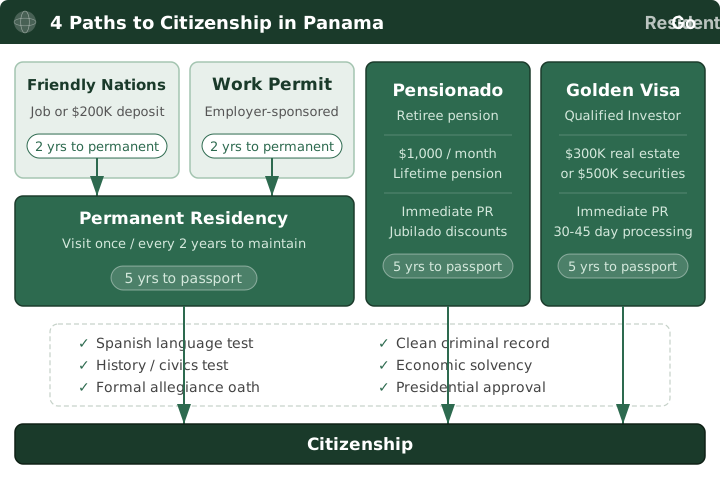
Panamanian citizenship can be obtained through naturalization after long-term permanent residency. For most applicants, this means:
- Hold permanent residency in Panama for at least 5 continuous years (reduced to 3 years for those married to a Panamanian citizen or with Panamanian-born children)
- Maintain uninterrupted legal residency status during this period
- Pass a Spanish language exam and a test on Panamanian history, geography, and civic rights administered by the Electoral Tribunal
- Demonstrate good conduct, including a clean criminal record from both Panama and the country of origin
- Demonstrate economic solvency and stable livelihood in Panama
- Submit a formal naturalization application addressed to the President of the Republic of Panama
Citizenship approval is ultimately granted by the President of Panama personally, making the process discretionary. Only years spent under permanent residency count toward the naturalization timeline; time spent under temporary, provisional, or tourist status does not qualify. Upon naturalization, applicants must formally declare their allegiance to the Panamanian Constitution and renounce civil and political ties with their country of origin, although the practical effect of this renunciation varies by the applicant’s home country.
Overview of Panama Visas
Residencies that are based on Working Permits or Working visas are described in detail here:
→ Working Visas in Panama
Panama offers several well-established residency pathways based on retirement income, investment, or economic ties. Several options grant immediate permanent residency, while the Friendly Nations Visa follows a two-step process from provisional to permanent status. Panamanian citizenship can be pursued after 5 years of permanent residency.
Pensionado Visa (Retiree Residency)
The Pensionado residency is Panama’s flagship retirement program, in place since 1987. It is intended for retirees who receive a guaranteed lifetime pension of at least USD 1,000 per month - the same threshold as Costa Rica's Pensionado. The pension must be permanent and for life; fixed-term annuities or discretionary payouts generally do not qualify. If the applicant owns real estate in Panama valued at USD 100,000 or more, the minimum pension threshold is reduced to USD 750 per month. Each dependent included in the application increases the required monthly pension by USD 250.
Proof typically requires:
- Official pension letter issued by a government agency, social security institution, military retirement fund, or private corporate pension plan confirming a lifetime pension of at least USD 1,000 per month
- Documentation explicitly confirming that the pension is lifetime and permanent, not fixed-term or discretionary
- Pension payment history (for example bank statements) demonstrating that pension payments have been received consistently
- If claiming the reduced threshold: proof of ownership of Panamanian real estate valued at USD 100,000 or more
Qualified Investor Visa (Golden Visa)
The Qualified Investor Visa, established by Executive Decree No. 722 of October 2020 and updated by Decree No. 193 of October 2024, grants immediate permanent residency to foreign nationals who make a qualifying investment in Panama using funds of foreign origin. Three investment routes are available:
Proof typically requires:
- Real estate investment: Purchase of Panamanian property worth at least USD 300,000, free of liens, held for a minimum of 5 years. Pre-sale purchases with notarized contracts are also accepted.
- Securities investment: Purchase of at least USD 500,000 in Panamanian securities through a licensed local brokerage firm, held for a minimum of 5 years
- Fixed-term bank deposit: A time deposit of at least USD 750,000 in an approved Panamanian bank, free of liens, for a minimum term of 5 years
- Proof that all investment funds originate from abroad (foreign-source requirement)
- Government fees of USD 5,000 to the National Immigration Service and USD 5,000 to the National Treasury for the main applicant, plus USD 1,000 per dependent to each entity
Friendly Nations Visa (Economic Ties Residency)
The Friendly Nations Visa is available to citizens of approximately 50 countries with which Panama maintains close economic and professional ties, including the United States, Canada, the United Kingdom, all EU member states, Australia, Japan, Brazil, and several Latin American nations. Unlike the Pensionado or Qualified Investor programs, the Friendly Nations Visa initially grants a two-year provisional residency, after which permanent residency can be applied for separately.
Proof typically requires one of the following economic ties:
- Employment in Panama: A valid employment contract with a registered Panamanian company, along with a work permit application filed with the Ministry of Labor (MITRADEL)
- Real estate investment: Proof of ownership of Panamanian property with a registered value of at least USD 200,000 (can be financed through a local bank)
- Fixed-term bank deposit: A certificate of deposit of at least USD 200,000 in a Panamanian bank, free of liens, with a minimum validity of 3 years
Digital Nomad Visa (Short-Stay Visa for Remote Workers)
Panama’s Digital Nomad Visa, formally the Short-Stay Visa for Remote Workers (established by Executive Decree 198 of May 2021), allows remote workers employed by foreign companies or working as independent freelancers to reside in Panama for up to 9 months, extendable once for an additional 9 months (18 months total). This visa does not lead to permanent residency and does not permit work for Panamanian companies or clients.
Proof typically requires:
- Proof of remote employment with a foreign company or independent freelance activity with clients outside Panama
- Minimum annual income of USD 36,000 (equivalent to USD 3,000 per month)
- Valid health insurance covering the full duration of stay in Panama
- Sworn declaration not to accept work offers or provide services within Panama
Tax Residency Considerations in Panama
From a tax perspective, Panama is widely considered one of the most favorable jurisdictions in Latin America for individuals who earn income abroad, hold international assets, or are planning long-term residency without automatically triggering worldwide taxation.
However, tax outcomes depend on personal circumstances, and the following points help assess this in practice:
- Panama applies a territorial tax system, taxing only income sourced within Panama - the same approach used by Paraguay and Costa Rica
- Foreign-sourced income, including pensions, dividends, investment returns, and remote work income for foreign clients, is generally not subject to Panamanian income tax
- Immigration residency and tax residency are separate concepts; holding a residency permit does not automatically create tax residency
- Tax residency is established when an individual spends more than 183 days in Panama within a calendar year or has established permanent economic ties in the country
- Panama does not impose worldwide income taxation based solely on residency status
- There is no wealth tax, no inheritance tax on foreign assets, and no exit tax triggered by becoming or ending residency
- Panama uses the US dollar as its official currency, eliminating exchange rate risk for dollar-denominated income and assets
Income generated within Panama is subject to progressive personal income tax: the first USD 11,000 of annual Panama-sourced income is tax-free, income between USD 11,000 and USD 50,000 is taxed at 15%, and income above USD 50,000 is taxed at 25%. Capital gains on the sale of real estate or securities are taxed at a flat rate of 10%. These rates apply only to Panama-sourced income and do not extend to foreign-sourced income under Panama’s territorial tax system. Tax brackets and thresholds are subject to periodic adjustment.
Residency Status Comparison
| Status | Typical Duration | Status Renewal | Identification | Minimum Presence to Maintain Status | Counts Toward Citizenship |
|---|---|---|---|---|---|
| Tourist | Up to 180 days | Via re-entering | Passport | None | No |
| Provisional Residency | 2 years (Friendly Nations) | Transition to permanent | Provisional Residency Card | At least one entry every 2 years | No |
| Permanent Residency | Indefinite | Not needed | E-Cédula (Foreigner ID) | At least one entry every 2 years | Yes |
| Citizenship | Permanent | Not needed | National ID / Passport | None | — |
Banking Compliance and Account Opening
Opening a bank account in Panama is significantly harder than in most of Latin America. Post-Panama Papers compliance rules mean banks require extensive documentation: passport, second ID, proof of address, proof of income source, and bank reference letters issued within 30–60 days. A compliance interview is standard. Approval takes days to eight weeks. Some banks refuse US citizens entirely due to FATCA.
Secure residency approval before attempting to open an account. Non-residents face minimum deposits of USD 10,000–250,000; with a residency card, minimums drop to USD 500–5,000. Applicants whose visa requires a Panamanian bank deposit should coordinate account opening and fund transfers with their attorney from the start, as these steps run in parallel with the immigration application.
Jubilado Discounts for Retirees
As a retiree in Panama, you get 25% off every restaurant meal, 25% off electricity and water bills, 50% off entertainment and hotels (Mon–Thu), 25% off airline tickets, 15–20% off medical services, and 10% off prescriptions. You can also import household goods duty-free and one vehicle every two years. These are statutory, not promotional, and apply nationwide.
Pensionado visa holders qualify at any age upon receiving permanent residency. Other permanent visa holders qualify at 55 (women) or 60 (men). A retiree spending regularly on flights, dining, utilities, and healthcare can recover the visa application cost within a few years through accumulated savings alone.
Frequently Asked Questions
✅ Eligibility
What is the most common residency path for expats in Panama?
The three most popular paths are the Pensionado Visa (for retirees with a lifetime pension of at least $1,000/month), the Qualified Investor Visa (minimum $300,000 investment), and the Friendly Nations Visa (for citizens of ~50 eligible countries who can show economic ties to Panama). The Pensionado and Qualified Investor visas both grant immediate permanent residency.
Can I include my family in a Panama residency application?
Yes. Spouses and dependent children can be included in most Panama residency applications. For the Pensionado Visa, each dependent increases the required monthly pension by $250. For the Qualified Investor Visa, dependents cost an additional $1,000 each to the National Immigration Service and $1,000 each to the National Treasury.
What is the minimum income required for Panama residency?
The Pensionado Visa requires a guaranteed lifetime pension of at least $1,000/month, reduced to $750/month if you own Panamanian real estate worth $100,000 or more. The Digital Nomad Visa requires a minimum annual income of $36,000 ($3,000/month). The Friendly Nations and Qualified Investor visas are asset-based rather than income-based.
What is the minimum investment amount required for Panama residency?
The Qualified Investor Visa requires a minimum of $300,000 in real estate, $500,000 in Panamanian securities, or $750,000 in a fixed-term bank deposit, all held for at least 5 years. The Friendly Nations Visa alternatively accepts a $200,000 real estate purchase or a $200,000 bank deposit locked for 3 years.
📝 Process & Timeline
How much does it cost to apply for Panama residency?
$2,400 to $17,000. Government fees range from approximately $1,400 (Friendly Nations Visa) to $10,000 (Qualified Investor Visa). Since Panamanian law requires all applications to be filed through a licensed immigration attorney, attorney fees of $1,000–$7,000 depending on visa type are an additional mandatory cost. Additional costs for apostilles and certified translations are separate.
What documents do I need to apply for Panama residency?
Core documents include a birth certificate, national-level police clearance (e.g. FBI check for US applicants) covering the last five years, a health certificate, and proof of eligibility specific to your visa (pension letter, investment documentation, or proof of economic ties). All documents must be apostilled or authenticated by a Panamanian consulate, translated into Spanish, and issued within six months of submission.
Can I apply for Panama residency while visiting as a tourist?
Yes. Most applicants enter Panama as tourists (up to 180 days) and file their residency application in-country through a licensed immigration attorney. Some visa categories, notably the Qualified Investor Visa, also allow the initial application to be submitted remotely via power of attorney, though you must later travel to Panama for biometrics.
Do I need to open a bank account in Panama to apply for residency?
It depends on the visa. If your visa requires a Panamanian bank deposit (Friendly Nations with $200,000 deposit or Qualified Investor with $750,000 deposit), then yes. Opening a bank account in Panama is difficult due to strict post-Panama Papers compliance rules, with extensive documentation required and approval taking days to eight weeks. Non-residents face minimum deposits of $10,000–$250,000, while residency card holders can open accounts with as little as $500–$5,000.
How long does it take to get temporary residency in Panama?
The Qualified Investor Visa is typically processed within 30–45 business days. The Pensionado Visa averages 3–6 months. The Friendly Nations Visa takes 2–4 months for the initial provisional residency approval. Processing times vary based on document completeness, nationality, and current volumes at the immigration office.
How long does it take to get Panama citizenship?
You need at least 5 years of continuous permanent residency (3 years if married to a Panamanian citizen or with Panamanian-born children). After meeting the residency requirement, the naturalization process itself, from application to final presidential approval, typically takes an additional 1–5 years. You must also pass a Spanish language exam and a test on Panamanian history and civics.
🏠 Living in Panama
Do I need to live in Panama to maintain residency?
No, Panama does not require full-time residence. However, all permanent residents must enter Panama at least once every two years to maintain their status. Absences exceeding 24 consecutive months may result in loss of residency. Only time under permanent residency counts toward the 5-year citizenship requirement.
Can I work in Panama as a foreign resident?
Residency alone does not grant the right to work. If you want to work for a Panamanian employer, you need a separate work permit from the Ministry of Labor (MITRADEL). Friendly Nations Visa applicants who qualify through employment must file a work permit application alongside their residency application. The Digital Nomad Visa explicitly prohibits working for Panamanian companies or clients.
Does Panama tax foreign income?
No. Panama uses a territorial tax system, meaning only income sourced within Panama is taxed. Foreign-sourced income, including pensions, dividends, investment returns, and remote work income for foreign clients, is generally not subject to Panamanian income tax. There is also no wealth tax, no inheritance tax on foreign assets, and no exit tax.
Is health insurance mandatory for residents in Panama?
Health insurance is only mandatory for the Digital Nomad Visa (covering the full duration of stay). For other residency visa holders, it is not a legal requirement, though it is strongly recommended. Employed residents and their dependents are enrolled in the public CSS system through payroll deductions, while self-employed or retired residents typically purchase private insurance (starting around $50–$125/month locally).
Can I have dual citizenship with Panama?
De facto, yes. Panama's naturalization process requires a formal oath renouncing civil and political ties with your country of origin, but this oath does not automatically result in the loss of your original citizenship unless you separately renounce through your home country's authorities. In practice, many naturalized Panamanians retain their original passport. Whether you can keep both depends primarily on your home country's laws.