No country in Latin America makes it cheaper to start working remotely than Uruguay. The Digital Nomad Permit costs USD 11, has no minimum income requirement, and processes in one to three weeks. Uruguay also has the fastest internet in the region, with median fixed broadband speeds around 160 Mbps and nationwide 5G coverage. New tax residents benefit from an 11-year exemption on foreign passive income. For local employment, the path runs through temporary residency rather than a standalone work permit: employers sponsor your residency application, which takes two to six months and grants full work authorization.
Work Options at a Glance
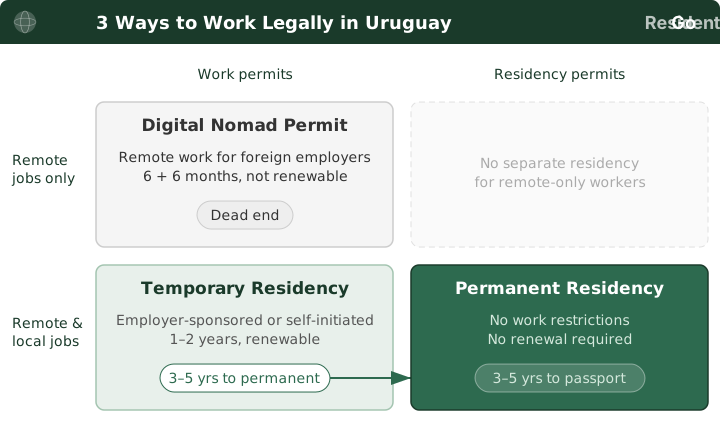
If you work remotely for foreign clients or employers, the Digital Nomad Permit is the fastest and cheapest option, but it caps out at 12 months with no path to residency. If a Uruguayan company is hiring you, or if you want long-term work authorization, you need temporary residency through the Dirección Nacional de Migración (DNM). Temporary residency leads to permanent residency after three to five years, and permanent residency opens the path to citizenship. The Digital Nomad Permit is a dead end: time spent on it does not count toward residency.
Comparing Work Visas in Detail
| Digital Nomad Permit | Temporary Residency (Work) | |
|---|---|---|
| For | Remote workers and freelancers | Local employment or long-term stay |
| Legal basis | Decree 238/022 (May 2023) | Decree 394/009 |
| Who qualifies | Everyone (any nationality) | Anyone with a job offer or qualifying purpose |
| Key requirement | Sworn affidavit of financial self-sufficiency | Employment contract or proof of means |
| Duration | 6 months + 6 months renewal | 1–2 years, renewable |
| Processing time | 1–3 weeks | 2–6 months |
| Government fees | ~USD 11 | ~USD 100–250 |
| Remote work for foreign employer | Yes | Yes |
| Work for Uruguayan companies | No | Yes |
| Change employer | - | Yes (update residency records) |
| Open bank account | Yes (with provisional ID) | Yes |
| Include dependents | No (individual applications only) | Yes (spouse and minor children) |
| Path to permanent residency | No | Yes, after 3–5 years |
*MERCOSUR and associate-state nationals (Argentina, Brazil, Paraguay, Chile, Colombia, Peru, Ecuador, Bolivia) benefit from simplified residency procedures and can apply for MERCOSUR-specific temporary or permanent residency directly.
Uruguay Digital Nomad Permit
Uruguay's Digital Nomad Permit, formally the Hoja de Identidad Provisoria Nómada Digital, is the simplest and cheapest digital nomad program in Latin America. No minimum income threshold, no employer letter, no investment. If you work remotely for anyone outside Uruguay, you qualify. Argentina's Digital Nomad Visa (USD 200) is the only other program in the region with no formal income minimum. The permit is individual-only: spouses and dependents must submit their own separate applications.
Documents required
- Valid passport (at least 6 months validity remaining)
- Sworn affidavit confirming financial self-sufficiency during your stay (no specific income amount required, but approximately USD 1,500–2,000/month is recommended in practice)
- Vaccination certificate issued or validated in Uruguay
- For the 6-month extension: clean criminal record certificate from every country where you lived more than 6 months in the past 5 years, apostilled and translated into Spanish
Process
You must be physically present in Uruguay to apply. Most applicants enter on a tourist stamp (visa-free for up to 90 days for US, EU, UK, Canadian, and Australian nationals) and then submit the Digital Nomad Permit application online through the Dirección Nacional de Migración website. After approval, you schedule an appointment at the National Civil Identification Office (DNIC) for biometrics and fingerprinting to receive your provisional Uruguayan identity card. Processing takes one to three weeks.
The permit is valid for 180 days. To extend for another 180 days, you must provide a criminal record certificate. After 12 months total, the permit expires. If you want to stay longer, you need to apply for permanent residency as a separate process.
Tax treatment
Digital Nomad Permit holders are not enrolled in Uruguayan social security and are exempt from income tax on foreign-sourced earnings. Remote work income from foreign clients or employers has zero Uruguayan tax liability.
Temporary Residency (Work Authorization)
Uruguay does not issue a standalone work permit. Instead, work authorization comes through residency status. The Dirección Nacional de Migración grants temporary residency to foreign nationals with an employment contract, and this residency automatically includes the right to work. Unlike most Latin American countries, Uruguay places no restriction on which professions foreigners can fill and imposes no requirement to prove that a local candidate was unavailable.
Documents required
- Valid passport (at least 6 months validity remaining)
- Employment contract or letter from the sponsoring employer on company letterhead, detailing role, salary, and duration
- Criminal record certificates from country of birth and every country where you lived more than 6 months in the past 5 years
- Birth certificate
- Vaccination certificate issued or validated in Uruguay
- All documents apostilled or legalized and translated into Spanish by a Uruguayan sworn translator
Process
Most applicants enter Uruguay on a tourist entry or a short-term work visa obtained at a Uruguayan consulate, then file for temporary residency in person through the DNM. You can work while the application is being processed. The DNM issues a provisional identity card (Hoja de Identidad Provisoria) that serves as your ID and work authorization during the processing period. Full processing takes two to six months, depending on nationality and document completeness.
Once temporary residency is granted, the employer must register you with the Banco de Previsión Social (BPS) for social security. Temporary residency is valid for one to two years and is renewable.
Tax treatment
Temporary residents employed locally pay progressive income tax (IRPF) on their Uruguayan-sourced salary and are enrolled in the BPS social security system. See the tax section below for brackets and rates.
For long-term residency pathways, see our Uruguay Residency Guide.
Taxes and Health Insurance
Uruguay applies a source-based tax system for employment income: only income earned from Uruguayan sources is subject to IRPF (Impuesto a la Renta de las Personas Físicas). Foreign-sourced salary, freelance income, and business revenue from outside Uruguay are not taxed under the employment income rules. Paraguay, Panama, and Costa Rica apply similar territorial principles to all income types. For passive foreign income (dividends, interest, capital gains), new tax residents can elect an 11-year tax holiday: zero tax on foreign passive income for the year of arrival plus the following 10 years. After that, a 12% flat rate applies. From 2026, this holiday requires qualifying investments in Uruguay.
For locally employed workers, progressive IRPF rates apply to monthly salary (2025 brackets, in UYU with approximate USD equivalents at ~42 UYU/USD): the first 7 BPC (~USD 1,100/month) is tax-free, then 10% up to ~USD 1,570, 15% up to ~USD 2,350, 24% up to ~USD 4,700, 25% up to ~USD 7,830, 27% up to ~USD 11,740, 31% up to ~USD 18,000, and 36% above that.
All locally employed workers and their employers contribute to BPS (Banco de Previsión Social). Employee contributions total approximately 18.5% to 20% of gross salary, covering retirement (15%), health insurance via FONASA (3% to 6.5% depending on family situation), and a labor reconversion fund. Employer contributions add approximately 12.6% on top of the employee's salary. These deductions are mandatory and withheld at source.
Uruguay has double taxation treaties with Germany, Spain, the United Kingdom, Belgium, Finland, Italy, Switzerland, Portugal, India, South Korea, Japan, Luxembourg, Mexico, Argentina, Chile, Ecuador, Paraguay, Romania, Hungary, Liechtenstein, Malta, Singapore, the UAE, and Vietnam, among others. Notably, Uruguay has no double taxation treaty with the United States. US citizens may owe US tax on worldwide income, potentially offset by the Foreign Earned Income Exclusion (~USD 126,500 for 2025).
Digital Nomad Permit holders are not enrolled in BPS and have no local social security obligation. Health insurance is not formally required for the Digital Nomad Permit, but it is strongly recommended. Private health insurance in Uruguay typically costs USD 50 to 200/month. For locally employed workers, health coverage is provided through FONASA (the national health fund) via mandatory payroll contributions.
Regardless of visa type, tax obligations in your home country may still apply. Holding a Uruguayan visa does not automatically end tax residency elsewhere.
Starting a Business in Uruguay
The Digital Nomad Permit restricts you to foreign clients, and temporary residency tied to an employer locks you to that employment relationship. If you want to start or invest in a Uruguayan company, you need residency that permits independent economic activity.
Uruguay imposes no restrictions on foreign ownership of companies. Any foreigner can incorporate a Sociedad de Responsabilidad Limitada (S.R.L.) or Sociedad Anónima (S.A.) without holding residency. However, actually working in or managing the business day-to-day requires a visa that authorizes local activity, which means obtaining temporary or permanent residency. There is no dedicated investor visa category with a fixed minimum investment threshold as in some other Latin American countries, but the 2026 tax residency rules now tie the foreign-income tax holiday to qualifying investments starting at USD 400,000 in real estate (or USD 100,000/year into the National Innovation Fund for tech entrepreneurs).
Uruguay's free trade zones (Zonas Francas), including Zonamerica and Aguada Park in Montevideo, offer full exemptions from corporate income tax, VAT, and wealth tax for qualifying businesses, particularly in technology, logistics, and international services. For a detailed breakdown of residency categories, see our Uruguay Residency Guide.
Tourist Visa and Work Rights
Most nationalities can enter Uruguay visa-free for up to 90 days. US, EU, UK, Canadian, and Australian citizens are all included. The tourist entry does not authorize any form of paid work, including remote work for a foreign employer.
Enforcement for remote workers is effectively nonexistent, and many digital nomads have historically worked on tourist entries without issue. The Digital Nomad Permit was introduced in 2023 partly to formalize this situation. At USD 11 and with no income proof required, there is minimal reason to remain in the gray area.
Frequently Asked Questions (FAQ)
🛂 Visa & Legal
Can US citizens work in Uruguay?
Yes. US citizens can enter Uruguay visa-free for 90 days and apply for the Digital Nomad Permit from within the country for remote work. For local employment, US citizens need temporary residency, which requires an employment contract and a standard application through the DNM. No special privileges or restrictions apply to US nationals.
Can I work in Uruguay on a tourist visa?
No. The 90-day tourist entry does not authorize any paid work. The Digital Nomad Permit (USD 11, 1–3 weeks processing) is the legal path for remote workers. For local employment, you need temporary residency.
Can freelancers work legally in Uruguay?
Yes, if serving international clients. Freelancers qualify for the Digital Nomad Permit with no minimum income requirement. Freelancers who want to serve Uruguayan clients need temporary or permanent residency and must register with the tax authority (DGI) and social security (BPS).
How long does it take to get a work visa in Uruguay?
The Digital Nomad Permit takes one to three weeks. Temporary residency for local employment takes two to six months, though you can work on a provisional identity card while the application processes.
Can I switch from a tourist visa to a work visa inside Uruguay?
Yes. Both the Digital Nomad Permit and temporary residency can be applied for from within Uruguay after entering on a tourist stamp. There is no need to leave the country or apply at a consulate first.
Can I work for a Uruguayan company on a Digital Nomad Permit?
No. The Digital Nomad Permit is exclusively for remote work with foreign clients or employers. To work for a Uruguayan company, you need temporary or permanent residency, which grants full local work authorization.
Does the Digital Nomad Permit lead to residency or citizenship?
No. The permit maxes out at 12 months (6 + 6 renewal) and does not establish residency status. Time on the Digital Nomad Permit does not count toward permanent residency or citizenship. You must apply for permanent residency as a separate process. Ecuador is the only country in the region where the Digital Nomad Visa itself counts toward permanent residency.
Can I include my family in a Uruguay work visa application?
Not on the Digital Nomad Permit, which is individual-only. Each family member must file a separate application. For temporary residency, dependents (spouse and minor children) can be included in the same application or apply based on their relationship to the principal applicant.
What types of jobs qualify for a Uruguay work permit?
Uruguay does not restrict work authorization to specific professions. Any job qualifies, provided the employer offers a valid contract and the foreign worker obtains temporary residency. There is no labor market test or requirement to prove that no local candidate was available, which is unusual in Latin America.
💰 Money & Tax
What is the average salary in Uruguay?
Approximately USD 880/month on average. The minimum wage is UYU 23,604/month (~USD 560). Tech professionals employed locally earn USD 26,000 to 60,000/year depending on seniority, with senior developers at international companies reaching USD 60,000 to 94,000/year.
Does Uruguay tax foreign income?
Employment income from foreign sources is not taxed. For passive foreign income (dividends, interest, capital gains), new tax residents can elect an 11-year tax holiday, paying zero on these categories. After the holiday, a 12% flat rate applies. Digital Nomad Permit holders are fully exempt from Uruguayan tax on all foreign earnings.
How much does it cost to apply for a Uruguay work visa?
The Digital Nomad Permit costs approximately USD 11 in government fees. Temporary residency costs approximately USD 100 to 250 depending on nationality and visa type. Additional costs for apostilles, certified translations, and legal assistance are separate.
🏠 Practical
Do I need to speak Spanish to work in Uruguay?
Not for remote work. For local employment, Spanish is expected by most employers, though tech companies in Montevideo's free trade zones (Zonamerica, Aguada Park) often operate in English. All immigration documents must be submitted in Spanish via a Uruguayan sworn translator.
Is health insurance mandatory for work visa holders in Uruguay?
For Digital Nomad Permit holders, health insurance is strongly recommended but not strictly required by the permit application. For locally employed workers on temporary residency, health coverage is mandatory through FONASA (national health fund) via payroll contributions of 3% to 6.5% of salary. Private insurance typically costs USD 50 to 200/month.
Is the internet fast enough for remote work?
Yes. Uruguay has the fastest internet in Latin America. Median fixed broadband download speeds are around 160 Mbps nationally, with fiber plans from state-owned ANTEL reaching 400 to 1,000 Mbps for USD 38 to 100/month. Mobile internet ranks fourth globally at ~149 Mbps. Montevideo is the second-fastest city in the world for mobile download speeds, behind only Dubai.
Compare all 12 countries in our Working Abroad Guide. Looking for residency instead? See our Latin America Residency Guide.