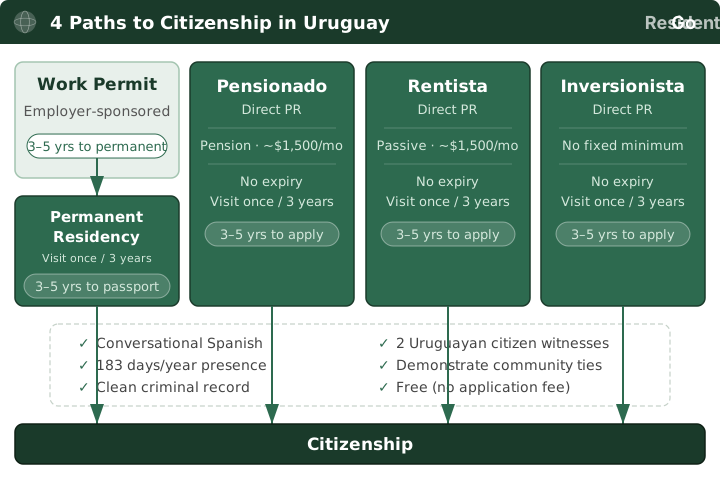
Uruguay is one of the few countries in Latin America - along with Panama (via Pensionado and Qualified Investor) - where residency is granted directly as permanent residency rather than requiring years of temporary status first. The country has no legally fixed minimum investment or income threshold written into immigration law, relying instead on case-by-case assessment of financial solvency. This makes Uruguay unusual in the region: applicants demonstrate means of support rather than meeting a rigid dollar figure, and immigration authorities have historically maintained low rejection rates for complete applications.
Uruguay Residencies Overview
| Residency Path | Exists | Minimum Requirement | Duration | Leads to Permanent Residency | Key Insight |
|---|---|---|---|---|---|
| Pensionado | Yes | ~USD 1,500 / month pension (practical threshold) | Permanent | Granted directly | No legal minimum |
| Rentista | Yes | ~USD 1,500 / month passive income (practical threshold) | Permanent | Granted directly | Income must be certified by Uruguayan notary |
| Inversionista | Yes | No fixed legal minimum | Permanent | Granted directly | tax residency has higher thresholds |
| Work Permit | Yes | Employer-sponsored | 1–2 years (renewable) | Yes, after 3–5 years | No labor market test required |
| Asset-based | No | — | — | — | No standalone solvency-only path |
| Digital Nomad | Yes | Self-declared financial solvency | 6 months (renewable once) | No | Separate framework |
*Practical income thresholds shown as of 2026. Uruguay does not set a legally fixed minimum income in immigration law; the amounts above reflect commonly applied administrative expectations. Actual requirements may vary by applicant profile and family size.*
Step-by-Step Guide from Resident to Passport
Prepare documents in your home country
The following documents must be obtained in your home country before traveling to Uruguay:
- Birth certificate
- Police clearance certificate from country of origin and any country of residence in the last five years
- Marriage certificate (if applicable)
- Birth certificates of children (if applicable)
- Residency-specific proof of eligibility (such as pension confirmation, passive income documentation, or investment records)
All official documents must carry an apostille issued in the country of origin and be accompanied by a certified Spanish translation. In practice, this means obtaining the original document, having it apostilled by the competent authority, and then arranging a certified translation into Spanish. Police clearance certificates must not be older than six months at the time of application.
Enter Uruguay and file the application
Citizens of the EU, US, Canada, Australia, and many other countries can enter Uruguay visa-free for up to 90 days as tourists. The residency application is filed in person at the Dirección Nacional de Migración (National Directorate of Migration), which includes:
- Submitting the full application package including all apostilled and translated documents
- Providing proof of income certified by a Uruguayan public notary (escribano)
- Completing a medical examination at an authorized local clinic
- Presenting proof of vaccinations approved by a Uruguayan vaccination center
- Paying government filing fees
All applications are processed in Spanish and follow local administrative procedures. Income proof in Uruguay must be formalized through a local notary (escribano) who prepares a certified income statement that meets government standards. Simple bank statements alone are generally not sufficient. Many applicants work with local immigration lawyers to coordinate translations, appointments, and submissions.
Temporary identity document and waiting period
Upon filing the application, applicants receive a temporary identity document (Hoja de Identidad Provisoria) that allows them to remain legally in Uruguay while the permanent residency application is processed. This temporary document typically enables:
- Legal stay in Uruguay beyond the initial tourist entry period
- Opening a bank account and conducting financial transactions
- Working legally in Uruguay (if applicable)
The temporary identity document is generally issued within a few weeks of filing the complete application. During the waiting period, immigration authorities may request additional documents or clarifications. Changes in personal or financial circumstances during the review phase may require updated documentation.
Permanent residency approval
Unlike most countries in the region, Uruguay grants permanent residency directly rather than requiring a multi-year temporary residency phase first. Once the application is approved, the applicant receives a Cédula de Identidad (Uruguayan identity card) confirming permanent resident status. This includes:
- Register with the Dirección Nacional de Identificación Civil (DNIC) to obtain the identity card
- Register with the Banco de Previsión Social (BPS) for social security purposes if applicable
- Comply with any ongoing residency conditions
Permanent residency in Uruguay does not expire in the same way as temporary residency in other countries. However, residents who remain outside Uruguay for more than three consecutive years may lose their residency status. Short return visits to Uruguay are generally sufficient to maintain status for those who are not pursuing citizenship.
Maintaining residency and citizenship eligibility
Permanent residency in Uruguay is maintained as long as the resident does not abandon the country for more than three consecutive years. However, applicants who intend to pursue citizenship must meet stricter physical presence requirements:
- Maintain permanent residency status without interruption
- Spend at least 183 days (six months) per year in Uruguay during the qualifying period
- Build demonstrable ties to Uruguay, such as employment, business activity, or community involvement
The qualifying period for citizenship is three years for married couples or individuals with established families, and five years for single applicants. For comparison, Argentina and Peru offer citizenship after just 2 years regardless of marital status. This period is counted from the date of first entry into Uruguay to apply for residency, not from the date residency is formally granted.
Path to citizenship
Uruguayan legal citizenship (ciudadanía legal) can be obtained through naturalization after meeting the residency and presence requirements. For most applicants, this means:
- Hold legal residency in Uruguay for at least 3 years (married couples or established families) or 5 years (single applicants)
- Spend at least 183 days per year physically in Uruguay during the qualifying period
- Demonstrate integration into Uruguayan society, such as employment, business activity, or community participation
- Pass an interview demonstrating conversational Spanish ability
- Provide two Uruguayan citizen witnesses who can attest to the applicant’s character and integration
- Submit a citizenship application to the Corte Electoral (Electoral Court)
Uruguay allows dual citizenship and does not require renunciation of existing nationality. The citizenship application is free of charge. Processing times for citizenship applications are currently approximately one year from submission to approval.
Overview of Uruguay Visas
Residencies that are based on Working Permits or Working visas are described in detail here:
→ Working Visas in Uruguay
Uruguay offers several residency pathways based on retirement income, passive income, investment, or employment. All options lead directly to permanent residency upon approval, without a mandatory temporary residency phase. Citizenship can then be pursued after 3 years (married) or 5 years (single) of legal residence with sufficient physical presence.
Pensionado (Retiree Residency)
The Pensionado pathway is intended for retirees who receive a regular pension. Uruguay does not set a legally fixed minimum pension amount, but immigration authorities in practice typically expect applicants to demonstrate a pension of at least approximately USD 1,500 per month. The pension must be stable and ongoing.
Proof typically requires:
- Official pension statements or letters from the pension provider, certified and apostilled, confirming the monthly pension amount and its permanent nature
- A notarial income certification (certificación de ingresos) prepared by a Uruguayan public notary (escribano), which formalizes the pension income in a format accepted by immigration authorities
- Bank statements or payment records showing consistent pension receipt over recent months
- If applicable, documentation of the pension source (public pension authority, private pension plan, or equivalent institution)
Rentista Visa (Passive Income Residency)
The Rentista residency (also referred to as Independent Means or Medios de Vida Propios) is designed for financially independent individuals who can demonstrate stable passive income from abroad. This includes dividends, rental income, investment returns, or other recurring non-employment income. Employment income earned locally generally does not qualify under this pathway.
Proof typically requires:
- Documentation showing passive income of at least approximately USD 1,500 per month, formalized through a Uruguayan public notary (escribano) in a certified income statement
- Evidence that this income has been received consistently, typically covering at least 6–12 months of payment history
- Source documentation demonstrating the nature and stability of the income, such as contracts, dividend statements, rental agreements, or distribution records
- Bank statements supporting the certified income claim (as supplementary evidence; not sufficient on their own)
Inversionista (Investment Residency)
Uruguay allows investors and business owners to obtain permanent residency by demonstrating economic activity or investment in the country. Unlike some Latin American programs, Uruguay does not set a single fixed minimum investment amount in immigration law for residency purposes. Instead, applicants must demonstrate that they have a meaningful economic presence or investment that supports their solvency in Uruguay.
Proof typically requires:
- Documentation of a qualifying investment or business in Uruguay, such as a property title, business registration, or equity stake in a Uruguayan company
- Evidence of the investment’s value through purchase contracts, appraisals, or financial statements
- If the investment generates income, proof of that income stream certified by a Uruguayan notary
- Proof that the investment or business is maintained and operational
Digital Nomad Permit (not a residency path)
Since May 2023 (Decree 238/022), Uruguay offers a Digital Nomad Permit for remote workers, freelancers, and individuals employed by companies outside Uruguay. The permit allows a legal stay of six months, renewable once for an additional six months. There is no formally fixed minimum income requirement; applicants sign an affidavit declaring financial self-sufficiency, though demonstrating income of approximately USD 1,500–2,000 per month is considered advisable in practice.
The Digital Nomad Permit does not constitute residency and does not count toward the citizenship timeline. However, holders may transition to permanent residency through a separate application if they decide to stay long-term.
Tax Residency Considerations in Uruguay
From a tax perspective, Uruguay is often considered by individuals who earn income abroad, hold international investment portfolios, or are structuring long-term residency to benefit from a territorial tax system. Uruguay has actively positioned itself as a destination for tax-motivated relocation, particularly through its revised Tax Holiday 2.0 regime effective from January 1, 2026.
Tax outcomes depend on personal circumstances, and the following points help assess this in practice:
- Uruguay applies a source-based (territorial) tax system, meaning residents are primarily taxed on income sourced within Uruguay - similar to Paraguay and Panama
- Immigration residency and tax residency are separate concepts; holding permanent residency does not automatically create tax residency
- Tax residency is triggered by spending 183 or more days per year in Uruguay, having one’s center of vital or economic interests in the country, or meeting specific investment criteria combined with a lower presence requirement (at least 60 days per year)
- New tax residents from January 1, 2026 onward may elect the Tax Holiday 2.0 regime, which provides a 10-year exemption on foreign-source capital income (dividends, interest, and capital gains). Eligibility conditions differ depending on how tax residency is established: physical presence (183+ days) requires no investment, while investment-based tax residency requires approximately USD 2,000,000 in Uruguayan real estate or USD 100,000 per year contributed to a government innovation fund
- After the 10-year holiday period, a preferential rate of 50% of the applicable IRPF rate (effectively approximately 6%) applies for up to 5 additional years, provided investment conditions continue to be met
- The alternative to the Tax Holiday is electing a flat 7% rate on foreign-source passive income indefinitely, with no holiday period
- Uruguay does not impose inheritance or gift tax
- A Net Wealth Tax (Impuesto al Patrimonio) applies only to assets located within Uruguay, with a threshold of approximately USD 120,000 for individuals and USD 240,000 for family groups, at rates ranging from 0.2% to 1.5%
- Foreign-held assets are not subject to the wealth tax
Income generated within Uruguay is subject to the Personal Income Tax (IRPF), which is structured as a dual system. Labor income is taxed at progressive rates ranging from 10% to 36%. Capital income from Uruguayan sources (such as local rental income, dividends from Uruguayan companies, or interest from local deposits) is generally taxed at a flat rate of 12%. These rates apply only to Uruguayan-sourced income and do not extend to foreign-sourced income during the applicable tax holiday period. Tax brackets and thresholds are adjusted periodically using the Uruguayan inflation-indexed unit (BPC).
Residency Status Comparison
| Status | Typical Duration | Status Renewal | Identification | Minimum Presence to Maintain Status | Counts Toward Citizenship |
|---|---|---|---|---|---|
| Tourist | 90 days (extendable to 180) | Via re-entering | Passport | None | No |
| Digital Nomad Permit | 6 months (renewable once) | One-time renewal for 6 months | Temporary identity document | None (continuous stay implied) | No |
| Permanent Residency | Indefinite | Not needed (ID renewed every 10 years) | Cédula de Identidad | Must not be absent for more than 3 consecutive years | Yes (with 183 days/year presence) |
| Citizenship (Legal Citizen) | Permanent | Not needed (ID renewed every 10 years) | Cédula de Identidad / Passport | Absence of more than 3 years may suspend political rights (not citizenship itself) | — |
The Escribano: How Income Proof Works
You cannot prove your income remotely or before arriving in Uruguay. All income claims must be formalized in person through a Uruguayan public notary (escribano), who reviews your source documentation, verifies at least 3 months of consistent income, and issues a notarial certificate recognized by immigration authorities.
For straightforward pensions or rental income, a single notarial session may suffice. Those with income from multiple investment accounts, trusts, or foreign structures should expect requests for additional documentation and allow extra time. The process takes days to weeks. Fees range from USD 300 to USD 800 depending on complexity.
Banking: What to Open and When
Start transferring income into a Uruguayan bank account at least 3 months before your escribano appointment. The notary needs to see local bank records as part of income certification, so opening an account early is not optional. Non-residents can open accounts using a passport, proof of home-country address, proof of income origin, and a bank reference letter. No cédula is required.
Banco República (BROU), the state bank, is the most accessible option with lower fees, but its online banking does not support outbound international transfers. Non-resident account maintenance runs USD 30–50 per month and drops after permanent residency. Accounts can be held in USD, EUR, or Uruguayan pesos.
Healthcare Costs After Residency
Most incoming retirees and rentistas will pay USD 70–250 per month for healthcare through a mutualista, a private nonprofit health cooperative that provides comprehensive care with no deductibles or lifetime caps. This is the practical path because residents living on foreign passive income are not automatically enrolled in the national health fund (FONASA).
FONASA enrollment kicks in only if you register as employed or self-employed. Contributions are 3% of declared income for individuals without dependents, rising to 4.5–8% for those covering a spouse or children. All legal residents also have the right to use the public hospital system (ASSE) at no cost, regardless of FONASA status.
Frequently Asked Questions
✅ Eligibility
What is the most common residency path for expats in Uruguay?
The Rentista (passive income) and Pensionado (retiree) pathways are the most common for expats. Both lead directly to permanent residency upon approval, without requiring a temporary residency phase first. Applicants must demonstrate approximately USD 1,500 per month in passive income or pension, certified through a Uruguayan public notary (escribano).
Can I include my family in a Uruguay residency application?
Yes. Your spouse or legally recognized partner (including common-law and same-sex partnerships), dependent children, and dependent parents can be included. The minimum income threshold increases depending on family size, and each family member needs their own set of apostilled, translated documents.
What is the minimum income required for Uruguay residency?
There is no legally fixed minimum in Uruguay's immigration law, but the practical threshold applied by authorities is approximately USD 1,500 per month for a single applicant. This income must be from passive sources (pension, dividends, rental income) and certified by a Uruguayan public notary.
What is the minimum investment amount required for Uruguay residency?
Uruguay does not set a fixed minimum investment amount for immigration residency. Inversionista applicants must demonstrate a meaningful economic presence, such as property ownership or a business in Uruguay. Note that tax residency by investment has separate, much higher thresholds: approximately USD 2,000,000 in Uruguayan real estate or USD 100,000 per year into a government innovation fund.
📝 Process & Timeline
How much does it cost to apply for Uruguay residency?
$380 to $900. Government filing fees are approximately $80–$100, plus a mandatory escribano (notary) fee of $300–$800 for income certification, which is a procedural requirement for the application. Additional costs for apostilles, certified translations, and legal assistance are separate.
What documents do I need to apply for Uruguay residency?
You need an apostilled and Spanish-translated birth certificate, police clearance certificates from every country you've lived in over the past five years, proof of income or investment, a local medical examination, and vaccination verification from an authorized Uruguayan center. Marriage and children's birth certificates are required if applicable. Police clearances must be less than six months old at the time of application.
Can I apply for Uruguay residency while visiting as a tourist?
Yes. Citizens of the EU, US, Canada, Australia, and many other countries enter Uruguay visa-free for up to 90 days. The residency application is filed in person at the Dirección Nacional de Migración during this tourist stay. Upon filing, you receive a temporary identity document that allows you to remain legally while your application is processed.
Do I need to open a bank account in Uruguay to apply for residency?
Yes. You should open a Uruguayan bank account and begin transferring income into it at least 3 months before your escribano appointment, as the notary needs local bank records for income certification. Non-residents can open an account with a passport, proof of home-country address, proof of income origin, and a bank reference letter. Banco República (BROU) is the most accessible option, with account maintenance running USD 30–50 per month.
How long does it take to get temporary residency in Uruguay?
Uruguay is unusual in that it grants permanent residency directly, skipping a temporary phase. After filing your application, you receive a temporary identity document (Hoja de Identidad Provisoria) within a few weeks. Full permanent residency approval typically takes 6 to 12 months from the date of submission.
How long does it take to get Uruguay citizenship?
The qualifying period is 3 years for married couples or those with established families, and 5 years for single applicants, counted from the date of first entry to apply for residency. You must spend at least 183 days per year in Uruguay during this period, demonstrate integration (including conversational Spanish), and provide two Uruguayan citizen witnesses. The citizenship application itself takes approximately one additional year to process.
🏠 Living in Uruguay
Do I need to live in Uruguay to maintain residency?
No. Permanent residency is maintained as long as you do not remain outside Uruguay for more than 3 consecutive years. Short return visits are sufficient. However, if you intend to pursue citizenship, you must spend at least 183 days per year in Uruguay during the qualifying period.
Can I work in Uruguay as a foreign resident?
Yes. Once you file your residency application, the temporary identity document you receive allows you to work legally in Uruguay. Permanent residents have full access to the local job market. Digital Nomad Permit holders, by contrast, may only work for employers or clients based outside Uruguay.
Does Uruguay tax foreign income?
Uruguay uses a territorial (source-based) tax system, so residents are primarily taxed on income sourced within Uruguay. New tax residents from January 1, 2026 onward can elect the Tax Holiday 2.0 regime, which exempts foreign-source capital income (dividends, interest, capital gains) for 10 years. The alternative is a flat 7% rate on foreign passive income indefinitely. Uruguay does not impose inheritance or gift tax, and its wealth tax applies only to assets located within Uruguay.
Is health insurance mandatory for residents in Uruguay?
There is no strict legal mandate to carry private insurance, but most retirees and rentistas join a mutualista (private nonprofit health cooperative) at USD 70–250 per month, since those living on foreign passive income are not automatically enrolled in the national health fund (FONASA). FONASA enrollment is triggered only by registering as employed or self-employed. All legal residents also have the right to use the free public hospital system (ASSE).
Can I have dual citizenship with Uruguay?
Yes. Uruguay allows dual citizenship and does not require you to renounce your existing nationality. Note that naturalized "legal citizens" receive full political rights, but the Uruguayan passport will list the country of birth as nationality rather than "Uruguayan," which is a constitutional distinction unique to Uruguay.