Argentina is one of the most affordable places in Latin America for remote workers to set up legally. The Digital Nomad Visa costs roughly USD 200, has no formal minimum income requirement, and processes in 10 to 45 days. Buenos Aires alone receives over 70,000 digital nomads per year, drawn by a cost of living that runs 50% to 60% below Western European or US levels. For local employment, the process is more structured: employers must register with RENURE (the national sponsor registry) and obtain an entry permit before the worker can apply for a visa, but there are no profession restrictions and no annual quotas.
Work Options at a Glance
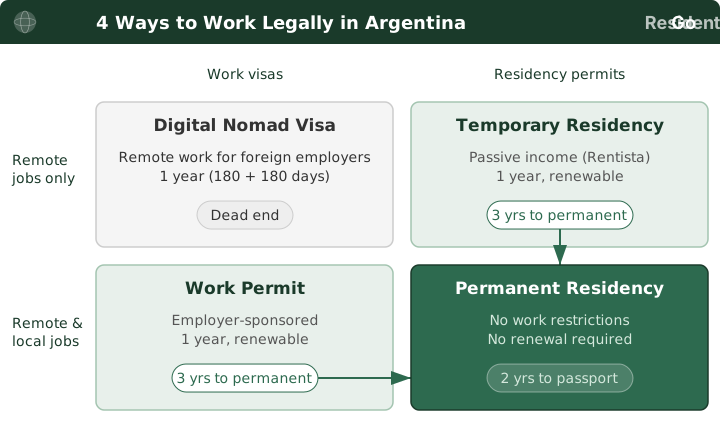
Which visa you need depends on where your income comes from. If you work remotely for foreign clients or employers, the Digital Nomad Visa is the simplest path, though it caps out at 12 months with no way to extend further or transition to residency. If an Argentine company is hiring you, you need an employer-sponsored work permit (23A temporary residency). And if you have passive income or savings, a Rentista temporary residency lets you skip the employment question entirely. Only the work permit and temporary residency tracks lead to permanent residency, and Argentina offers the fastest naturalization timeline in the Americas: two years of legal residency to qualify for citizenship.
Comparing Work Visas in Detail
| Digital Nomad Visa | Employer-Sponsored Work Permit | |
|---|---|---|
| For | Remote workers and freelancers | Local employment |
| Legal basis | Disposition 758/2022 (DNM) | Migration Law No. 25.871, Decree 616/2010 |
| Who qualifies | Citizens of visa-exempt countries | Anyone with a local job offer |
| Key requirement | Proof of remote employment or freelance income | Employment contract + employer registered with RENURE |
| Duration | 180 days + 180-day renewal | 1 year, renewable indefinitely |
| Processing time | 10–45 business days | 1–3 months |
| Government fees | ~USD 200 | ~USD 250–310 |
| Remote work for foreign employer | Yes | - |
| Work for Argentine companies | No | Yes, sponsoring employer only |
| Change employer | - | Requires new authorization |
| Open bank account | Difficult (no DNI issued) | Yes (DNI issued on arrival) |
| Include dependents | No | Yes (spouse, children under 18) |
| Path to permanent residency | No | Yes, after 3 years |
Argentina Digital Nomad Visa
Argentina's Digital Nomad Visa, introduced in May 2022 under Disposition 758/2022, is classified as a transitory residence and is one of the cheapest digital nomad programs in Latin America. There is no published minimum income threshold: you need to show that you have regular remote income, but the government has not set a specific dollar figure. Uruguay's Digital Nomad Permit is the only other program in the region with no formal income minimum, and at USD 11, it costs even less. The visa is only available to citizens of countries that do not need a tourist visa to enter Argentina, which includes the US, Canada, the UK, the EU, and Australia. Dependents cannot be included, and the visa does not lead to residency or a DNI (national identity card), which limits access to banking and local services.
Documents required
- Valid passport with at least six months remaining validity and two blank pages
- Application note explaining your remote work activity, signed by the applicant
- CV detailing professional experience and qualifications, in Spanish or with a Spanish translation
- Proof of remote income: employment contract, company endorsement letter, client contracts, or recent pay stubs, apostilled and translated into Spanish
- Criminal background check from each country of residence in the past three years, apostilled and translated
- Health insurance valid in Argentina for the duration of stay (recommended; some consulates require it)
Process
You can apply online through the National Migration Directorate's (DNM) Radix portal using the TIE 24H (electronic entry processing) service, or at an Argentine consulate abroad. The online route tends to be faster: approval typically arrives within 10 to 15 business days. Consulate applications can take up to 45 business days. The total fee is approximately USD 200, paid in two installments (USD 120 online, then USD 80 via bank transfer to the designated consulate).
You can also enter Argentina as a tourist and then apply for the Digital Nomad Visa from within the country. Upon approval, you receive a digital confirmation by email. The visa grants 180 days, renewable once for an additional 180 days. Argentina provides a welcome package for digital nomads arriving at Buenos Aires airport, including a 40% discount on airport transfers, a discounted first-night hotel, a SIM card, and a SUBE card for public transport.
Tax treatment
Digital Nomad Visa holders are not considered Argentine tax residents because their stay does not exceed 12 months. Foreign-sourced income is untaxed during the visa period.
Employer-Sponsored Work Permit
Argentina places no restrictions on which professions qualify for a work permit and sets no annual quotas on foreign hires. Any company registered in Argentina can sponsor a foreign worker, provided the employer is enrolled in RENURE (Registro Nacional Único de Requirentes de Extranjeros), the national registry of entities authorized to petition for foreign employees. The most common visa is the 23A (employment contract) for salaried positions, while the 23E covers intra-company transfers for employees relocating from a foreign branch.
Documents required
- Signed employment contract, translated into Spanish, notarized by a public notary (Escribano Público), and certified by the Colegio de Escribanos
- Employer's RENURE registration number (must be current)
- Entry permit (Permiso de Ingreso) obtained by the employer through the DNM
- Valid passport with at least six months remaining and two blank pages
- Criminal background check from countries of residence in the past three years, apostilled and translated
- Medical fitness certificate
- Two passport-size photos (4x4 cm, color, white background)
- Proof of address within the jurisdiction of the consulate
Process
The employer initiates the process by filing for an entry permit (Permiso de Ingreso) with the DNM in Argentina. Once approved, the foreign worker applies for the work visa at the Argentine consulate in their country of residence, attends an in-person interview, and pays the consular fee of USD 250 (plus USD 60 for contract certification). Total processing time from filing to visa issuance is typically 1 to 3 months. After arriving in Argentina, the employee must register with RENAPER to obtain a DNI (national identity card) and with ANSES to receive a CUIL (tax identification number) before starting work.
Mercosur nationals (Brazil, Paraguay, Uruguay, Bolivia, Chile, Colombia, Ecuador, Peru, Venezuela) follow a simplified process and can apply for temporary or permanent residency directly, without employer sponsorship through RENURE.
Tax treatment
Work permit holders are Argentine tax residents and pay progressive income tax on their worldwide income, plus 17% in social security contributions. See the tax section below for brackets and rates.
For long-term residency pathways, see our Argentina Residency Guide.
Taxes and Health Insurance
Argentina operates a worldwide tax system. Residents are taxed on all income regardless of source, while non-residents pay tax only on Argentine-sourced income. You become a tax resident after spending 12 months in the country (temporary absences do not reset the clock). Digital Nomad Visa holders, capped at 12 months total, typically do not trigger tax residency. If you plan a longer stay and want to keep foreign income untaxed, Paraguay and Uruguay both use territorial tax systems and share a border with Argentina.
For locally employed workers, progressive income tax rates apply to net annual income (2025 brackets, adjusted semi-annually for inflation): 5% on the first ~ARS 1.5 million (~USD 1,300), scaling through nine brackets to 35% on income above ~ARS 53 million (~USD 45,000). A personal deduction of approximately ARS 12.3 million (~USD 10,500) effectively makes the first portion of salary tax-free. Because of Argentina's high inflation, these thresholds are adjusted in January and July each year.
Social security contributions are mandatory for all locally employed workers. Employees pay 17% of gross salary (11% pension fund, 3% public health insurance, 3% social services), capped at a monthly ceiling that adjusts quarterly. Employers contribute an additional 24% to 27% on top of salary, uncapped. These fund the pension system, the public healthcare network (PAMI), and obra social (union-linked health plans).
Argentina has double taxation treaties with Germany, France, the UK, Spain, Italy, Canada, Brazil, Chile, Switzerland, Australia, Belgium, Sweden, Denmark, Norway, Finland, the Netherlands, and others (approximately 21 in force). There is no income tax treaty with the United States, only a Tax Information Exchange Agreement (TIEA). US citizens working in Argentina may owe US tax on worldwide income, with the Foreign Earned Income Exclusion (approximately USD 126,500 for 2025) potentially offsetting some or all Argentine liability.
Digital Nomad Visa holders are not enrolled in the public health system and should carry private health insurance for the duration of their stay. Typical costs range from USD 50 to 150/month. Work permit holders are automatically enrolled in the obra social system through their employer's mandatory contributions, which provides access to both public and private healthcare networks depending on the plan.
Regardless of visa type, tax obligations in your home country may still apply. Holding an Argentine visa does not automatically end tax residency elsewhere.
Starting a Business in Argentina
Neither the Digital Nomad Visa nor the employer-sponsored work permit allows you to run a local business. The Digital Nomad Visa restricts you to foreign clients, and the work permit ties you to a single sponsoring employer. If you want to start or invest in an Argentine company, you need a residency permit.
The most common path is the Inversionista (investor) visa, which requires an investment of at least ARS 1,500,000 in a productive, commercial, or service business. At current exchange rates, that threshold is remarkably low (roughly USD 1,300), though the Ministry of Economy must approve the business plan, and the investor must personally manage the business and be present at least 183 days per year. The visa is initially granted for one year, renewable for three years, with permanent residency available after three years and citizenship after just two. Argentina also launched a Citizenship by Investment program in July 2025 (Decree 524/2025) for investments of USD 500,000 or more, which grants citizenship directly without a residency period.
Any foreigner can incorporate an Argentine company (SAS, SRL, or SA) without residency. The IGJ (Inspección General de Justicia) handles registrations, typically completed within 15 days. Foreign ownership is generally unrestricted, with exceptions in aviation (49% cap) and media (30% cap). However, actually working in or managing the business day-to-day requires a visa that authorizes local activity. For a detailed breakdown of residency categories, see our Argentina Residency Guide.
Tourist Visa and Work Rights
Most nationalities can enter Argentina visa-free for 90 days, with a single 90-day extension available (180 days total). No form of paid work is permitted on a tourist entry, including remote work for foreign employers.
Argentina is unusually lenient on overstays. Overstaying is not a criminal offense: the penalty is a fixed fine of approximately ARS 40,000 (~USD 35), regardless of how long you overstayed. Many remote workers historically used tourist entries and accepted the fine on departure. The Digital Nomad Visa was introduced partly to formalize this gray area, and at roughly USD 200, it costs only slightly more than the fine while providing legal status for up to 12 months.
Frequently Asked Questions (FAQ)
🛂 Visa & Legal
Can US citizens work in Argentina?
Yes. US citizens can enter Argentina visa-free for 90 days (extendable to 180) and are eligible for the Digital Nomad Visa for remote work. For local employment, a US citizen needs an employer-sponsored work permit (23A visa). Argentina does not grant any special work privileges based on nationality, except for Mercosur citizens who benefit from simplified residency procedures.
Can I work in Argentina on a tourist visa?
No. The 90-day tourist entry does not authorize any paid work, including remote work. The penalty for overstaying is a fixed fine of ~USD 35, but working without authorization carries additional legal risk. The Digital Nomad Visa (~USD 200, 10 to 45 days processing) is the legal alternative for remote workers.
Can freelancers work legally in Argentina?
Yes, if serving foreign clients. Freelancers qualify for the Digital Nomad Visa by showing proof of regular remote income (there is no fixed minimum threshold). Freelancers who want to serve Argentine clients need a work visa with local authorization and must register as a monotributista (simplified tax regime for self-employed individuals).
How long does it take to get a work visa in Argentina?
Digital Nomad Visa: 10 to 45 business days depending on the application method (online is faster). Employer-sponsored work permit: 1 to 3 months total, including the entry permit process initiated by the employer and the consular visa application.
Can I switch from a tourist visa to a work visa inside Argentina?
For the Digital Nomad Visa, yes. You can enter as a tourist and apply from within Argentina through the DNM's online portal. For employer-sponsored work permits, the standard process requires the employer to obtain an entry permit, after which the employee typically applies at a consulate abroad. In limited cases, an in-country change of status may be processed by the DNM.
Can I work for an Argentine company on a Digital Nomad Visa?
No. The Digital Nomad Visa is exclusively for remote work with foreign employers or clients. Taking employment with an Argentine company requires a separate employer-sponsored work permit (23A temporary residency) with RENURE registration.
Does the Digital Nomad Visa lead to residency or citizenship?
No. The Digital Nomad Visa is classified as transitory residence and maxes out at 12 months (180 + 180 days). Time on this visa does not count toward permanent residency or citizenship. To build toward either, you need to switch to a temporary residency category such as a work permit, Rentista, or Inversionista visa.
Can I include my family in an Argentina work visa application?
Not on the Digital Nomad Visa, which is individual-only and cannot include dependents. For employer-sponsored work permits, dependents (spouse, parents, and children under 18) can apply for dependent visas alongside the primary applicant, submitting their own documentation at the same time.
What types of jobs qualify for an Argentina work permit?
Argentina does not restrict work permits to specific professions. Any role qualifies, provided the employer is registered with RENURE and can provide a valid employment contract. There are no annual quotas on foreign hires. Mercosur nationals bypass the employer-sponsorship requirement entirely and can apply for residency with fewer restrictions.
💰 Money & Tax
What is the average salary in Argentina?
The average salary is approximately USD 650/month (~USD 7,800/year). The national minimum wage is ARS 341,000/month (~USD 280) as of early 2026. Software developers employed locally earn roughly USD 20,000 to 55,000/year depending on seniority, with Buenos Aires paying the highest rates in the country.
Does Argentina tax foreign income?
Yes, for tax residents. Argentina uses a worldwide tax system: residents are taxed on all income regardless of where it is earned. You become a tax resident after 12 months in the country. Digital Nomad Visa holders (max 12 months) typically stay below this threshold and owe nothing. Non-residents are taxed only on Argentine-sourced income at a flat withholding rate of up to 35%.
How much does it cost to apply for an Argentina work visa?
The Digital Nomad Visa costs approximately USD 200 total (paid in two installments). An employer-sponsored work permit costs USD 250 in consular fees plus USD 60 for contract certification, totaling approximately USD 310. Additional costs for apostilles, certified translations, and legal assistance are separate.
🏠 Practical
Do I need to speak Spanish to work in Argentina?
Not for remote work. English is widely spoken in Buenos Aires tech and startup circles. For local employment, most employers expect professional Spanish. All visa documents must be submitted in Spanish (certified translations are accepted). For citizenship by naturalization, basic Spanish proficiency is required at the interview.
Is health insurance mandatory for work visa holders in Argentina?
For work permit holders, healthcare is provided through the obra social system via mandatory employer and employee social security contributions (17% employee, 24-27% employer). Digital Nomad Visa holders are not enrolled in the public system and should carry private health insurance, which typically costs USD 50 to 150/month. Some consulates require proof of coverage as part of the Digital Nomad Visa application.
Is the internet fast enough for remote work?
Yes. Argentina's median fixed broadband speed is approximately 93 Mbps nationally, with Buenos Aires averaging over 150 Mbps. Fiber plans up to 1 Gbps are available in major cities from providers like Fibertel, Movistar, and Telecentro. 5G is expanding in Buenos Aires, Córdoba, Rosario, and Mendoza. Rural and Patagonian areas can be significantly slower, though Starlink is available as a backup.
Compare all 12 countries in our Working Abroad Guide. Looking for residency instead? See our Latin America Residency Guide.