Chile has the fastest fixed broadband in Latin America, a double taxation treaty with the United States (one of very few in the region), and a three-year exemption on foreign income for new arrivals. There is no dedicated Digital Nomad Visa, but the Temporary Residency Visa lets remote workers stay legally for up to two years and leads directly to permanent residency. For local employment, the employer-sponsored work visa follows the same timeline. The catch: processing currently takes 6 to 8 months due to backlogs from Chile's 2022 immigration law overhaul.
Work Options at a Glance
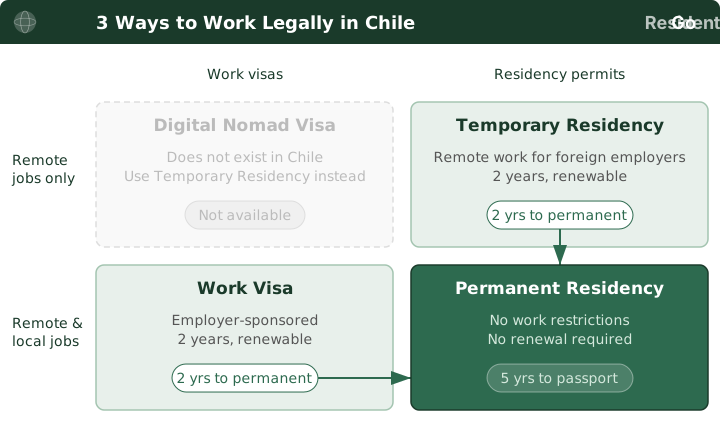
Both paths to legal work in Chile run through the Temporary Residency Visa (Residencia Temporal), managed by the Servicio Nacional de Migraciones (SERMIG). If you work remotely with a service contract for foreign clients (freelance, consultant, contractor), you apply under the subcategory for remunerated activities. Salaried employees of a foreign employer without Chilean presence do not qualify under this subcategory; under Decreto Supremo 177, the foreign employer would need to establish presence in Chile, otherwise the relationship has to be a service-contract relationship with a foreign client, not an employment relationship. If a Chilean company is hiring you, you apply with a local employment contract. Both visas are valid for up to two years, are renewable, and lead to permanent residency (Residencia Definitiva) after two years of continuous residence. Ecuador has an even shorter path: its Digital Nomad Visa counts toward permanent residency after 21 months. Mexico requires four years of temporary residency before permanent status.
Comparing Work Visas in Detail
| Temporary Residency (Remote Work) | Employer-Sponsored Work Visa | |
|---|---|---|
| For | Remote workers and freelancers | Local employment |
| Legal basis | Law No. 21.325, Decree No. 177 | Law No. 21.325, Decree No. 177 |
| Who qualifies | Anyone with foreign income | Anyone with a Chilean job offer |
| Key requirement | Service contract with foreign company + proof of income | Signed employment contract with Chilean employer |
| Duration | Up to 2 years, renewable | Up to 2 years, renewable |
| Processing time | 6–8 months | 6–8 months |
| Government fees | Up to ~USD 300 (varies by nationality) | Up to ~USD 300 (varies by nationality) |
| Remote work for foreign clients (service contract) | Yes | - |
| Salaried employment by foreign employer (no Chilean presence) | No | - |
| Work for Chilean companies | No | Yes, sponsoring employer only |
| Change employer | - | Yes, with new contract* |
| Open bank account | Yes (after RUT issued) | Yes (after RUT issued) |
| Include dependents | Yes (as dependent visa holders) | Yes (as dependent visa holders) |
| Path to permanent residency | Yes, after 2 years | Yes, after 2 years |
*Under Law No. 21.325, the work visa is no longer strictly tied to a single employer. Changing jobs requires filing a new contract with SERMIG, but does not require restarting the visa process from scratch.
Temporary Residency Visa (Remote Work)
Chile does not have a dedicated Digital Nomad Visa. Countries with formal digital nomad programs include Colombia (from ~USD 1,300/month), Brazil (from USD 1,500/month), and Uruguay (USD 11, no income minimum). Remote workers who want to stay longer than 180 days apply for the Temporary Residency Visa under the subcategory for lawful remunerated activities. The key requirement is a service contract (contrato de prestación de servicios) with a foreign company, signed by a Chilean or foreign attorney-in-fact resident in Chile. There is no official minimum income threshold published by SERMIG, but immigration practitioners recommend demonstrating at least USD 1,500 to 2,000/month in stable income.
Documents required
- Service contract with a foreign company, signed by a Chilean or foreign attorney-in-fact resident in Chile
- Proof of income: bank statements (3–12 months) or salary slips showing at least USD 1,500/month
- Criminal record certificate from country of origin, apostilled and translated into Spanish
- Valid passport with at least 6 months validity
- Recent passport-sized photo (color, white background)
- Health insurance is not formally mandatory for the application, but may be requested and is strongly recommended
Process
Applications are filed online through the SERMIG digital portal (Portal de Trámites Digitales). If applying from outside Chile, you submit through the portal and, once approved, have 90 days to enter the country. If applying from within Chile, you must generally already hold a valid Temporary Residency permit in another subcategory or qualify under the exceptions in Article 69 of Law 21.325 (such as having family ties to Chilean nationals). Tourists cannot normally switch to residency from inside the country.
Processing currently takes 6 to 8 months. Once approved, you download your electronic visa stamp (Estampado Electrónico) and must register for a Chilean identity card (Cédula de Identidad) and tax ID (RUT) at the Civil Registry. The RUT is required to open a bank account, sign a lease, and pay taxes.
Tax treatment
Foreigners arriving in Chile are taxed only on Chilean-source income for their first three years of residence. Since Temporary Residency holders working remotely earn from foreign sources, most have zero Chilean tax liability during this period.
Employer-Sponsored Work Visa
Unlike Costa Rica or Panama, Chile does not restrict work permits to specialized roles. Any foreign national with a signed employment contract from a Chilean company can apply. The contract must be notarized: the employer signs before a Chilean notary, and the employee signs before a Chilean consul abroad. The minimum salary must meet Chile's legal minimum of CLP 510,500/month (~USD 535), though most professional roles pay substantially more.
Documents required
- Signed employment contract, notarized (employer before Chilean notary, employee before Chilean consul)
- Employer's legal registration and tax enrollment proof (Certificado de inicio de actividades from SII)
- Proof of employer's financial capacity to hire
- Criminal record certificate from country of origin, apostilled and translated
- Valid passport with at least 6 months validity
- Recent passport-sized photo (color, white background)
- Professional credentials, apostilled and translated (if applicable)
Process
The application is submitted through the SERMIG digital portal from outside Chile. If approved, the employee has 90 days to enter Chile and begin work. It is also possible to apply with a formal job offer rather than a signed contract: SERMIG grants a 90-day entry visa, and the applicant must submit the signed contract within 45 days of arrival, which then extends the visa to one year.
Processing takes 6 to 8 months. If the contract ends or is terminated, the visa remains valid for 30 days, during which the holder can apply for a new visa with a different employer.
Tax treatment
Work visa holders pay progressive income tax (0% to 40%) on their Chilean salary from day one. The three-year foreign income exemption still applies to any non-Chilean income. Employers withhold income tax and social security contributions at source.
For long-term residency pathways, see our Chile Residency Guide.
Taxes and Health Insurance
Chile taxes residents on worldwide income, with one major exception: foreigners are taxed only on Chilean-source income for their first three years of residence. After year three, worldwide income is taxed. This exemption applies regardless of visa type and makes Chile unusually favorable for remote workers earning from abroad during that initial period. For a permanent exemption on foreign income, Panama, Paraguay, and Costa Rica use territorial tax systems with no time limit.
For locally employed workers, progressive income tax rates apply monthly. The brackets (as of 2025, adjusted by the monthly tax unit/UTM) are: 0% on income up to ~CLP 918,000 (~USD 970), then 4% up to ~CLP 2,041,000 (~USD 2,150), 8% up to ~CLP 3,401,000 (~USD 3,580), 13.5% up to ~CLP 4,762,000 (~USD 5,015), 23% up to ~CLP 6,122,000 (~USD 6,450), 30.4% up to ~CLP 8,163,000 (~USD 8,595), 35% up to ~CLP 10,884,000 (~USD 11,460), and 40% above that.
Employee social security contributions total approximately 17.6% of gross salary: roughly 10% for pension (AFP), 7% for health insurance (FONASA or private ISAPRE), and 0.6% for unemployment insurance. These are capped at 87.8 UF (~USD 3,050/month). Employer contributions have historically been low (~1.5% for disability and survival insurance plus ~2.4% for unemployment insurance plus ~0.93% for workplace accident insurance), but a major pension reform enacted in March 2025 is gradually raising employer contributions by 7 percentage points, starting with an additional 1% from August 2025 and reaching the full 8.5% by 2033.
Chile has double taxation treaties with over 35 countries. Notably, the US-Chile treaty entered into force in December 2023, making Chile one of only two South American countries with a comprehensive US tax treaty (the other is Venezuela). Treaties are also in force with Germany, Spain, the United Kingdom, France, and most other major economies. US citizens working in Chile can use the Foreign Earned Income Exclusion (approximately USD 130,000 for 2026) and the treaty provisions to offset double taxation.
Temporary Residency holders working remotely for foreign companies are not automatically enrolled in Chile's public health system (FONASA) or pension system. Enrollment requires a RUT and formal employment or independent contractor registration with SII (Chile's tax authority). Private health insurance for expats typically costs USD 80 to 250/month depending on age and coverage.
Regardless of visa type, tax obligations in your home country may still apply. Holding a Chilean visa does not automatically end tax residency elsewhere.
Starting a Business in Chile
Neither the remote work visa nor the employer-sponsored work visa is designed for running a local business. The remote work path restricts you to foreign clients, and the employment visa ties you to a specific employer's contract. If you want to start or invest in a Chilean company, you need a Temporary Residency Visa under the investor subcategory.
Chile's Start-Up Chile program (run by CORFO, the state development agency) has been one of Latin America's most recognized startup accelerators since 2010, providing equity-free grants of up to USD 80,000 and a one-year visa for founders. Outside the accelerator, any foreigner can incorporate a Sociedad por Acciones (SpA) or Sociedad de Responsabilidad Limitada (Ltda.) without residency, often within a single day using the online Empresa en un Día portal. However, actually working in and managing the business day-to-day requires a residency visa that authorizes local activity.
For a detailed breakdown of residency categories, see our Chile Residency Guide.
Tourist Visa and Work Rights
Most nationalities, including US and EU citizens, can enter Chile visa-free for up to 90 days. This can be extended once for another 90 days (USD 100 fee) at the SERMIG office in Santiago, for a maximum of 180 days per year. No form of paid work is permitted on a tourist entry, including remote work for a foreign employer.
In practice, enforcement against laptop-based remote work has been minimal, and many digital nomads work informally on tourist entries. Since Chile has no Digital Nomad Visa to formalize this, the Temporary Residency Visa is the only legal path for remote workers planning to stay long-term. The 6 to 8 month processing time means most people start the application well before they intend to move.
Frequently Asked Questions (FAQ)
🛂 Visa & Legal
Can US citizens work in Chile?
Yes. US citizens can enter Chile visa-free for 90 days (extendable to 180), but paid work is not permitted on a tourist entry. For remote work, the Temporary Residency Visa is the standard path. For local employment, an employer-sponsored work visa is required. The US-Chile tax treaty (in force since December 2023) provides additional benefits for managing tax obligations across both countries.
Can I work in Chile on a tourist visa?
No. The tourist entry (Permanencia Transitoria) does not authorize any form of paid work. Extensions are available for an additional 90 days (USD 100), but work remains prohibited. The Temporary Residency Visa is the legal alternative for remote workers.
Can freelancers work legally in Chile?
Yes, if serving foreign clients. Freelancers apply for the Temporary Residency Visa with a service contract (contrato de prestación de servicios) and proof of stable income, typically at least USD 1,500/month. Freelancers serving Chilean clients need a visa that authorizes local work and must register as independent contractors with SII.
How long does it take to get a work visa in Chile?
Both the Temporary Residency Visa (remote work) and the employer-sponsored work visa currently take 6 to 8 months. The backlog stems from the 2022 migration law (Law 21.325) that overhauled Chile's immigration system. There is no expedited processing option.
Can I switch from a tourist visa to a work visa inside Chile?
Generally, no. Under Law 21.325, tourists (Permanencia Transitoria holders) cannot apply for residency from within Chile unless they meet specific exceptions: family ties to Chilean nationals, applying as a dependent, or other cases qualified by the Interior Ministry. Most applicants must start the process from outside Chile.
Can I include my family in a Chile work visa application?
Yes. Spouses and children can apply for a Dependent Temporary Residency Visa alongside the primary applicant. Dependents can live in Chile but are not authorized to work. Each dependent must submit their own application and documentation through the SERMIG portal.
What types of jobs qualify for a Chile work permit?
Chile does not restrict work visas to specific professions. Any position with a signed employment contract from a registered Chilean company qualifies, provided the salary meets or exceeds the minimum wage (CLP 510,500/month, ~USD 535). This openness sets Chile apart from countries like Costa Rica and Panama, where permits are limited to specialized roles.
Can I work remotely without a work visa?
Not legally. Chile has no Digital Nomad Visa, and the tourist entry explicitly prohibits paid work. Many remote workers do so informally on tourist entries, but this carries legal risk. The Temporary Residency Visa is the compliant path for stays beyond 180 days.
What visa do remote workers use in Chile?
The Temporary Residency Visa (Residencia Temporal) under the subcategory for lawful remunerated activities. The application requires a service contract with a foreign company, signed by an attorney-in-fact resident in Chile. The visa is valid for up to two years, renewable, and leads to permanent residency.
💰 Money & Tax
What is the average salary in Chile?
Approximately USD 1,030/month (~USD 12,360/year). The minimum wage is CLP 510,500/month (~USD 535). Software developers employed locally earn USD 18,000 to 50,000/year, with senior roles and those working remotely for international companies earning USD 50,000 to 90,000/year.
Does Chile tax foreign income?
Not for the first three years. Foreigners who establish residence in Chile are taxed only on Chilean-source income during their first three years. After that, worldwide income is taxed at progressive rates up to 40%. This three-year exemption applies regardless of visa type and is one of Chile's strongest advantages for remote workers.
How much does it cost to apply for a Chile work visa?
Government fees for the Temporary Residency Visa are up to approximately USD 300, varying by nationality under Chile's reciprocity-based fee system. Permanent residency costs approximately USD 130. Tourist visa extensions cost USD 100. Additional costs for apostilles, certified translations, and legal assistance are separate.
🏠 Practical
Do I need to speak Spanish to work in Chile?
Not for remote work. English is widely understood in tech and startup circles, especially in Santiago. For local employment, most employers expect professional-level Spanish. All visa documents must be submitted in Spanish (translations accepted if apostilled).
Is health insurance mandatory for work visa holders in Chile?
For locally employed workers, yes. Employers must enroll employees in either FONASA (public) or an ISAPRE (private), with approximately 7% of salary withheld for health contributions. For Temporary Residency holders working remotely, enrollment in the public system is not automatic. Private health insurance (USD 80 to 250/month) is strongly recommended and may be required during the visa application.
Is the internet fast enough for remote work?
Chile has the fastest fixed broadband in Latin America. The median download speed is approximately 280 Mbps nationally, with fiber accounting for about 70% of all fixed connections. Valparaíso was ranked the fastest city in the world for fixed broadband in late 2025 (398 Mbps average). Santiago, Viña del Mar, and Concepción all offer reliable fiber coverage. Coworking spaces in Santiago typically provide 200+ Mbps connections.
Compare all 12 countries in our Working Abroad Guide. Looking for residency instead? See our Latin America Residency Guide.