Chile stands out in Latin America for combining a modern, digitized immigration system with a tax framework that temporarily shields new foreign residents from worldwide taxation. Under the Migration and Aliens Act (Law 21.325), which replaced decades-old regulations in 2022, all temporary residency applications are processed through the National Migration Service (SERMIG) and its digital portal, making Chile one of the most procedurally transparent residency destinations in the region. At the same time, Chile grants foreigners a three-year exemption from taxation on foreign-sourced income, extendable to six years upon request, a feature that distinguishes it sharply from countries that tax worldwide income from day one or that apply purely territorial taxation.
Chile Residencies Overview
| Residency Path | Exists | Minimum Requirement | Duration | Leads to Permanent Residency | Key Insight |
|---|---|---|---|---|---|
| Jubilado (Retirement) | Yes | ~USD 1,000–1,500 / month pension | Temporary (up to 2 years) | Yes | No official fixed minimum |
| Rentista (Passive Income) | Yes | ~USD 1,500 / month passive income | Temporary (up to 2 years) | Yes | Pension + rental cannot combine |
| Inversionista (Investor) | Yes | USD 500,000 investment | Temporary (up to 2 years) | Yes | Must be productive investment |
| Work Visa (Employer-Sponsored) | Yes | Employment contract with Chilean company | Temporary (up to 2 years) | Yes | No profession restrictions |
| Work Visa (Remote Work) | Yes | ~USD 1,500 / month foreign income | Temporary (up to 2 years) | Yes | Requires foreign service contract (freelance / contractor, not salaried employment) |
| Asset-based | No | — | — | — | Not available |
| Digital Nomad | No | — | — | — | Use Work Visa (Remote Work) |
| Pensionado | Yes | Covered under Jubilado | Temporary (up to 2 years) | Yes | Same category as Jubilado |
*Indicative minimum thresholds shown as of 2026. Chile does not publish a single official income floor; amounts reflect commonly accepted practice. Interpretation and documentation standards may vary.*
Important on the Remote Work subcategory: Under Decreto Supremo 177, the remote-work pathway is for foreign service contracts (freelancers, consultants, contractors invoicing a foreign client). Salaried employees of a foreign company without Chilean presence do not qualify under this subcategory. The decree text requires that the foreign employer either has presence in Chile or that the relationship is a service-contract relationship with a foreign client, not an employment relationship with a foreign employer.
Step-by-Step Guide from Resident to Passport
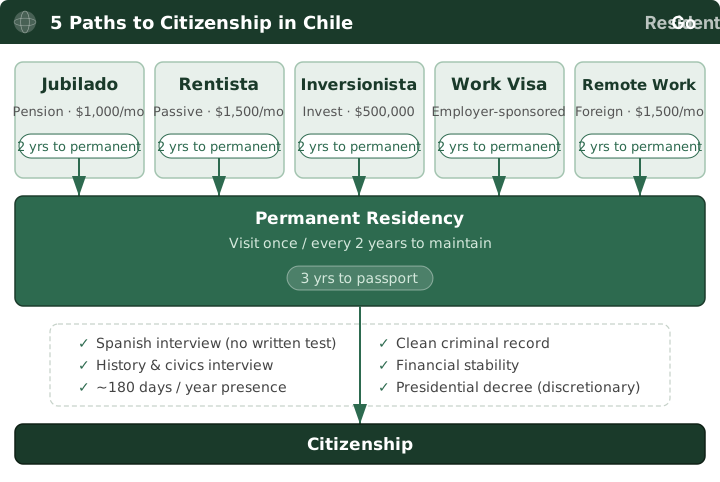
Prepare documents in your home country
The following documents must be obtained in your home country before applying for a Chilean temporary residency permit:
- Valid passport (minimum 12 months remaining validity at time of application)
- Criminal record certificate from your country of origin or the country where you have resided during the last 5 years
- Birth certificate
- Marriage certificate (if applicable)
- Residency-specific proof of eligibility (such as pension certificate, passive income documentation, or investment proof)
- Recent color passport photograph (white background, no accessories)
All documents issued abroad must be apostilled or legally legalized under Articles 345 and 345 bis of the Chilean Code of Civil Procedure. Documents in languages other than Spanish or English must include a certified translation. Criminal record certificates are valid for only 60 days from the date of issuance, and private documents for 30 days, so timing is critical.
Submit the online application from abroad
Unlike many Latin American countries, Chile requires that temporary residency applications be submitted digitally before the applicant enters the country. The process includes:
- Creating an account on SERMIG's Portal de Trámites Digitales
- Completing the online application form (“Solicitud de Residencias Temporales para Extranjeros Fuera de Chile”)
- Uploading all required documents in PDF format
- Paying the application fee, which varies by nationality (typically USD 100–200)
Once the application is submitted, SERMIG processes it remotely. Processing times typically range from 30 days to several months, depending on the subcategory and completeness of the documentation. Applicants should monitor their account for notifications and requests for additional documents.
Visa approval and entry into Chile
Once the application is approved, the applicant receives an electronic visa stamp (Estampado Electrónico). The next steps are:
- Collecting the visa stamp at the nearest Chilean consulate (in some cases)
- Entering Chile and registering with the Policía de Investigaciones (PDI) upon arrival
- Requesting a Chilean identity card for foreigners (Cédula de Identidad) at the Civil Registry within 30 days of arrival
The Chilean identity card serves as the primary identification document for all administrative, banking, and legal purposes within Chile. Without it, most day-to-day formalities, including opening a bank account or signing a lease, cannot be completed.
Temporary residency period
Temporary residency in Chile is granted for up to 2 years and comes with specific obligations:
- Maintaining physical presence of at least 180 days per year in Chile
- Registering with the Chilean tax authority (Servicio de Impuestos Internos, SII) and declaring income for at least 9 months before applying for permanent residency
- Complying with the conditions of the specific visa subcategory (maintaining the income source, investment, or pension that justified the visa)
Temporary residents are authorized to live, work, and engage in any lawful activity in Chile, regardless of the visa subcategory. The retirement and rentista visas do not restrict holders from also working or starting businesses.
Transition to permanent residency
Permanent residency (Residencia Definitiva) can be applied for after holding temporary residency, typically after 24 months of continuous residence. The timeline can be reduced to 12 months in specific cases, such as:
- Applying within 10 to 90 days before the temporary residency expires
- Submitting the application through SERMIG's digital portal with updated documentation
- Providing a current criminal record certificate (valid for 90 days from issuance)
- Demonstrating continued financial stability and tax compliance
Once permanent residency is granted, it is valid indefinitely. The physical identity card must be renewed every 5 years, but the underlying status does not expire as long as the holder does not remain outside Chile for more than 2 consecutive years.
Path to citizenship
Chilean citizenship can be obtained through naturalization after long-term legal residency. For most applicants, this means:
- Hold legal residency in Chile for at least 5 years in total (including temporary residency periods, counted from the date of the first electronic visa stamp)
- Hold valid permanent residency (Residencia Definitiva) at the time of application
- Demonstrate basic proficiency in Spanish and knowledge of Chilean history, geography, and civic principles
- Maintain a clean criminal record in Chile and in your country of origin
- Demonstrate financial stability
- Submit the application through SERMIG's digital portal
Chilean citizenship is ultimately granted by presidential decree, which makes the final approval discretionary. The process from application to approval typically takes 2 to 3 years. Chile allows dual citizenship, so naturalized citizens do not need to renounce their original nationality. Spouses of Chilean citizens may apply after only 2 years of continuous residence, provided the marriage is registered in Chile and both spouses share a common household.
Overview of Chile Visas
Residencies that are based on Working Permits or Working visas are described in detail here:
→ Working Visas in Chile
Chile's 2022 Migration Act (Law 21.325) restructured all residency categories under a single Temporary Residency Permit (Residencia Temporal) with 16 subcategories. For internationally mobile individuals who are not employed by a Chilean company, the most relevant subcategories are the retirement visa (Jubilado), the passive income visa (Rentista), and the investor visa (Inversionista). All options initially grant temporary residency for up to 2 years and may later lead to permanent residency. Chilean citizenship can then be pursued after 5 years of total legal residence.
Jubilado Visa (Retirement Residency)
The Jubilado visa is designed for individuals who receive a retirement pension from their country of origin. Chile does not publish a fixed minimum pension amount, but immigration authorities in practice expect applicants to demonstrate a pension income of approximately USD 1,000 to 1,500 per month for a single applicant - in the same range as Panama and Costa Rica's published $1,000/mo thresholds, with additional amounts of approximately USD 500 per dependent.
Proof typically requires:
- Official retirement certificate specifying the income amount and the period for which the pension is granted, issued by the pension provider or relevant authority
- Receipt of the most recent pension payment available at the time of application, apostilled or legalized
- Copies of the last 3 monthly pension payments, legalized, or a consular certificate from the country of origin confirming the pension amount in Chilean Pesos or USD equivalent
- If applicable, supporting documentation for dependents (marriage certificate, birth certificates of children)
Rentista Visa (Passive Income Residency)
The Rentista visa covers individuals who are not retirees but have recurring passive income from real estate ownership or financial assets. In practice, immigration authorities expect a minimum income of approximately USD 1,500 per month. Income from multiple sources within the same category (for example, two rental properties) can be combined, but pension income and rental income cannot be combined across subcategories within a single application.
Proof typically requires:
- Certificate issued by the competent authority certifying ownership of the income-generating property or asset, apostilled or legalized
- Lease contracts or financial statements demonstrating recurring passive income from real estate or financial assets
- Bank statements or other documentation confirming that income has been received regularly over recent months
- If income derives from financial assets: documentation of the asset (dividend statements, bond coupon payments, trust distributions, or similar instruments)
Inversionista Visa (Investor Residency)
The Inversionista visa is available to foreign nationals who invest or intend to invest a minimum of USD 500,000 in a productive project in Chile. Unlike some Latin American countries where personal property purchases qualify, Chile requires the investment to be directed toward the production of goods or services. The visa also covers senior managers of Chilean companies where a foreign investor directly controls at least 10% of the company's voting rights.
Proof typically requires:
- Documentation of the investment or intended investment of at least USD 500,000 in a Chilean business or project
- Business plan or project description outlining the purpose and economic impact of the investment
- Proof of funds and financial capacity to execute the investment
- For senior managers: documentation of the investor's controlling stake and the applicant's role in the company
Tax Residency Considerations in Chile
From a tax perspective, Chile is particularly relevant for foreigners with international income who want a transition period before worldwide taxation applies. Unlike purely territorial tax systems (such as Costa Rica or Panama), Chile does tax worldwide income, but it grants new foreign residents a significant grace period during which only Chilean-sourced income is taxed.
- Chile taxes residents on worldwide income, but foreigners who establish residence or domicile in Chile are taxed only on Chilean-source income for their first 3 years in the country
- This 3-year exemption from foreign-source income taxation can be extended by an additional 3 years upon request to the Chilean tax authority (Servicio de Impuestos Internos), providing up to 6 years of Chilean-source-only taxation. Uruguay offers an even longer 10-year holiday on foreign capital income under its Tax Holiday 2.0 regime
- Tax residency is triggered by physical presence of 183 days or more within any 12-month period, or by spending 6 consecutive months in Chile in a calendar year
- Immigration residency and tax residency are separate concepts; holding a temporary residency visa does not automatically make someone a tax resident if the physical presence threshold is not met
- Foreign pension and social security income received by residents is generally not subject to Chilean income tax, regardless of residency duration
- There is no general wealth tax in Chile, although an annual 2% tax applies to high-value luxury assets (aircraft, yachts, and vehicles above defined value thresholds) located in Chilean territory
Income generated within Chile is subject to progressive personal income tax (Impuesto Global Complementario), with marginal rates currently ranging from 0% up to 40%. Employment income is taxed monthly under the Second Category Tax at the same progressive rates. These rates apply to Chilean-source income and, after the initial exemption period, to worldwide income. Tax brackets are denominated in Unidades Tributarias Mensuales (UTM), a monthly index adjusted for inflation, meaning the thresholds in absolute peso terms change each month.
Residency Status Comparison
| Status | Typical Duration | Status Renewal | Identification | Minimum Presence to Maintain Status | Counts Toward Citizenship |
|---|---|---|---|---|---|
| Tourist | Up to 90 days | Via re-entering (no extension from within) | Passport | None | No |
| Temporary Residency | Up to 2 years | Renewable via SERMIG portal | Cédula de Identidad (Foreigner ID) | At least 180 days per year | Yes |
| Permanent Residency | Indefinite | ID card renewed every 5 years | Cédula de Identidad (Foreigner ID) | Must return within 2 years | Yes |
| Citizenship | Permanent | Not needed | Chilean National ID / Passport | None | — |
The 2022 Migration Act
Since February 2022, you cannot enter Chile as a tourist and then apply for residency from inside the country. This was common practice under the old system but is now prohibited with only narrow humanitarian exceptions.
All residency applications must be submitted online from abroad through the National Migration Service (SERMIG) portal. You receive approval before traveling and enter Chile with your visa already in place. This applies equally to retirees, investors, and all other categories. All renewals and status changes also go through SERMIG's digital platform.
Why Chile Has No Published Income Thresholds
You will not find an official minimum income figure for Chile's retirement or passive income visas. There is no formula, no multiplier, no annual recalculation. SERMIG evaluates each application individually against cost-of-living standards and can reject borderline cases without citing a specific number.
In practice, single applicants showing USD 1,000–1,500 per month are generally approved, with USD 500–600 per dependent. These are informal benchmarks, not published rules. Submitting documentation well above this floor significantly reduces rejection risk.
The UF: Chile's Inflation-Indexed Unit
Your rent in Chile will almost certainly rise every month without a new contract. Leases are denominated in the Unidad de Fomento (UF), a unit that adjusts daily based on the previous month's inflation. As of February 2026, 1 UF equals roughly CLP 39,700 (USD 46).
Beyond rent, mortgage loans, real estate prices, and insurance premiums are also quoted in UF. For foreign-income earners, this creates layered currency exposure: your income is in your home currency, your rent adjusts with Chilean inflation, and the conversion passes through the peso. A stable peso exchange rate can still produce rising costs if domestic inflation pushes the UF upward.
Healthcare: FONASA vs. ISAPRE
Every resident earning income in Chile must direct 7% of their taxable income toward health insurance. The choice is between FONASA, the public fund covering 80% of the population with free services but long wait times, and an ISAPRE, a private insurer offering faster access and English-speaking doctors but premiums that scale with age and family size.
Retirees and rentistas without Chilean-source income are not automatically enrolled. They can join FONASA voluntarily, purchase an ISAPRE plan, or use international private health insurance, which is accepted at private clinics but gives no access to the FONASA network.
Frequently Asked Questions
✅ Eligibility
What is the most common residency path for expats in Chile?
The most relevant options for internationally mobile individuals are the Jubilado (retirement) visa, the Rentista (passive income) visa, and the Inversionista (investor) visa. All three fall under Chile's Temporary Residency Permit system, grant up to 2 years of temporary residency, and can lead to permanent residency.
Can I include my family in a Chile residency application?
Yes. Dependents can be included, with an additional income requirement of approximately USD 500 per month per dependent. Supporting documentation such as marriage certificates and birth certificates for children must be provided.
What is the minimum income required for Chile residency?
Chile does not publish a fixed minimum, but in practice single applicants showing USD 1,000–1,500 per month are generally approved for the Jubilado visa, and approximately USD 1,500 per month for the Rentista visa. Submitting documentation well above these informal benchmarks reduces rejection risk.
What is the minimum investment amount required for Chile residency?
The Inversionista visa requires a minimum investment of USD 500,000 in a productive project in Chile. The investment must be directed toward the production of goods or services; personal property purchases do not qualify.
📝 Process & Timeline
How much does it cost to apply for Chile residency?
$100 to $200. The application fee varies by nationality and is paid online through the SERMIG portal. Additional costs for apostilles, certified translations, and legal assistance are separate.
What documents do I need to apply for Chile residency?
Required documents include a valid passport (minimum 12 months validity), a criminal record certificate, birth certificate, proof of eligibility for your visa subcategory (pension certificate, passive income documentation, or investment proof), and a passport photograph. All foreign documents must be apostilled or legalized, and documents not in Spanish or English require certified translation.
Can I apply for Chile residency while visiting as a tourist?
No. Since the 2022 Migration Act took effect, tourists cannot apply for residency from inside Chile, with only narrow humanitarian exceptions. All temporary residency applications must be submitted online from abroad through the SERMIG portal before traveling.
Do I need to open a bank account in Chile to apply for residency?
A bank account is not required to apply, but once you arrive in Chile, you will need your Chilean identity card (Cédula de Identidad) to open a bank account. The identity card must be requested at the Civil Registry within 30 days of arrival, and most day-to-day formalities including banking cannot be completed without it.
How long does it take to get temporary residency in Chile?
Processing times typically range from 30 days to several months after submitting the online application, depending on the visa subcategory and completeness of documentation. Once approved, you receive an electronic visa stamp and can then enter Chile.
How long does it take to get Chile citizenship?
Citizenship requires at least 5 years of total legal residency in Chile, plus holding valid permanent residency at the time of application. The citizenship application itself typically takes 2 to 3 years to process, as it is granted by presidential decree.
🏠 Living in Chile
Do I need to live in Chile to maintain residency?
Temporary residents must be physically present at least 180 days per year, and absences exceeding 60 total days during the 24-month temporary period can delay eligibility for permanent residency. Permanent residency is automatically revoked if you stay outside Chile for more than 2 consecutive years without requesting an extension.
Can I work in Chile as a foreign resident?
Yes. Temporary residents are authorized to live, work, and engage in any lawful activity in Chile regardless of the visa subcategory. The retirement and rentista visas do not restrict holders from working or starting businesses.
Does Chile tax foreign income?
Chile taxes residents on worldwide income, but new foreign residents are taxed only on Chilean-source income for their first 3 years, extendable to 6 years upon request. After this grace period, worldwide income becomes taxable at progressive rates up to 40%. Foreign pension and social security income is generally exempt from Chilean income tax regardless of residency duration.
Is health insurance mandatory for residents in Chile?
Every resident earning income in Chile must direct 7% of their taxable income toward health insurance, choosing between FONASA (public) or an ISAPRE (private). Retirees and rentistas without Chilean-source income are not automatically enrolled but can join FONASA voluntarily, purchase an ISAPRE plan, or use international private health insurance.
Can I have dual citizenship with Chile?
Yes. Chile allows dual citizenship, so naturalized citizens do not need to renounce their original nationality.