Brazil is the largest economy in Latin America and one of the few countries in the region that applies worldwide income taxation to its tax residents. Unlike most neighboring countries that offer territorial tax systems, Brazil taxes residents on global income at progressive rates up to 27.5%. This makes Brazil a fundamentally different proposition from countries like Uruguay or Paraguay for tax-motivated relocation. Instead, Brazil attracts applicants who are drawn to its scale, lifestyle, investment opportunities, and one of the shortest naturalization timelines in the region — as little as four years from initial residency to citizenship, or one year in qualifying family situations.
Brazil Residencies Overview
| Residency Path | Exists | Minimum Requirement | Duration | Leads to Permanent Residency | Key Insight |
|---|---|---|---|---|---|
| Pensionado | Yes | USD 2,000 / month pension or passive income | Temporary (1–2 years) | Yes, after 2 years | No work rights |
| Rentista | No | — | — | — | No separate visa program |
| Inversionista | Yes | BRL 500,000 business / BRL 1,000,000 real estate | Permanent (subject to 3-year review) | Granted directly | Threshold reduced in some regions |
| Asset-based | No | — | — | — | No solvency-only option |
| Work Permit | Yes | Employer-sponsored | Temporary (up to 2 years) | Yes, after 2 years | |
| Digital Nomad | Yes | USD 1,500 / month or USD 18,000 savings | 1 year (renewable once) | No | Separate framework |
*Indicative minimum thresholds shown as of 2026. BRL amounts are set in Brazilian law and do not change with exchange rate fluctuations. USD equivalents are approximate.*
Step-by-Step Guide from Resident to Passport
Prepare documents in your home country
The following documents must be obtained in your home country before traveling to Brazil:
- Birth certificate
- Police clearance certificate (criminal background check)
- Marriage certificate (if applicable)
- Birth certificates of dependents (if applicable)
- Residency-specific proof of eligibility (such as pension confirmation, investment documentation, or proof of remote employment)
- Health insurance certificate valid in Brazil (required for consular applications)
All official documents must be apostilled in the country of origin (or legalized at a Brazilian consulate if the country is not party to the Hague Convention). Documents then require sworn translation into Portuguese by a certified Brazilian translator (tradutor juramentado). Police clearance certificates must typically be issued no more than 90 days before the application date.
Apply for a visa or residence authorization
Brazil offers two application routes depending on the applicant’s situation:
- Apply at a Brazilian consulate abroad (consular route): submit the visa application in person, provide all apostilled and translated documents, and pay the consular fee (typically USD 200–400 depending on nationality)
- Apply from within Brazil (MigranteWeb route): if already in Brazil on a valid tourist entry or visa, submit a residence authorization request through the Federal Police’s online MigranteWeb system
For investor visa applicants (VIPER), the process additionally involves setting up or investing in a Brazilian legal entity, registering the foreign direct investment with the Central Bank of Brazil (SISBACEN), and submitting an investment or business plan for approval. All funds must be transferred through official banking channels and properly documented.
Register with the Federal Police
Upon arrival in Brazil with a visa, or upon approval of a residence authorization, the applicant must register with the Federal Police (Polícia Federal) to obtain a national migration registration card:
- Schedule an appointment with the Federal Police in the city of residence
- Submit biometric data (fingerprints and photograph)
- Present the original visa stamp or residence authorization approval
- Pay the registration processing fee (approximately BRL 168 as of 2025)
Registration must be completed within 90 days of first entry into Brazil (for consular visa holders) or within 30 days of publication of the residence authorization (for in-country applicants). The Federal Police appointment system in major cities such as São Paulo and Rio de Janeiro often has limited availability, so scheduling should be done as early as possible after arrival.
Temporary residency status and obligations
Most residency paths in Brazil begin with temporary residency. Once the CRNM card is issued, the resident must comply with the conditions of their visa category:
- Maintain the conditions of the original visa (for example, continued pension receipt, maintained investment, or active remote employment contract)
- Comply with physical presence requirements: investors on real estate visas should spend at least 30 days per year in Brazil; retirement visa holders should maintain regular presence
- The retirement visa (VITEM XIV) is initially granted for 1–2 years
- The investor visa (VIPER) via business investment can be granted as permanent residency from the outset but is subject to a mandatory review in the third year
- Real estate investor visas are typically granted as temporary residence for an initial period, convertible to permanent residency after maintaining the investment
Renewals and transition to permanent residency
Temporary residents must renew their residency before expiration through the Federal Police or MigranteWeb system. For applicants who did not receive permanent residency directly (such as retirement visa holders), the transition to permanent residency requires:
- Renew temporary residency before each expiration, demonstrating that the original eligibility conditions remain met
- Hold temporary residency for at least 2 years continuously
- Apply for conversion to permanent residency through the Federal Police
Once permanent residency is granted, the resident receives an updated CRNM card and can live and work in Brazil without time restrictions. Permanent residents have the right to employment, business ownership, and access to public services on the same basis as Brazilian citizens.
Path to citizenship
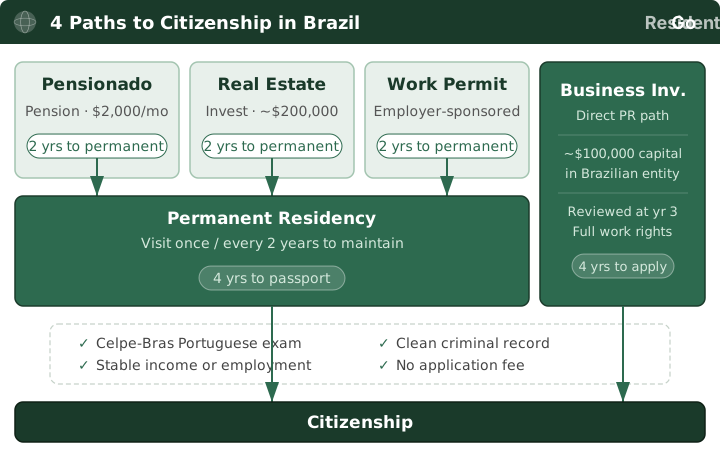
Brazilian citizenship can be obtained through naturalization after holding permanent residency. For most applicants, this means:
- Hold permanent residency in Brazil for at least 4 continuous years (reduced to 1 year for spouses of Brazilian citizens, parents of Brazilian children, or nationals of Portuguese-speaking countries)
- Demonstrate Portuguese language proficiency sufficient for everyday communication
- Maintain a clean criminal record in Brazil and abroad
- Show stable income or employment sufficient to support oneself
- Submit a naturalization application to the Ministry of Justice and Public Security
Brazil allows dual citizenship without requiring renunciation of existing nationality. The total timeline from initial temporary residency to citizenship eligibility is approximately 6 years for retirement visa holders (2 years temporary + 4 years permanent) and potentially shorter for business investors who receive permanent residency directly (4 years from initial grant).
Overview of Brazil Visas
Residencies that are based on Working Permits or Working visas are described in detail here:
→ Working Visas in Brazil
Brazil offers residency pathways based primarily on retirement income, business or real estate investment, and remote work. Retirement and digital nomad visas begin as temporary residency and may lead to permanent residency. Business and certain real estate investment routes can grant permanent residency directly. Brazilian citizenship can be pursued after 4 years of permanent residency for most applicants.
Retirement Visa / Pensionado (VITEM XIV)
The retirement visa is available to formally retired individuals who can demonstrate a stable pension or passive income of at least USD 2,000 per month (approximately BRL 6,000) - significantly higher than the $1,000/mo threshold in Panama, Costa Rica, or Peru. The applicant must be retired according to the laws of their home country. Passive income from sources such as rental income, dividends, or annuities may also qualify, but the applicant must not be actively employed. The retirement visa does not grant work rights in Brazil.
Proof typically requires:
- Official pension or retirement certificate from the pension authority or private provider, apostilled and sworn-translated, confirming the monthly income amount
- Bank statements covering the last three months, showing consistent receipt of pension or passive income of at least USD 2,000 per month
- A letter from the applicant’s bank confirming the ability to transfer at least USD 2,000 monthly to a Brazilian bank account
- Health insurance certificate valid in Brazil (required for consular applications)
Investor Visa (VIPER) — Business Investment
The business investor visa grants permanent residency to foreign nationals who invest in a Brazilian company. The standard minimum investment is BRL 500,000 (approximately USD 100,000) in a new or existing Brazilian enterprise. Investments of BRL 150,000 (approximately USD 30,000) may qualify if directed at innovative or technology-focused activities that also create at least 10 local jobs within two years. The investment must be registered with the Central Bank of Brazil and approved by immigration authorities.
Proof typically requires:
- Articles of incorporation or registration of the Brazilian legal entity receiving the investment
- Declaratory registration of Foreign Direct Investment (FDI) with the Central Bank of Brazil (SISBACEN) or exchange contract from the receiving bank
- Investment or business plan demonstrating economic benefit to Brazil (job creation, income generation, or innovation)
- Proof of funds transfer through official banking channels and confirmation of the investment value meeting or exceeding the applicable minimum threshold
Investor Visa (VIPER) — Real Estate Investment
Foreign nationals may obtain residency through the purchase of qualifying urban real estate in Brazil. The minimum investment is BRL 1,000,000 (approximately USD 200,000) for properties in most of Brazil, or BRL 700,000 (approximately USD 140,000) for properties in the North and Northeast regions, representing a 30% reduction designed to encourage investment in developing areas. The investment may be spread across multiple properties as long as the combined value meets the threshold. Properties must be urban, formally registered, and can include residential or commercial real estate, whether completed or under construction.
Proof typically requires:
- Property title or registration from the Registro Geral do Imóvel (property registry) confirming ownership
- Proof that funds were transferred from abroad via a Central Bank-authorized institution and registered as foreign direct investment
- Appraisals, purchase contracts, or closing statements demonstrating the property value meets the applicable minimum
- Evidence that the investment is maintained throughout the residency period
Digital Nomad Visa (VITEM XIV)
Since January 2022, Brazil has offered a Digital Nomad Visa for remote workers employed by or providing services to companies located outside Brazil. The minimum income requirement is USD 1,500 per month, or alternatively USD 18,000 in savings. The visa is granted for one year and is renewable once for a second year, allowing a maximum stay of 24 months. The Digital Nomad Visa does not permit employment with Brazilian companies and does not directly lead to permanent residency.
Proof typically requires:
- Proof of foreign employment or service contract (employment letter, freelance contract, or equivalent documentation from a non-Brazilian entity)
- Bank statements from the last three months showing a minimum monthly income of USD 1,500, or a bank balance of at least USD 18,000
- Private health insurance valid in Brazil for the entire intended duration of stay
- Criminal background check from country of residence, apostilled and sworn-translated into Portuguese
Tax Residency Considerations in Brazil
From a tax perspective, Brazil is fundamentally different from most countries in the region because it applies worldwide income taxation to its tax residents. Brazil does not offer a territorial tax system or a tax holiday on foreign income. This makes Brazil less attractive than countries like Uruguay or Paraguay for individuals whose primary goal is tax optimization on foreign-sourced income, but potentially suitable for those who plan to earn income primarily within Brazil or who have offsetting benefits from double taxation treaties. The following points outline the key tax rules relevant to foreign residents:
- Brazil taxes residents on worldwide income, including salaries, pensions, dividends, interest, rental income, and capital gains from both Brazilian and foreign sources
- Tax residency is triggered by holding a permanent visa, by staying in Brazil for more than 183 days within a 12-month period, or by holding a temporary visa with a local employment contract
- Immigration residency and tax residency are closely linked in Brazil: obtaining a permanent visa automatically creates tax residency, unlike in countries where these are assessed separately
- There is no tax holiday, exemption period, or reduced rate for foreign income applicable to new residents; worldwide income is taxable from the first year of tax residency
- From 2024 onward (Law 14,754/2023), income from foreign financial investments and profits from controlled foreign entities held abroad are taxed at a flat rate of 15% annually
- From 2026 onward (Law 15,270/2025), dividends paid to individuals exceeding BRL 50,000 per month from the same entity are subject to a 10% withholding tax; dividends paid to non-residents are also subject to 10% withholding
- There is no federal wealth tax, but state-level inheritance and gift taxes (ITCMD) apply at rates up to 8% depending on the state
- Brazil has double taxation treaties with several countries including the United Kingdom, Germany, France, Spain, Italy, and Japan, but not with the United States
Income generated within Brazil is subject to progressive personal income tax (IRPF) with monthly rates ranging from 0% (for monthly income up to approximately BRL 2,428) to 27.5% (for monthly income above approximately BRL 4,664). Capital gains on assets are taxed at 15% up to BRL 5 million, rising progressively to 22.5% for gains exceeding BRL 30 million. These rates apply to both locally and foreign-sourced income for tax residents. Tax brackets and thresholds are adjusted periodically by the Brazilian tax authority (Receita Federal).
Residency Status Comparison
| Status | Typical Duration | Status Renewal | Identification | Minimum Presence to Maintain Status | Counts Toward Citizenship |
|---|---|---|---|---|---|
| Tourist | 90 days (extendable to 180) | Via re-entering | Passport | None | No |
| Digital Nomad (VITEM XIV) | 1 year (renewable once) | One-time renewal for 1 year | CRNM card | Active remote work contract maintained | No |
| Temporary Residency | 1–2 years (renewable) | Via application before expiry | CRNM card | Regular presence; conditions vary by visa type | No (time accrues only from permanent residency) |
| Permanent Residency | Indefinite (reviewed at year 3) | Subject to review; must maintain conditions | CRNM card | Must not be absent for more than 2 consecutive years | Yes (4 years to citizenship eligibility) |
| Citizenship | Permanent | Not needed | Brazilian ID (RG) / Passport | None | — |
CPF: The Number You Need for Everything
You cannot open a bank account, sign a lease, buy property, or register a phone in Brazil without a CPF number. Get it at a Brazilian consulate abroad, ideally at the same appointment where you submit your visa. It is free. Those already in Brazil can apply online through the Receita Federal or at a Correios post office. Processing takes days to weeks.
Monthly Tax on Foreign Income
If you receive a pension, rental income, or dividends from outside Brazil, you owe tax the following month, not once a year. Brazil's Carnê-Leão system requires monthly self-assessment at progressive rates up to 27.5%. Missing a single monthly payment triggers automatic interest and penalties even if your annual total is correct. This catches most new residents off guard.
An annual return (DIRPF) is also required by end of May, declaring worldwide income and all foreign assets. Residents holding foreign assets worth BRL 300,000 or more must file regardless of income level. Since 2024, offshore investment income is taxed at a flat 15% annually. The return must be filed in Portuguese using Receita Federal software.
Frequently Asked Questions
✅ Eligibility
What is the most common residency path for expats in Brazil?
The most common paths are the Retirement Visa (Pensionado) for those with passive income of at least USD 2,000/month, and the Investor Visa (VIPER) for those who invest in a Brazilian business or real estate. The Digital Nomad Visa is also popular for remote workers earning at least USD 1,500/month, though it does not lead to permanent residency.
Can I include my family in a Brazil residency application?
Yes. Spouses, dependent children, and in some cases dependent parents can be included. For investor visas, family members receive derivative visas without needing a separate investment. For the retirement visa, each additional dependent requires approximately R$2,000/month (~USD 400) in extra income.
What is the minimum income required for Brazil residency?
The Retirement Visa requires at least USD 2,000 per month (approximately BRL 6,000) in pension or passive income. The Digital Nomad Visa requires at least USD 1,500 per month or USD 18,000 in savings. The Investor Visa has no fixed monthly income requirement but requires a lump-sum investment.
What is the minimum investment amount required for Brazil residency?
For business investment, the standard minimum is BRL 500,000 (approximately USD 100,000), reduced to BRL 150,000 (approximately USD 30,000) for innovative or tech-focused ventures that create at least 10 local jobs. For real estate, the minimum is BRL 1,000,000 (approximately USD 200,000), or BRL 700,000 (approximately USD 140,000) in Brazil's North and Northeast regions.
📝 Process & Timeline
How much does it cost to apply for Brazil residency?
$235 to $435. Government fees include a consular visa application fee of $200–$400 (varies by nationality) and a Federal Police registration fee of approximately BRL 168 (~$34). Additional costs for apostilles, certified translations, and legal assistance are separate.
What documents do I need to apply for Brazil residency?
Core documents include your birth certificate, police clearance certificate (issued within 90 days), marriage certificate (if applicable), dependents' birth certificates, proof of eligibility (pension confirmation, investment documentation, or remote employment contract), and a health insurance certificate valid in Brazil. All documents must be apostilled and sworn-translated into Portuguese by a Brazilian-certified translator.
Can I apply for Brazil residency while visiting as a tourist?
Yes. If you are in Brazil on a valid tourist entry, you can submit a residence authorization request through the Federal Police's online MigranteWeb system. Note that as of April 2025, US, Canadian, and Australian citizens must obtain an e-Visa before entering Brazil, even for tourism.
Do I need to open a bank account in Brazil to apply for residency?
You need a CPF number first, which you can get at a Brazilian consulate abroad for free. For investor visas, a Brazilian bank account is effectively required to transfer and register investment funds through official banking channels. Retirement visa holders must also transfer their pension income monthly to a Brazilian bank account.
How long does it take to get temporary residency in Brazil?
Processing times vary by route and location. Consular applications typically take 3–6 months. In-country applications through the Federal Police average 30–90 days. Ministry of Justice cases can take up to 180 days. Scheduling a Federal Police appointment in major cities like São Paulo or Rio de Janeiro can add additional waiting time.
How long does it take to get Brazil citizenship?
Most applicants need 4 years of continuous permanent residency before applying for naturalization. For retirement visa holders, the total timeline is approximately 6 years (2 years temporary + 4 years permanent). Business investors who receive permanent residency directly can apply after 4 years. The timeline is reduced to 1 year of permanent residency for spouses of Brazilians, parents of Brazilian children, or nationals of Portuguese-speaking countries.
🏠 Living in Brazil
Do I need to live in Brazil to maintain residency?
Yes, to a degree. Investors on real estate visas should spend at least 30 days per year in Brazil. Permanent residents who remain outside Brazil for more than 2 consecutive years may lose their status. For temporary residents, allowing visa conditions to lapse can terminate residency entirely.
Can I work in Brazil as a foreign resident?
It depends on your visa type. The Retirement Visa does not grant work rights, and the Digital Nomad Visa only permits remote work for non-Brazilian employers. Once you obtain permanent residency, you have the right to employment and business ownership on the same basis as Brazilian citizens.
Does Brazil tax foreign income?
Yes. Brazil taxes residents on worldwide income at progressive rates up to 27.5%, with no tax holiday for new residents. Foreign income such as pensions, dividends, and rental income must be declared and taxed monthly through the Carnê-Leão system. Since 2024, offshore investment income is taxed at a flat 15% annually.
Is health insurance mandatory for residents in Brazil?
Health insurance valid in Brazil is required when applying for residency at a consulate and is mandatory for the Digital Nomad Visa for the entire duration of stay. Once residency is granted, all residents have access to Brazil's public healthcare system (SUS), though private health insurance is strongly recommended.
Can I have dual citizenship with Brazil?
Yes. Brazil allows dual citizenship without requiring renunciation of your existing nationality. After meeting the naturalization requirements (typically 4 years of permanent residency, Portuguese language proficiency, clean criminal record, and stable income), you can become a Brazilian citizen while keeping your original passport.