Mexico is one of the most accessible and well-established residency destinations in Latin America, attracting retirees, remote workers, financially independent individuals, and long-term investors. Mexico’s immigration system is governed by the Ley de Migración (Immigration Law) and administered by the Instituto Nacional de Migración (INM). Residency is primarily granted based on “economic solvency,” meaning applicants must demonstrate sufficient income or assets to sustain themselves in Mexico.
Mexico Residencies Overview
| Residency Path | Exists | Minimum Requirement | Duration | Leads to Permanent Residency | Key Insight |
|---|---|---|---|---|---|
| Temporary Residency (Income) | Yes | ~USD 4,400 / month net income | 1–4 years | Yes | Most common path |
| Temporary Residency (Savings) | Yes | ~USD 74,000 balance over 12 months | 1–4 years | Yes | Savings must not drop below minimum |
| Permanent Residency (direct) | Yes | ~USD 7,400 / month or ~USD 298,000 savings | Indefinite | — | Available only to retirees |
| Work Permit | Yes | Employer-sponsored | 1–4 years | Yes | Tied to specific employer |
| Property-based | Yes | ~USD 598,000 Mexican property value | Temporary | Yes | Property must be free of liens |
| Capital Investment | Yes | ~USD 300,000 in Mexican company | Temporary | Yes | More complex |
| Family Unit | Yes | ~USD 1,434 / month income | Temporary or Permanent | Yes | Mexican family ties required |
| Digital Nomad Visa | No | — | — | — | No dedicated program |
*Approximate USD thresholds shown as of 2026 based on UMA 2026 ($117.31 MXN) and an exchange rate of 18 MXN/USD. Actual requirements vary by consulate and exchange rate applied.*
Step-by-Step Guide from Resident to Passport
Prepare documents in your home country
The following documents must be obtained in your home country before applying at a Mexican consulate:
- Valid passport (must remain valid for at least 6 months beyond the application date)
- Birth certificate (long-form, including parents’ information)
- Proof of economic solvency: bank statements showing the required income or savings for the preceding 6 or 12 months, depending on the consulate
- Completed application form (provided by the Mexican consulate)
- Passport-sized photographs meeting consulate specifications
- Marriage certificate (if applying with a spouse or under family unity)
- For property or investment routes: title deed, purchase contract, official valuation, or proof of capital investment
All official foreign documents generally require an apostille issued in the country of origin and a certified Spanish translation. In practice, this means obtaining the original document, arranging a certified translation, and submitting both to the competent authority for apostille.
Apply at a Mexican consulate abroad
Most initial residency applications must be filed in person at a Mexican consulate outside of Mexico. The main exception is “Family Unit” applications, which can sometimes be initiated within Mexico. The consulate appointment includes:
- Submitting the completed application and supporting documents
- In-person interview with a consular officer
- Payment of consulate processing fees
If approved, the consulate issues a pre-approved visa sticker in the applicant’s passport, which is valid for 180 days from the date of issuance. The applicant must enter Mexico within this window to complete the next step.
Enter Mexico and complete the Canje process
Upon entering Mexico with the pre-approved visa, the applicant must register with INM (Instituto Nacional de Migración) within 30 calendar days to exchange the visa for a physical resident card. This process is called “Canje” and includes:
- Visiting the local INM office to submit the application for the resident card
- Providing biometric data (fingerprints, photograph)
- Paying the INM government processing fee for the resident card
It is critical that the immigration officer at the airport or border marks the entry as “Canje” rather than as a tourist arrival. If the entry is recorded as a tourist, the pre-approved visa process may need to be restarted.
Temporary residency approval and card issuance
Once the Canje process is complete, the applicant receives a Residente Temporal card. Key points about temporary residency:
- The first temporary resident card is issued for 1 year
- The expiration date is based on the date of entry into Mexico, not the card issuance date
- Temporary residency permits the holder to live in Mexico and, with the appropriate card type, to work for employers outside of Mexico. Working for a Mexican employer requires a separate work permit
- The holder must carry the original resident card at all times while in Mexico
Renewals and transition to permanent residency
Temporary residency in Mexico can be held for up to 4 years in total. After the first 1-year card, the holder may renew for 1, 2, or 3 additional years. The renewal process involves:
- Initiating the renewal at INM before the current card expires (renewals may begin up to 30 days before expiration)
- Demonstrating continued economic solvency at renewal, using UMA-based thresholds
- Paying the applicable INM renewal fee
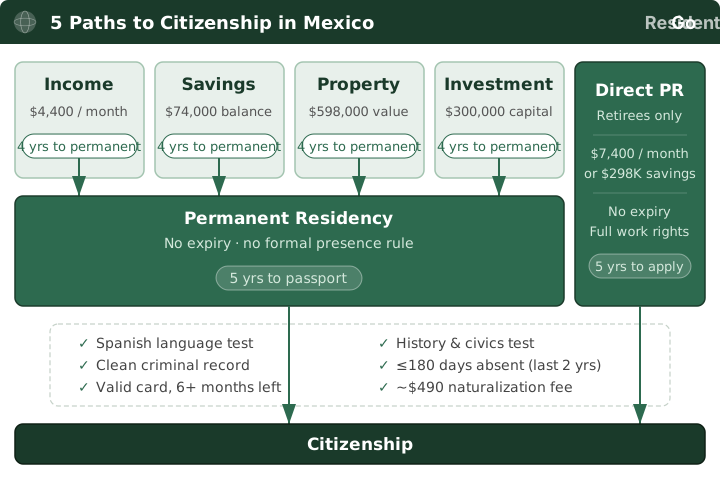
After 4 consecutive years of temporary residency, the holder may apply to exchange their status for permanent residency. Permanent residency does not require ongoing proof of income or savings. Once granted, the permanent resident card has no expiration date for adults.
Path to citizenship
Mexican citizenship can be obtained through naturalization after long-term legal residency. Naturalization is administered by the Secretaría de Relaciones Exteriores (SRE). For most applicants, this means:
- Hold legal residency (temporary or permanent) in Mexico for at least 5 consecutive years
- Not have been absent from Mexico for more than 180 days total in the 2 years immediately before the application
- Pass a Spanish language proficiency exam and a Mexican history and civics test administered by the SRE
- Demonstrate a clean criminal record in Mexico and in the home country
- Hold a valid residency card with at least 6 months of remaining validity at the time of application
- Be at least 18 years old
- Submit a separate naturalization application and pay the processing fee (8,755 MXN as of 2025)
Reduced residency requirements apply in certain cases: applicants married to a Mexican citizen, those with a Mexican child, and nationals of Latin American or Iberian Peninsula countries may apply after 2 years of legal residency. For comparison, Argentina offers citizenship to all applicants after 2 years.
Mexico allows dual citizenship. Naturalized citizens receive a Carta de Naturalización and may apply for a Mexican passport. However, naturalized Mexicans who reside outside Mexico for 5 or more consecutive years may legally lose their Mexican citizenship.
Overview of Mexico Visas
Residencies that are based on Working Permits or Working visas are described in detail here:
→ Working Visas in Mexico
Mexico does not use separate visa categories like “Pensionado” or “Rentista” found in countries such as Costa Rica or Colombia. Instead, all residency applications based on financial means fall under a unified framework of “economic solvency.” The applicant qualifies for either temporary or permanent residency by proving they meet one of four financial criteria: monthly income, savings/investment balances, Mexican property value, or capital investment in a Mexican company.
Temporary Residency via Monthly Income
Temporary residency via monthly income is the most common path for remote workers, retirees, and financially independent individuals. As of 2026, the applicant must demonstrate a consistent net monthly income of approximately USD 4,400 (equivalent to 680× the daily UMA of $117.31 MXN) over the preceding 6 months. Some consulates require 12 months of income history.
Proof typically requires:
- Original bank statements for the previous 6 to 12 months showing regular monthly income deposits meeting or exceeding the threshold
- Income must appear as actual cash deposits: pension payments, investment distributions, rental income, business income, and similar recurring sources are generally accepted
- Statements must be in the applicant’s name and show the account holder’s name clearly
- A dependent spouse or minor child adds an additional requirement of approximately USD 1,434 per month (220× UMA) to the principal applicant’s threshold
Temporary Residency via Savings or Investments
Applicants who do not meet the monthly income threshold may qualify using savings or investment balances. As of 2026, the applicant must demonstrate a minimum balance of approximately USD 74,000 (equivalent to 11,460× the daily UMA) held continuously for the 12 months preceding the application. The balance must not fall below the minimum at any point during this period.
Proof typically requires:
- Bank statements or investment account statements for the full 12-month period showing the balance maintained above the minimum
- Qualifying accounts include checking, savings, 401(k), IRA, RRSP, trust funds, and certain other investment accounts with verifiable balances
- Cryptocurrencies, precious metals, real estate equity, and other illiquid assets are not accepted
- Some consulates have begun requiring cash savings only, rejecting balances held in investment accounts: this varies by consulate
Permanent Residency (Direct Application)
Permanent residency can be obtained directly, without first holding temporary residency, but Mexican consulates generally restrict this to applicants who are retired or pensioned. The income threshold is approximately USD 7,400 per month (1,140× UMA), or approximately USD 298,000 in savings/investments maintained for 12 months (45,850× UMA).
Applicants who meet the financial threshold but are not retired will typically be offered temporary residency instead. The alternative path to permanent residency is to hold temporary residency for 4 consecutive years and then apply to exchange status.
Temporary Residency via Mexican Property Ownership
Applicants who own a residential property in Mexico may qualify for temporary residency if the property has a market value of at least approximately USD 598,000 (MXN 10,758,500). The property must be located in Mexico, free of any liens or mortgages, and the title deed or sales contract must be in the applicant’s name.
Temporary Residency via Capital Investment
Residency is also available to applicants who make a capital investment of at least approximately USD 300,000 (MXN 5,378,664) in a private Mexican-owned company or in companies listed on the Mexican stock exchange. This route is considerably more complex than income or savings-based applications and typically requires legal assistance.
Family Unit Residency
Applicants with direct Mexican family ties, such as a Mexican spouse, a Mexican child, or Mexican parentage, may apply for residency under the “Family Unit” (Unidad Familiar) provision. The financial threshold is significantly lower: approximately USD 1,434 per month income or USD 1,434 in savings (220× UMA). Family Unit applications can often be initiated within Mexico rather than at a consulate abroad, and they lead to either temporary or permanent residency depending on the circumstances.
Tax Residency Considerations in Mexico
From a tax perspective, Mexico differs significantly from countries that apply a territorial tax system. Mexico taxes its tax residents on their worldwide income, which means individuals who become tax residents may owe Mexican income tax on earnings from all sources globally, including foreign pensions, rental income, investment returns, and employment income.
Tax outcomes depend on personal circumstances, and the following points help assess this in practice:
- Mexico applies a worldwide income tax system for tax residents, not a territorial system like Panama or Paraguay
- An individual becomes a Mexican tax resident by spending more than 183 days in Mexico during a calendar year, or by establishing a “center of vital interests” in Mexico (defined as having a primary home, immediate family, or principal economic activities there)
- Immigration residency and tax residency are separate concepts: holding a temporary or permanent resident card does not automatically create tax residency if the 183-day or center-of-vital-interests tests are not met
- Non-residents are taxed only on Mexican-sourced income
- Mexico does not impose a wealth tax, inheritance tax, estate tax, or gift tax
- There is no formal exit tax triggered by ending residency, but a formal notice must be filed with SAT (Mexico’s tax authority) at least 15 days before a change of tax residency takes effect
Income generated while tax resident in Mexico is subject to progressive personal income tax (ISR), with marginal rates ranging from 1.92% to 35%. The top marginal rate of 35% applies to annual income exceeding approximately MXN 4,511,707 (roughly USD 250,000 at 18 MXN/USD). These rates apply to the individual’s total worldwide income while tax resident in Mexico.
A foreign tax credit is available to reduce double taxation: tax residents can credit income taxes paid to foreign governments against their Mexican tax liability. Mexico also has tax treaties with numerous countries, including the United States, Canada, and many EU member states, which may further reduce or eliminate double taxation on specific types of income.
Residency Status Comparison
| Status | Typical Duration | Status Renewal | Identification | Minimum Presence to Maintain Status | Counts Toward Citizenship |
|---|---|---|---|---|---|
| Tourist | Up to 180 days | Via re-entering | Passport + FMM | None | No |
| Temporary Residency | 1 year (renewable up to 4 years total) | Via application at INM | Residente Temporal card | No formal minimum, but prolonged absence may affect renewal | Yes |
| Permanent Residency | Indefinite (adults) | Not required | Residente Permanente card | No formal minimum | Yes |
| Citizenship | Permanent | Not required | National ID (INE) / Passport | Must reside in Mexico or risk losing naturalized citizenship after 5 years abroad | — |
How Financial Thresholds Are Calculated (UMA)
Mexico’s financial requirements for residency are calculated using multiples of the UMA (Unidad de Medida y Actualización), an official unit of measurement published annually by INEGI. The daily UMA value for 2026 is $117.31 MXN. The required multiples were set by visa guidelines published in July 2025.
| Residency Type | Multiple (Monthly Income) | Approx. USD / Month | Multiple (Savings) | Approx. USD Savings |
|---|---|---|---|---|
| Temporary Residency | 680× UMA | ~$4,432 | 11,460× UMA | ~$74,687 |
| Permanent Residency | 1,140× UMA | ~$7,430 | 45,850× UMA | ~$298,815 |
| Dependent Spouse / Minor | 220× UMA | ~$1,434 | 220× UMA | ~$1,434 |
| Family Unit | 220× UMA | ~$1,434 | 220× UMA | ~$1,434 |
| Student (Temporary) | 220× UMA | ~$1,434 | 2,290× UMA | ~$14,924 |
*USD amounts calculated at 18 MXN/USD. UMA 2026: $117.31 MXN. Actual consulate requirements may vary by ±5–10% depending on the exchange rate applied.*
RFC Tax Registration for All Residents
Without an RFC (Registro Federal de Contribuyentes), you cannot open most bank accounts, buy a car with a proper invoice, set up utility accounts in your name, or claim capital gains exemptions when selling property. Since 2022, SAT has required all temporary and permanent residents aged 18 and older to obtain an RFC, regardless of whether they earn income in Mexico. Registration is free and done in person at a SAT office with your residency card, passport, CURP, and a proof of address (which does not need to be in your name).
Once registered, SAT considers you part of Mexico’s tax system. You are expected to file an annual tax declaration, even if your income is taxed elsewhere and you owe nothing in Mexico. Failure to activate your Buzón Tributario (SAT’s electronic mailbox) can result in fines of MXN 3,850 to MXN 11,540, and SAT has begun sending compliance letters to foreign residents with active RFCs who have not filed.
Restricted Zone and Coastal Property
Foreigners cannot own residential property directly within 50 kilometers of any coastline or 100 kilometers of any international border. This constitutional restriction under Article 27 covers Cancún, Playa del Carmen, Tulum, Puerto Vallarta, Los Cabos, and every other coastal city. Properties outside the restricted zone, such as in Mexico City, Guadalajara, or Mérida, can be purchased with direct title.
The standard solution for restricted-zone purchases is a fideicomiso: a bank trust in which a Mexican bank holds legal title while the foreign buyer retains all practical ownership rights, including the ability to live in, rent, renovate, sell, or bequeath the property. The trust runs for 50 years, is renewable indefinitely, costs USD 2,000 to USD 3,000 to set up, and carries annual bank fees of USD 550 to USD 1,000.
Foreign-Plated Vehicles and Residency
Temporary residents may bring a foreign-plated car into Mexico under a Temporary Import Permit (TIP), valid for the duration of their residency card. Permanent residents cannot obtain a TIP and, by law, cannot drive a foreign-plated vehicle anywhere in Mexico outside designated free zones. This rule dates to the 2012 immigration reform but was rarely enforced until late 2025, when customs officers in Baja California began seizing vehicles from permanent residents at checkpoints.
Before converting from temporary to permanent residency, you must either export your foreign-plated vehicle or permanently import it by paying duties and obtaining Mexican plates through a customs broker. A government regularization program for older vehicles has been extended through September 2026 but applies only to vehicles meeting specific age requirements. For most long-term residents, buying a Mexican-plated vehicle is the simplest path.
Frequently Asked Questions
✅ Eligibility
What is the most common residency path for expats in Mexico?
Temporary residency via monthly income is the most common path for remote workers, retirees, and financially independent individuals. Applicants must demonstrate a consistent net monthly income of approximately USD 4,400 (680× the daily UMA) over the preceding 6 to 12 months, depending on the consulate.
Can I include my family in a Mexico residency application?
Yes. A dependent spouse or minor child adds approximately USD 1,434 per month (220× UMA) to the principal applicant's income threshold. Marriage certificates or birth certificates must be apostilled and translated into Spanish.
What is the minimum income required for Mexico residency?
For temporary residency, approximately USD 4,400 per month in net income. For direct permanent residency (retirees only), approximately USD 7,400 per month. Alternatively, applicants can qualify with savings of approximately USD 74,000 for temporary or USD 298,000 for permanent residency, maintained for 12 months.
What is the minimum investment amount required for Mexico residency?
A capital investment of at least approximately USD 300,000 (MXN 5,378,664) in a private Mexican company or publicly listed Mexican company qualifies for temporary residency. Alternatively, owning Mexican property valued at approximately USD 598,000 or more also qualifies.
📝 Process & Timeline
How much does it cost to apply for Mexico residency?
About $620. The INM government processing fee for a first-year temporary resident card is approximately MXN 11,141. Consulate processing fees are separate and vary by location. Additional costs for apostilles, certified translations, and legal assistance are separate.
What documents do I need to apply for Mexico residency?
You need a valid passport (at least 6 months validity), long-form birth certificate, bank statements proving economic solvency for 6 to 12 months, completed application form, passport photos, and a marriage certificate if applying with a spouse. All foreign documents require an apostille and certified Spanish translation.
Can I apply for Mexico residency while visiting as a tourist?
No. Most initial residency applications must be filed in person at a Mexican consulate outside of Mexico. The main exception is "Family Unit" applications (for those with Mexican family ties), which can sometimes be initiated within Mexico.
Do I need to open a bank account in Mexico to apply for residency?
No. Economic solvency is proven using bank statements from your home country showing income or savings in the applicant's name. However, after obtaining residency and an RFC tax number, you will need the RFC to open most Mexican bank accounts.
How long does it take to get temporary residency in Mexico?
After consulate approval, you receive a pre-approved visa sticker valid for 180 days. Upon entering Mexico, you must register with INM within 30 calendar days to complete the "Canje" process and receive your physical resident card. The first temporary resident card is issued for 1 year.
How long does it take to get Mexico citizenship?
Most applicants need at least 5 consecutive years of legal residency, with no more than 180 days of absence in the 2 years before applying. Those married to a Mexican citizen or with a Mexican child may apply after 2 years. The naturalization process itself typically takes 6 to 12 months.
🏠 Living in Mexico
Do I need to live in Mexico to maintain residency?
There is no formal minimum presence requirement for maintaining temporary or permanent residency. However, prolonged or frequent absences may be flagged by INM and could affect renewal of temporary residency. Naturalized citizens who reside outside Mexico for 5 or more consecutive years may lose their citizenship.
Can I work in Mexico as a foreign resident?
Temporary residents may work for employers outside of Mexico. Working for a Mexican employer requires a separate work permit. Permanent residents have the automatic right to work in Mexico without needing additional permits.
Does Mexico tax foreign income?
Yes. Mexico taxes its tax residents on worldwide income, with progressive rates from 1.92% to 35%. You become a tax resident by spending more than 183 days in Mexico per calendar year or by establishing a "center of vital interests" there. A foreign tax credit and tax treaties with many countries can reduce or eliminate double taxation.
Is health insurance mandatory for residents in Mexico?
No. Health insurance is not a legal requirement for obtaining or maintaining residency in Mexico. However, it is strongly recommended. Foreign residents can voluntarily enroll in Mexico's public healthcare system (IMSS) for an annual fee, or purchase private health insurance.
Can I have dual citizenship with Mexico?
Yes. Mexico allows dual citizenship. Naturalized citizens receive a Carta de Naturalización and may apply for a Mexican passport. However, naturalized Mexicans who reside outside Mexico for 5 or more consecutive years may legally lose their Mexican citizenship.