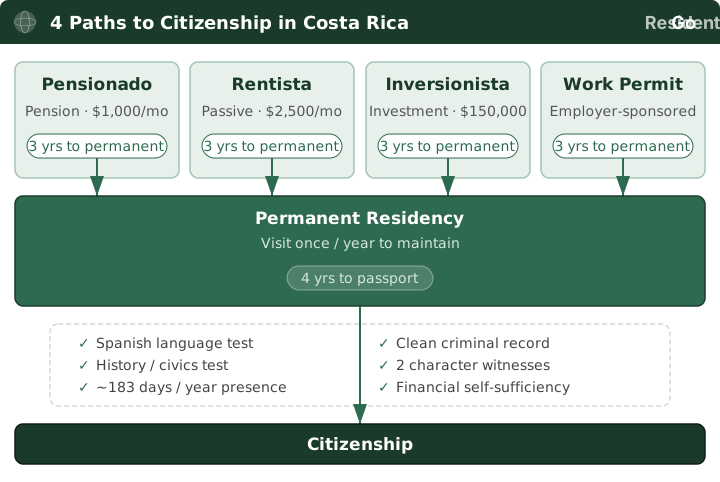
Costa Rica runs one of the oldest and most established residency programs in Latin America. The Pensionado visa has been in place since 1971, which means the process is well-documented, the thresholds are fixed and publicly published, and local immigration professionals are experienced with the requirements. Three pathways cover most applicants: Pensionado ($1,000/mo lifetime pension, the same threshold as Panama's Pensionado), Rentista ($2,500/mo passive income), and Inversionista ($150,000 investment). All three grant temporary residency that converts to permanent residency after three years and citizenship after seven. One obligation applies across all categories regardless of how long you plan to stay: mandatory enrollment in the public health system (CAJA), which runs $90–$350/mo depending on declared income and cannot be replaced or offset by private insurance.
Costa Rica Residencies Overview
| Residency Path | Exists | Minimum Requirement | Duration | Leads to Permanent Residency | Key Insight |
|---|---|---|---|---|---|
| Pensionado | Yes | USD 1,000 / month lifetime pension | Temporary | Yes | Pension must be permanent |
| Rentista | Yes | USD 2,500 / month passive income | Temporary | Yes | Employment income does not qualify |
| Inversionista | Yes | USD 150,000 investment | Temporary | Yes | Personal assets like a home or car can qualify |
| Work Permit | Yes | Employer-sponsored | Temporary | Yes | Restricted to specialized roles |
| Asset-based | No | — | — | — | No solvency-only option |
| Digital Nomad | Limited | USD 3,000 / month income | Temporary | No | Separate framework, not a PR path |
*Indicative minimum thresholds shown as of 2026. Interpretation and documentation standards may vary.*
Step-by-Step Guide from Resident to Passport
Prepare documents in your home country
The following documents must be obtained in your home country before traveling to Costa Rica:
- Birth certificate
- Police clearance certificate
- Marriage certificate (if applicable)
- Birth certificates and police clearance of spouse and children (if applicable)
- Residency-specific proof of eligibility (such as pension confirmation, passive income proof, or investment documentation)
All official documents generally require an apostille issued in the country of origin as well as a certified Spanish translation. In practice, this means obtaining the original document, arranging a certified translation, and submitting both to the competent authority for apostille.
Enter Costa Rica and file the application
Once all documents are prepared, the residency application must be filed in person in Costa Rica, which includes:
- Submitting the full application to immigration
- Paying government filing fees
- Registration of fingerprints and biometrics
All applications are processed in Spanish and follow local administrative procedures. Communication, follow-ups, and clarification requests typically take place locally, which is why many applicants choose to work with local immigration professionals.
Application review and waiting period
- Wait for the application to be reviewed
- Provide additional documents or clarifications if requested
- Attend follow-up appointments if required
During this period, applications are reviewed administratively and may remain under review for extended periods without visible progress. Changes in personal or financial circumstances during the review phase may require additional documentation.
Temporary residency approval
Once the application is approved, temporary residency is granted and must be completed locally.
- Register with local authorities
- Obtain a residency identification document
- Comply with ongoing residency conditions (e.g. entering Costa Rica once per year)
Temporary residency is granted for a fixed period and must be renewed before expiration. Even if you do not live in Costa Rica, temporary residency generally requires at least one physical entry per year, including a passport entry stamp.
Renewals and transition to permanent residency
Temporary residency in Costa Rica is granted for fixed periods and must be renewed before expiration. Most applicants hold temporary residency for several consecutive years before transitioning to permanent residency.
- Renew temporary residency before each expiration
- Maintain uninterrupted residency status
- Apply for permanent residency after three years of continuous temporary residency
Changes in income source, marital status, or investment structure during the temporary residency period may require additional documentation and can affect renewals or eligibility for permanent residency. Once permanent residency is granted, ongoing proof of income or investment is generally no longer required.
Path to citizenship
Costa Rican citizenship can be obtained through naturalization after long-term legal residency. For most applicants, this means:
- Hold legal residency in Costa Rica for at least 7 years in total
- Maintain uninterrupted legal residency status during this period
- Pass a Spanish language exam and a civics / history test administered by Costa Rican authorities
- Demonstrate good conduct, including a clean criminal record
- Submit a separate citizenship (naturalization) application after meeting all requirements
Residency obtained through Pensionado, Rentista, or investment residency can therefore serve as the starting point toward a Costa Rican passport, but the process is long-term and sequential. For those who prioritize a faster path to citizenship, Argentina and Peru offer naturalization after just 2 years.
Overview of Costa Rica Visas
Residencies that are based on Working Permits or Working visas are described in detail here:
→ Working Visas in Costa Rica
Costa Rica offers several well-established residency pathways based on retirement income, passive income, or investment. All options initially grant temporary residency and may later lead to permanent residency. Costa Rica citizenship can then be gained after 7 years of legal residence.
Pensionado Visa (Retiree Residency)
The Pensionado residency is intended for retirees who receive a lifetime pension of at least USD 1,000 per month. The pension must be permanent and guaranteed rather than fixed-term or discretionary.
Proof typically requires:
- Official pension statements or letters issued by the pension provider showing a minimum pension income of at least USD 1,000 per month
- Documentation confirming that the pension is lifetime and permanent, not fixed-term or discretionary
- Pension payment history (for example bank statements) showing that pension payments have been received consistently over time
- If applicable, supporting documentation explaining the pension source (public pension authority, private pension plan, or similar institution)
Rentista Visa (Passive Income Residency)
Rentista residency is designed for financially independent individuals who do not receive a formal pension but have passive income of at least USD 2,500 per month. Employment income or salary payments generally do not qualify.
Proof typically requires:
- Bank statements and/or tax statements showing passive income of at least USD 2,500 per month
- Proof that this passive income has been received consistently, typically covering at least 6–12 months (longer histories are generally viewed more favorably)
- Documentation demonstrating that the passive income is stable and recurring in the future, such as contracts, distribution agreements, or similar instruments guaranteeing ongoing payouts
Inversionista Visa (Investment Residency / Golden Visa)
Residency by investment (unofficially “Golden Visa”) is available to applicants who make a qualifying investment of at least USD 150,000 in Costa Rica. The investment does not need to fund an operating business and may consist of personal assets such as a house or car.
Proof typically requires:
- Ownership documentation that confirms the qualifying investment (for example property title, vehicle registration, or business ownership documents)
- Evidence that the investment has a minimum value of USD 150,000, such as purchase contracts, appraisals, or valuation statements
- Proof that the investment is maintained over time and remains under the applicant’s ownership
Tax Residency Considerations in Costa Rica
From a tax perspective, Costa Rica is often considered by individuals who earn income abroad, hold international assets, or are planning long-term residency without automatically triggering worldwide taxation. However, tax outcomes depend on personal circumstances, and the following points help assess this in practice:
- Costa Rica applies a territorial tax system, taxing only income sourced within Costa Rica - the same approach used by Panama and Paraguay
- Foreign-sourced income is generally not subject to Costa Rican income tax
- Immigration residency and tax residency are separate concepts; holding residency does not automatically create tax residency
- Tax residency is assessed case by case, primarily based on physical presence, economic ties, and local income activity
- Costa Rica does not impose worldwide income taxation based solely on residency status
- There is no wealth tax or exit tax triggered by becoming or ending residency
Income generated within Costa Rica is subject to progressive personal income tax, with marginal rates currently reaching up to approximately 25%. These rates apply only to Costa Rica–sourced income and do not extend to foreign-sourced income under Costa Rica’s territorial tax system. Tax brackets and thresholds are adjusted periodically.
Residency Status Comparison
| Status | Typical Duration | Status Renewal | Identification | Minimum Presence to Maintain Status | Counts Toward Citizenship |
|---|---|---|---|---|---|
| Tourist | 90–180 days | Via re-entering | Passport | None | No |
| Temporary Residency | 2 years (renewable) | Via application | Residency ID (DIMEX) | At least one entry per year | Yes |
| Permanent Residency | Indefinite | Not needed | Residency ID (DIMEX) | Generally flexible | Yes |
| Citizenship | Permanent | Not needed | National ID / Passport | None | — |
Mandatory CAJA Enrollment and Costs
Every resident must pay into Costa Rica's public health system (CAJA). Private insurance does not replace this obligation. Contributions run 9–11% of declared income: roughly USD 90–150/month for a Pensionado at the minimum USD 1,000 pension, or USD 280–350 for a Rentista declaring USD 2,500. Spouse and children under 18 are covered at no extra cost.
Falling behind blocks your DIMEX issuance, prevents residency renewal, and interrupts your citizenship timeline. Since 2026, immigration and CAJA databases are cross-checked automatically. Set up automatic bank payments immediately after enrollment.
Work Restrictions for Temporary Residents
Temporary residents under Pensionado, Rentista, and Inversionista categories cannot work as employees of a Costa Rican company. This lasts the full temporary residency period, a minimum of three years, until permanent residency is available. Remote work for a foreign employer is a gray area with no explicit legislation, but the formal legal position is that temporary residents may not engage in remunerated work.
Temporary residents can own a Costa Rican business, hold shares, and receive investment income. The common workaround is owning and directing a company while hiring employees for day-to-day operations. Anyone whose income could be interpreted as employment should factor in the three-year wait for full work rights.
Frequently Asked Questions
✅ Eligibility
What is the most common residency path for expats in Costa Rica?
The three main paths are Pensionado (for retirees with a lifetime pension), Rentista (for people with passive income), and Inversionista (for investors). All three grant temporary residency that leads to permanent residency after three years. Most financially independent expats choose the Rentista or Pensionado route depending on their income source.
Can I include my family in a Costa Rica residency application?
Yes. A spouse and dependent children can be included in a single application. Under the CAJA public health system, a spouse and children under 18 are covered at no extra cost once the primary applicant is enrolled.
What is the minimum income required for Costa Rica residency?
For Pensionado residency, you need a permanent lifetime pension of at least $1,000/month. For Rentista residency, you need passive income of at least $2,500/month. Employment income or salary does not qualify for either category.
What is the minimum investment amount required for Costa Rica residency?
The Inversionista (Golden Visa) path requires a minimum investment of $150,000 in Costa Rica. The investment does not need to be in a business and can include personal assets such as a house or car, as long as it is maintained and documented over time.
📝 Process & Timeline
How much does it cost to apply for Costa Rica residency?
About $565. This includes a $250 application deposit, a $200 change-of-status fee, and approximately $100–$125 for the DIMEX residency card. Additional costs for apostilles, certified translations, and legal assistance are separate.
What documents do I need to apply for Costa Rica residency?
You need a birth certificate, police clearance certificate, marriage certificate (if applicable), and proof of eligibility specific to your category (pension letter, passive income statements, or investment documentation). All documents must be apostilled in your home country and accompanied by a certified Spanish translation.
Can I apply for Costa Rica residency while visiting as a tourist?
Yes. You prepare your documents in your home country, then enter Costa Rica and file the application in person at immigration. The application must be submitted locally, including fingerprints and biometrics, and many applicants begin the process while on a tourist entry.
Do I need to open a bank account in Costa Rica to apply for residency?
A Costa Rican bank account is not strictly required to file the application. However, Rentista applicants who choose the $60,000 deposit route (instead of proving $2,500/month income) must open one. After approval, all residents need a local account for mandatory CAJA social security payments.
How long does it take to get temporary residency in Costa Rica?
Processing times vary widely. Some applications are approved within a few months, while others can take up to a year. Temporary residency is granted for a two-year period and is renewable. After three years of continuous temporary residency, you can apply for permanent residency.
How long does it take to get Costa Rica citizenship?
Citizenship by naturalization requires at least 7 years of uninterrupted legal residency. Applicants must also pass a Spanish language exam and a civics/history test, and demonstrate good conduct. Approval is discretionary and not guaranteed by meeting the time requirement alone.
🏠 Living in Costa Rica
Do I need to live in Costa Rica to maintain residency?
Temporary residents must physically enter Costa Rica at least once per year to maintain their status. Failing to do so may prevent renewal or lead to loss of residency. Permanent residency has generally more flexible presence requirements.
Can I work in Costa Rica as a foreign resident?
Temporary residents under Pensionado, Rentista, and Inversionista categories cannot work as employees of a Costa Rican company. You can own a business, hold shares, and receive investment income, but formal employment rights only come with permanent residency after a minimum of three years.
Does Costa Rica tax foreign income?
No. Costa Rica uses a territorial tax system, meaning only income sourced within Costa Rica is taxed. Foreign-sourced income is generally not subject to Costa Rican income tax. There is also no wealth tax or exit tax tied to residency status.
Is health insurance mandatory for residents in Costa Rica?
Yes. Every resident must enroll in and pay into the public health system (CAJA/CCSS), regardless of whether they also hold private insurance. Contributions are 9–11% of declared income, roughly $90–$150/month for Pensionados or $280–$350/month for Rentistas. Falling behind on payments blocks your DIMEX card and residency renewal.
Can I have dual citizenship with Costa Rica?
Yes. Costa Rica has permitted dual citizenship since a 1995 constitutional amendment. Naturalized citizens are not required to renounce their original nationality. However, you should verify your home country's rules, as not all nations allow dual citizenship on their side.